Monday, October 27, 2008

travel journal#4.19: Alachua/Gainesville, FL & Albany, NY

Diary of a Traveling Sadhaka, Vol. 4, No. 19
By Krishna-kripa das
(October 2008, part one)
Alachua and Gainesville, Florida, and Albany, New York
(Sent from Gainesville, Flordia, U.S.A. on 10/25/08)

Where I Am and What I Am Doing

Visiting Alachua temple. Chanting at the campus in Gainesville. Visiting my family in Albany. (Not necessarily in that order.)

Devotional Meditations

From a Srila Prabhupada lecture: "Unless you become first-class devotee there is no chance of being relieved of this material existence."

"Every family in every society can conduct sankirtana-yajna at least every evening. In this way there will be no disturbance or scarcity of rain. It is essential for the people in this age to perform the sankirtana-yajna in order to be materially happy and to advance spiritually" (SB 5.4.3).


Notes from a darshan with Hridayananda Dasa Goswami SB 5.9.13-14:

  1. Srila Prabhupada mentions in the purport that human sacrifice is done by barbaric, low class people. Everything in the scripture is not necessarily "Vedic". The Srimad-Bhagavatam was just describing human nature as it is, and the Vedic culture was just trying to deal with realities of human nature. Whenever you get a sufficently varigated gene pool, you are bound to get some people who are into human sacrifices.

  2. The idea of kings hunting is not necessarily "Vedic". To get someone passionate enough to be king, they are bound to have some bad qualities. The allowance for ksatriyas to hunt is not there by intent but by necessity because they will do it anyway.

  3. Satsvarupa Dasa Goswami asked Srila Prabhupada how do fire sacrifices. Srila Prabhupada said, "Shortcut."

  4. For people’s psychological needs they want a guru is a superman or celebrity. Someone purely representing the sastra alone is does not satisfy them.

  5. To really be a second class devotee is not easy. Can you have an international society where most of the devotees are absorbed in missionary work? In the beginning we were all youthful with recent conversion experiences so enthusiasm for preaching was natural. But can that be maintained in an institution?

  6. In Jada-yoga, you put yourself in the lowest possible state, by accepting various dualities, and thus become free from false ego. It works but it is not for this age.

  7. We have technology far beyond what we had in the 1970s but in many ways we have less communication.

  8. I am trying to figure out what I can do with my psychophysical nature to benefit the greatest number of people for Srila Prabhupada, and have a transforming effect on Srila Prabhupada’s movement.


Notes from class by Kripa Sindhu Prabhu:

ISKCON history: In the early days, after the morning program, they had another class, and then went on harinama for three hours, took lunch, and then went out on harinama for three more hours, and then took a shower and went to the evening program. Srila Prabhupada said if we don’t go to the evening program, we would all fall down. Every one was fully engaged and it was pretty fired up because of that. We would tell the people to surrender to Krishna now, and many did.

In Brihad Bhagavatamrita, Gopa Kumar did not know if he was in Goloka, the spiritual abode, or Gokula, its replica in this world, because the same activities are going on in both.

We can understand from the scripture, we have already been through the different bodies and had the different experiences.

Acaryas
compare the desire for fame to be in the same category as having sex with a low-class prostitute.

We should follow Srila Prabhupada’s program because we are not perfect pure and are subjected to the four defects of the conditioned soul. [We cannot devise a better path.]

In the questions and answers after class, one devotee lady told of an impromptu Sunday feast program at a friendly Indian’s house where she and a friend followed Srila Prabhupada whole program with kirtana, lecture, and prasadam and how it was amazingly successful. There was no prasadam left for them at the end, but they were so happy from sharing Krishna consciousness with others, they didn’t mind.


Notes from a class by Dravida Prabhu on Caitanya-caritamrita Adi 17.50-51:

We should not blame anyone else for our suffering, especially God. We must understand that the suffering we encounter is Krishna’s personal program for our purification from the tendency for sense gratification, and is thus benedictory. Practically every great devotee encountered some misery in the course of his life. Because the devotees are eager to go back to Godhead, they want to receive all the reactions that they are due before the end of life, and so are not disturbed by the miseries, but are grateful for them.

Kaviraja Goswami spoke very wonderfully and his words did not offend even those he rebuked during chastisement. Raghunatha Dasa Goswami established the superiority of the service of Srimati Radharani. Raghunatha Bhatta Goswami considered that all Vaishnavas are sincerely serving the Lord according to their realizations and should not be criticized.


Notes from a class in Gainesville by Dravida Prabhu:

The modern tendency is to depersonalize everything including our own consciousness, but the Vaisnava principle is to see the personality of Godhead everywhere and in everything.

The names that describe Krishna’s forms and pastimes are His primary names.

One of the reasons the Hare Krishna mantra is called the maha-mantra is that it not only offers obeisances to and glorifies the Lord, but directly calls out and implores the Lord to be engaged in His service.


Notes from a class by Laskmi Nrsimha Prabhu:

The Christians have the idea that Jesus and the Father are one. We can understand how that can be true because we understand the principle of the satyavesa-avatara, in which a living entity is empowered as an incarnation of Godhead with special powers.

All the ‘rights’ movements reveal intense identification with the body.

Campus Bhajanas Awaken Devotion in Students

Brian from Santa Fe Community College and Celia from University of Florida both excitedly told me how they became attracted to Krishna consciousness from the campus bhajana programs at their respective colleges. Celia said that the chanting attracts you on a deeper level than you can realize. Both now attend the daily chanting on the University of Florida campus and talked to me during an evening program at our Gainesville Krishna House. I felt so inspired to hear how the chanting attracted them since the public chanting is an important part of my life. I suggested that Celia might try coming to the morning program, which Brian is already doing, and she expressed some interest in that. The next day both of them helped carry the instruments back to our Krishna center after the campus bhajanas. The following day they came to our gourmet dinner program, and after it was over, asked the devotees if we could have a kirtana. The other devotees were tired from cooking and serving out and still needed to clean up, but I, who was also feeling a void without an evening kirtana, chanted with them for fifteen minutes. My friends from Europe speak disparagingly from what they have heard about our outreach programs in America, but I can see, as American book distributors tell me, the field in America is as good as it ever has been, if not better. When we are out in public to share Krishna with others, people there become attracted. The problem is that there are only a too few fulltime or even parttime missionary devotees in America. Otherwise it is a great place to share Krishna
consciousness with others.

You Should Choose a Religion!

My sister, Karen, that her daughter, Fern, told her how her grandmother wanted her to choose a religion. To hear that was humorous for me because I had been considering advising her in the same way. Now she is sixteen. Her mom is a Buddhist, her grandmother, Quaker, and me, her uncle, am a Hare Krishna. She comes to all the different services from time to time, but doesn’t really practice any of them on her own. She is a lifetime vegetarian, however. Karen thinks that as she has taken her studies seriously like adults around her did, she will some day take up a religious practice on her own, like those around her. The Vedic idea is that children should be reminded that this human form of life is simply meant for spiritual life and be encouraged to endeavor in that way. My father and my mother were not so attached to the Anglican and Catholic religions of their births, so when Karen and I were young they looked for a path they both had faith in so we would have some idea of spirituality. Thus they joined the Quaker meeting in Albany. That consideration by the parents to promote spirituality in their children is actually the parents’ dharma. We will see what happens with Fern. I told Fern I was thinking the same thing as her grandmother (my mother), but I did not push her to choose a religion. I am so averse to people trying to push me to make decisions, I cannot do the same to others. I did, however, make the point to her that at least when she goes to the Hare Krishna services, she can count on there being vegetarian food. With the others, you never know. Even the Buddhists sometimes have preparations containing meat at their programs.

Quaker Meeting

The Sunday I was home in Albany I went to the Quaker meeting I attended as a youth. The Quakers teach complete pacifism, equality to all human beings, andthat God is in everyone’s heart. They also highly value the search for spiritual truth. In the unprogrammed meetings as we have in Albany, they sit in silence for an hour, presumably thinking of godly things, and anyone can stand up and speak briefly, if inspired, during that time. After their meetings, they serve refreshments. I was late half an hour because I miscalculated the baking time for some prasadam cookies I made to add to the refreshments. No one spoke for the first twenty minutes I was there. I decide to quote a very ecumenical verse from the Vedic literature: smartavyah satatam vishnur, vismartavyo na jatucit, sarve vidhi-nishedhah syur, etayor eva kinkarah. "One should always remember the Supreme Lord. One should not forget Him at any time. All the other scriptural injunctions and prohibitions are servants of these two principles." I spoke briefly saying that whatever our religion is, we may sometimes get caught up in the rules and rituals and forget that the important thing is to remember God. After that in the five remaining minutes at least a couple people spoke, each talking about how they saw God in their life recently in some way or other. One saw Him in the colorful autumn leaves and another in the loving responses of friends during his illness. I felt victorious because we as devotees promote the glorification of God, and so that a couple people broke the silence, and spoke in God’s favor made me smile. One elderly lady told me afterwards that now she is almost completely vegetarian now, and I encouraged her. A sociology major from Skidmore told me she liked my quote, and I sent it to her by email. Many liked the cookies. One later mentioned them in an email to my mother. I noticed the Sunday school kids playing outside and took a few cookies to them. They had studied that day the Biblical story of Jonah and the whale, and I asked them to tell it, as I did not know it. Apparently God wanted Jonah to preach, but he did not want to, and went sailing instead. He got in an accident and ended up being swallowed by whale. He realized that he made a mistake, and prayed to God who arranged his rescue. Then he went to preach to the people God had ordered him to. It reminded me of the fact that Lord Caitanya has ordered us all to preach. Perhaps if we do not do so, we will get into a jam like Jonah. Better not chance it.

ataeva ami ajna dilun sabakare
yahan tahan prema-phala deha’ yare tare

[Lord Caitanya continued,]
"Therefore I order every man within this universe to accept this
Krishna consciousness movement and distribute it everywhere"
(Cc. Adi 9.36).

Friday, October 17, 2008

travel journal#4.18: The Best Ukraine Festival Ever and More!

Diary of a Traveling Sadhaka, Vol. 4, No. 18
By Krishna-kripa das
(September 2008, part two)
Ukraine Festival, Poland, England, and Back to the USA
(Sent from Gainesville, Florida, on 10/17/08)


Where I Am and What I Am Doing


The second half of September I went to a very sweet festival
in Ukraine attended by four thousand devotees, and then traveled through Katowice, Wroclaw, London, and Manchester, on the way back to Alachua, Florida, U.S.A., where I attended a memorial service for Sadaputa Prabhu.

Devotional Meditations


Notes from Prabhupada Lecture:


If we see the Ford car, which was produced under the direction of Mr. Ford, and we think we have met Mr. Ford himself, that is foolishness. In the same way, everything is God, but God Himself is not every thing.


If you meet someone who has no father, that is God.


Om namah bhagavate vasudevaya, means "Krishna, I accept your invitation to surrender unto You."


By chanting Hare Krishna you can always think of Krishna and become a first-class yogi. The perfect yogi has all power from within.


Q: Sometimes there is maya in the temple.
A: Show me a place where maya is not.


God is one and the path to God is one, bhakti, as Krishna says in Bg. 18.55. Others persons, who take to other paths, waste their time because it will take them longer.


One who is inquisitive about the Absolute Truth will ultimate attain it depending on how he is situated, but for a devotee who can accept immediately the Bhagavatam version, liberation is attained. Those who can accept the authority save time.


God is not dead, because we are part of God and we are not dead.


Notes on Srila Prabhupada lecture (SB 1.5.15, New Vrndavana, June 15, 1969):


If we do not come to the spiritual platform, just some regulative principles on the material platform will not help us. Neither will going to the temple, while maintaining desires for sense enjoyment, bring the ultimate benefit.


Just as you can get a position in the government and be better situated than an ordinary man, you can become a demigod and be better situated than a human being.


Direct people to Krishna. Do not misguide them by leading them to some demigod.


The impersonalists claim the impersonal feature of God is supreme, and think that temporarily one can worship any demigod to elevate himself to that point. The Vaishnavas accept the Bhagavatam version that the personal form of Krishna is Supreme.


Krishna and maya are side by side. As soon as you are a little slack in Krishna consciousness, maya is there waiting for you.


We give brahminical initiation as recognition that the disciple is pure in habits, learned in the scripture, and engaged in devotional service.


The born brahmanas without brahminical qualities have destroyed the India’s spiritual culture.


I foolishly left my notebook in Poland, but I remember one class at the Ukraine festival by Gopiparanadhana Prabhu on the prayers of Queen Kunti. He was making the point that the devotees of the Lord do not actually suffer although they may appear to. One devotee raised a doubt, "Didn’t Devaki suffer when her six children were killed?" Gopiparanadhana was firm in his reply, "No." He explained that when actors put on a play, so many calamaties may happen in the course of the drama, but no one actually gets hurt. Rather the actors are happy to see that the audience enjoys the play. In the same way, the pure devotees of the Lord do not actually suffer in the course of playing their parts in the Lord’s pastimes. It was such a powerful analogy, it remains fresh in my mind.


Ukraine Festival—Better Than Ever


Many people I talked to said that the Ukraine festival was better than ever this year. Many reasons combined to make it so. There were no festival or prasadam fees. There were an estimated 4,000 devotees, more than ever and 500 more than last year. B.B. Govinda Swami and his harmonium player and saxophonist/backup singer were there to lead bhajanas every night, along with Niranjana Swami, Indradyumna Swami, and Bhaktivaibhava Swami and others. One very special reason for the swell of devotional emotions is that Niranjana Swami, who has been a GBC in Ukraine for many years and is a main inspiration behind the festival, returned after a two-year absence because of health. He fully participated and the devotees were grateful. Moreover, some wonderful presenters made their first appearance this year, Bhanu Swami, and Deena Bandhu and Gopiparadhana Prabhus. The three hours of kirtana every evening was taken very seriously both by the presenters and the attenders, perhaps even more so than usual, and there was much chanting and dancing and great joy. The organizers planned for no seminars, prasadam serve outs, or vendors of devotional items during the scheduled evening kirtana, to encourage participation. Those evening kirtanas are what I miss the most as I recollect the festival, sitting crosslegged on my gray cadar at Pzremysl Glowny, the train station just over the Poland-Ukraine border, grateful to the Polish railroad company, PKP, for the free power. Unfortunately, they leave the train station doors open, and the coldness of late September creeps in. Thinking of the festival, I feel the saddest of separation from the devotees, their devotion, and their kirtana. Of course, there is always next year, and one can always get the DVD with all the lectures and kirtanas, and relive it through hearing.


The devotees in Ukraine are sweet. One young male devotee came up to me the first day of the festival and gave me a bag saying, "Some matajis wanted me to give you this." I thanked him, and later looked in the bag. It was some very thick woolen socks. During the next mangala arati, feeling the unexpected cold of the floor, I realized what a great gift they were. Indradyumna Swami once told me, "The best gift is not the most valuable thing, but that which is most needed."


Devotees are such charitable people, I asked one for change for ten euros, and he gave me six more euros and told me to keep the ten. The next day, I asked another to change ten euros into grivnas, the Ukrainian currency, he gave me a hundred grivnas (over sixteen euros) and also would not accept the ten. When will I become charitable by their good association? Krishna says in Bhagavad-gita 18.5, "Sacrifice, charity, and penances purify even the great souls." What to speak of me.


As I took the bus from the Ukraine’s Lvov airport to Shegyni on the border of Poland, I saw about fifteen cows coming down a rural highway closely followed by a middle-aged woman with a stick. It reminded me of India. There, of course, it would have been a man with the stick. Many houses have vegetable gardens and squash is in season. The crowded condition of the bus also reminded me of India as do the simplicity of the people and their paraphenalia. That the prices are less is also like India, although not that quite that much less. Of course, Ukraine is much greener than India.


On the train from Przemysl to Katowice, I met a Polish young man who has lived in Munich for four years, and I gave him a invitation to the Munich temple I obtained during my visit there. Another, who kindly lent me his phone, told me he had friends who enjoy going to the Hare Krishna camp at the Polish Woodstock. He recalled, "I think they call it Krishna’s Village of Peace." I smiled and replied with its Polish translation, "Pokojova Wioska Kryszny!" And he smiled back. By the grace of Indradyumna Swami and his followers, Krishna is popular in Poland.


Krishna Consciousness in Katowice


Although I visited Bhakta Adam and his very devotional wife three times last year, I always missed their Sunday nama-hatta program. This time I stayed for it, although it was austere as the city failed to begin heating his apartment building in time for the cool autumn season. I recall the seven or eight guests who came were all very attentive in the kirtana and played the instruments and chanted nicely. It is so much more fun when the people respond with a degree of enthusiasm. Adam and his wife will get some mercy from Lord Caitanya for faithfully maintaining that weekly program.


A Couple I Met in Wroclaw


While waiting for the bus to the Wroclaw airport, I passed out Polish Hare Krishna mantra cards to the others at the bus stop. One middle-aged couple enroute to London on the same flight as me I found out was vegetarian—a rarity in Poland. I invited them to our Sunday program there in Wroclaw as it was their home. The man had a African djembe drum, and I told him he could bring it to play at our program. I wrote down the address of our Govinda’s Restaurant on Soho St. so they could come there during their two-week London visit. I also told them about our summer festivals on the Baltic Sea and at the Polish Woodstock and gave them invitations for each, saying that next year’s schedule will be posted on the web site. I hope they take advantage of some of these many opportunities.


Painting by Jagannath Krishna Das,
now Gopi Vallabha Das.


Sadaputa Prabhu Memorial at London’s Matchless Gifts


Amazingly enough, the day after I arrived in London, I saw Jagannatha Krishna Prabhu, now reinitiated as Gopi Vallabha Prabhu, who did some illustrations for Sadaputa Prabhu in San Diego. I had not seen him since that time, and it was comforting to see a fellow associate of Sadaputa Prabhu, soon after hearing he left his body. Gopi Vallabha and Rama Nrsimha Prabhus were planning a memorial service at the King’s Cross store front’s, Matchless Gifts’, Friday evening program, and they invited me to participate. I showed some clips from Sadaputa Prabhu’s videos, including those showing cheating in archeology, the complete improbability of evolution by natural selection, and empirical evidence for the difference between the mind and the brain. Gopi Vallabha told of how Sadaputa Prabhu patiently answered his scientific doubts for two or three hours when he was becoming a devotee, and how that helped him greatly in his Krishna consciousness. We felt happy that Parasurama Prabhu, the president of the center, and several individual devotees said they liked the program very much.


Manchester Ratha-yatra 2008


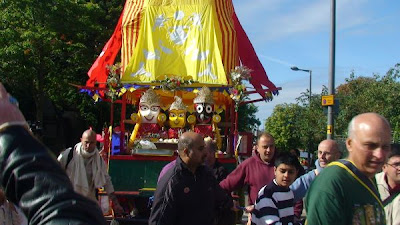
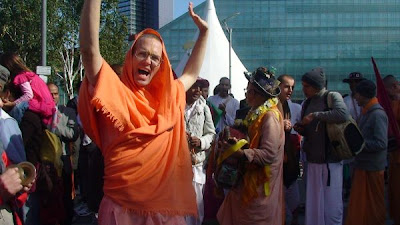
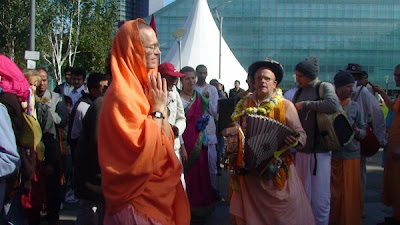
I went to a great harinama on Saturday in Manchester to advertise the next day’s Ratha-yatra and found the city to be a great venue for doing harinama, with many pedestrians walking in areas intentionally offlimits to cars. I was also inspired to see a group of enthusiastic congregational devotees eager to participate. Indeed, to witness the cooperative spirit among those planning and executing the Ratha-yatra was uplifting. Most amazing was that Manchester, reputed to be the rainiest city in England, had a mostly sunny day in honor of Lord Jagannatha. A busload of devotees came from London for the event.


Maha-Vishnu Swami, seen here with his accordion, played a key role in the life the kirtanas.


I am hopeful the event can happen yearly at a scale at least as large as it was this year. A brief article with a gallery of pictures can be found at: http://www.theasiannews.co.uk/news/s/1069576_krishna_devotees_enjoy_colourful_festival


That site links to a nice video as well: http://www.manchestereveningnews.co.uk/video/?bcpid=1138292711&bctid=1825764784


Memorial Service for Sadaputa Prabhu in Alachua, Florida


It was a little bewildering after sleeping one hour the night before, to take an hour and a half of buses, eleven hours of flights, from London to Orlando, and then two hours of traveling by car to Alachua for a memorial service for Sadaputa Prabhu that evening. I had been gone for fifteen months, and experienced the mixture of the happiness to see old friends and sadness that Sadaputa Prabhu was no longer with us, and the frustration at not being able to reciprocate with all the people I saw there that I knew. From the memorial service, I learned about other aspects of Sadaputa’s life, both as a new devotee and as a family man, that I had not known before, and I found that beneficial. For my part, I played an excerpt of his "Mind and Brain" video where he talks about empirical evidence that the soul is different from the body, near-death experiences and past life memories. I prefaced it by saying that we are so much affected by materialistic ideas we have learned in school, that hearing of this empirical evidence confirming scriptural injunctions about the eternality of the soul is valuable.


Birthday Party


Three devotees at Gainesville ISKCON had birthdays on September 30. We were 22, 32, and 49 years old. The two eldest of us, Saranga Prabhu and I, did presentations for the evening class. He discussed his silas and worshiping Them, and I showed some clips from Sadaputa Prabhu’s videos and shared some of the material I did not have time to present the previous night at the memorial service. Barbara and Brian, Sadaputa Prabhu’s wife and son from his first marriage, appreciated hearing more about him. We all had cake and ice cream. A nice way to end the month.


"Advanced people are eager to understand the Absolute Truth through the
medium of science, and therefore a great scientist should endeavor to prove the
existence of the Lord on a scientific basis" (Srimad-Bhagavatam 1.5.22,
purport). All glories to Sadaputa Prabhu, who endeavored his best in that
connection.

Sunday, October 12, 2008

travel journal#4-17: Finland and Ukraine

To see the illustrated version of this journal, click on the link below:
 Diary of a Traveling Sadhaka, Vol. 4, No. 17
By Krishna-kripa das
(September 2008, part one)
Tampere and Helsinki, Finland & Kharkov, Ukraine
(Sent from Gainesville, Florida on 10/11/08)
 
Where I Am and What I Am Doing
I spent the first week of September in Finland, researching an article on the Finnish yatra, especially its programs for academia, for Back to Godhead and meditating on speaking on the glories of Radharani for Radhastami. Then I went to Kharkov where we had a couple harinamas, including a very nice one at the college, and where Bhakta Andre kindly replaced eight fillings in my teeth.
 
Devotional Meditations
Notes on Kavicandra Swami's recorded class on Caitanya-caritamrita:
"Water, water, everywhere, but not a drop to drink" from Rime of the Ancient Mariner describes the nature of the material world. We are looking for enjoyment, but if we try to enjoy that which surrounds around us, we will just suffer, just as if one drinks the sea water to quench his thirst.
We want to go from lust to love, and from passion to compassion.
In this ISKCON movement we are doing the same things that Lord Caitanya did, so this is also Gaura-lila.
Notes from a recorded lecture by Bhakti Vidya Purna Swami:
In making emotional presentations, a pleasant background has to be created before the point is made, so the point is likely to be accepted. In intellectual presentations, the point is made in the beginning, and the presentation uses intelligent arguments to show the wisdom of the point.
If one foolishly drives off the road, one does not blame the road, the car, or the tires, but oneself, why then does one who has difficulty in a relationship, always blame the other person? If we could learn to refrain from doing this, we could improve our relationships among devotees considerably.
 
Academic Outreach in Finland
 
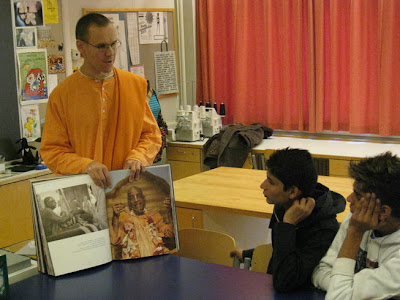
I have written an article for Back to Godhead, on Finland's academic outreach, but I want to say a little about it here. The "Krishna religion" is an official religion in Finland. If three or more kids in a city worship Krishna, then if their parents request, the school is obligated to teach a weekly class it in.
 
Tapo Divyam Prabhu teaches a class of Nepali boys about Srila Prabhupada.
Thus one devotee, Tapo Divyam Prabhu, teaches seven such courses in the Helsinki area schools.
 
Tattvavada Prabhu gives a lecture to a class of high school students. In addition a team of five devotees headed by Tattvavada Prabhu, ISKCON's regional secretary for Finland, gives lectures in 100 high schools and colleges and in six of the country's ten universities. Besides this, at least two or three classes visit the temple each week. One teacher of religion teachers brings his entire class once a year, and a class of nurses visits the temple once a year, as nurses need to be familiar with the different practices of their patients. Recently, a professor at the Helsinki University asked the devotees to write a curriculum for a course in the Krishna religion. Thus in the country of Finland the devotees are well respected for the knowledge that they share.
 
Harinama in Finland
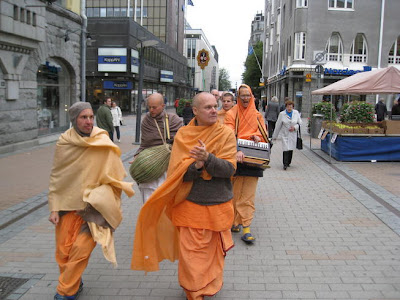
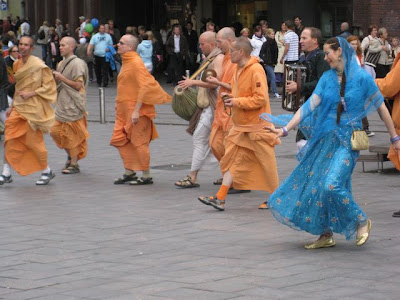
We did harinama in Tampere with the book distribution and college lecturing party, which they occasionally do midweek. We also did weekly two-hour harinama in a busy section of Helsinki. There they distributed hundreds of invitations to the Radhastami festival. They kindly let me lead the kirtana part of the time both place, and they had the cut-off harmoniums that Aindra Prabhu has especially made for harinama. It is three cities in a row that they have had those harmoniums, and I am happy to have the practice using them.
 
Book Distribution Stories from Finland
While researching my article on the academic programs done by ISKCON in Finland, I traveled for three days with their book and prasadam distribution devotees who worked Tampere, the same town as Tattvavada Prabhu gave his academic lectures in that week. Every day Avadhutacandra Prabhu, the party leader and one of the leading book distributors in Europe had a nice story to tell.
The first day he met a respectably dressed man who showed surprising interest in Prabhupada's books. It turned out, when the man was a student, he had heard a lecture by Tattvavada Prabhu and even stayed after class to continue speaking with him. Now he eagerly discussed the philosophy with Avadhutacandra and ultimately bought a book.In front of the library, Avadhutacandra talked with a student who had a heart condition so bad that he could actually die at any moment. He was convinced about the worlds' miseries, and Avadhutacandra sold him both the Gita and the Bhagavatam, Canto 1. When the man made the payment for the books, Avadhutacandra threw in the Mahabharata for another five euros. One boy really had an interest in Prabhupada's books, but he had no money. Just then a girl who had previously purchased the books came up and told Avadhutacandra how much she liked them. Seeing her enthusiasm for the books, he asked her if she would be willing to buy a book for the boy who had no money. The boy was a little shy at first to take help from the girl, but ultimately he did, and received the book. Avadhutacandra also sold another book to the girl at a discounted price.
 
Radhastami
I gave two lectures on Radhastami—one in the morning to the temple devotees, and one for the general Sunday feast crowd. In the morning, I talked about the feelings of separation of Radharani and how Lord Caitanya and Srila Prabhupada taught that devotees must learn how to love Krishna through feelings of separation following in the footsteps of the gopis. This is largely over my head, but I supported it with Prabhupada's statements from Krishna book. It is the right time to talk of such esoteric topics. If not on Radhastami, when? We cannot neglect such an important part of the philosophy. I read my poem about Radha and the bumblebee, which is based on Krishna book, and it went well. In the evening I stressed how Srila Prabhupada would often say that it is easy to attain Krishna by the mercy of Radharani, and we should beg for Her mercy in this connection, especially on this day.
 
During the Radhastami feast I talked to a young couple who had hitchhiked from Germany to Finland. I could see they were not so interested in religion, but they did like music. I talked with them about mantras and the purifying power of the Vedic sound vibration, and they seemed interested. The boy was a guitar player, and I showed him the chords for the simple tune that Srila Prabhupada often chanted, demonstrating with the harmonium. He said that they like to sing while they hitchhike, and I hope they experiment with the maha-mantra, and that it wins their hearts. One enthusiastic devotee gave them two liters of halava to take with them on the road. That it itself might prove an inspiration for devotional service. I learned from the girl that there is a bus that you can take to India from Instanbul for forty euros. Apparently, you do not need visas for the intervening countries as you don't get off the bus. She had never taken it but heard that it leaves from the main bus terminal there in Istanbul.
 
Harinama in Kharkov
 
Each venue we do harinama has a special flavor. I love the ones we do on the sidewalk near the university in Kharkov, Ukraine. What's special there is the devotees roll out about 15 meters of carpet on the curb across from us for interested people to sit and hear the transcendental sound. Usually between five and twelve people are sitting listening at any one time, and for at least half an hour during the three or four hours we chanted there, twenty people listened. This time we came out with four devotees. Two more devotees, who attend the university, later joined us. We played the harmonium, the mrdanga, karatalas, whompers (the big karatalas), a tambourine, and a djembe. The devotees, headed by brahmacari preacher, Krishna Dvaipayana Dasa, display a table of books, DVDs, incense, sweets, temple invitations, and a photo album of devotional pictures for people to look through. [The DVD distribution program is interesting. The DVDs, which are either for sale or to borrow, include kirtana, lectures, and movies of India and devotional topics, and create an interest in the people receiving them.] One new Kharkov devotee, a university student in technology, told me that he hears the passersby the harinamasay things like, "These Hare Krishnas are very powerful. They pass out sweets and incense, and make you feel like you don't want to go anywhere else." In Kharkov the devotees chant six days a week, at least three hours a day, either at the university, park, or downtown, depending on the day. I like to go there every year and become inspired. Sahasra Jit Prabhu, the temple president, tells me that each year they teach an introductory course to about twenty to thirty newcomers to Krishna consciousness, most having developed an interest as a result of the harinama program.
 
Some People I Encountered in Kharkov
 
There is Sahasra Jit Prabhu, the temple president, who always gets me at the train station, translates my Bhagavatam classes, finds a place for me to stay, and makes sure I can go on plenty of harinamas. There is Krishna Dvaipayana Prabhu, who is always jolly, and is a dedicated preacher. There is Drumila Dasa, who on harinama, closes his eyes and chants lively tunes with his whole heart. There is Bhakta Andre, the dentist, who kindly spent four hours replacing the fillings for eight of my cavities as a service, because he found my dancing inspiring at the Ukraine festival one year. There is householder Alexi, who invited the harinama party to lunch two days in a row. There was a five-year medical student from Malaysia who went to the Sunday feast there as a ten-year-old kid but decided to take devotional service seriously in Kharkov a few months ago and came out with us on harinama. There was a lady from Iran who teaches Farsi at the university, who developed an interest in Krishna consciousness in Kharkov, and came out on harinama along with her daughter. An English teacher from the university visited the harinama and decided she had to talk with me as I was an American. She blessed me to think good thoughts, say good words, do good activities, and to find God in my heart—all nice sentiments.
 
Bolo 'krishna,' bhajo 'krishna,' koro 'krishna–siksa'.
Chant "Krishna!" worship Krishna, and follow Krishna's instructions.
(from Bhaktivinoda Thakura's Gitavali)

Saturday, October 11, 2008

travel journal#4-17: Finland and Ukraine

Diary of a Traveling Sadhaka, Vol. 4, No. 17
By Krishna-kripa das
(September 2008, part one)
Tampere and Helsinki, Finland & Kharkov, Ukraine
(Sent from Gainesville, Florida on 10/11/08)

Where I Am and What I Am Doing

I spent the first week of September in Finland, researching an article on the Finnish yatra, especially its programs for academia, for Back to Godhead and meditating on speaking on the glories of Radharani for Radhastami. Then I went to Kharkov where we had a couple harinamas, including a very nice one at the college, and where Bhakta Andre kindly replaced eight fillings in my teeth.

Devotional Meditations

Notes on Kavicandra Swami’s recorded class on Caitanya-caritamrita:

"Water, water, everywhere, but not a drop to drink" from Rime of the Ancient Mariner describes the nature of the material world. We are looking for enjoyment, but if we try to enjoy that which surrounds around us, we will just suffer, just as if one drinks the sea water to quench his thirst.

We want to go from lust to love, and from passion to compassion.

In this ISKCON movement we are doing the same things that Lord Caitanya did, so this is also Gaura-lila.

Notes from a recorded lecture by Bhakti Vidya Purna Swami:

In making emotional presentations, a pleasant background has to be created before the point is made, so the point is likely to be accepted. In intellectual presentations, the point is made in the beginning, and the presentation uses intelligent arguments to show the wisdom of the point.

If one foolishly drives off the road, one does not blame the road, the car, or the tires, but oneself, why then does one who has difficulty in a relationship, always blame the other person? If we could learn to refrain from doing this, we could improve our relationships among devotees considerably.

Academic Outreach in Finland

I have written an article for Back to Godhead, on Finland’s academic outreach, but I want to say a little about it here. The "Krishna religion" is an official religion in Finland. If three or more kids in a city worship Krishna, then if their parents request, the school is obligated to teach a weekly class it in.


Tapo Divyam Prabhu teaches a class of Nepali boys about Srila Prabhupada.

Thus one devotee, Tapo Divyam Prabhu, teaches seven such courses in the Helsinki area schools.

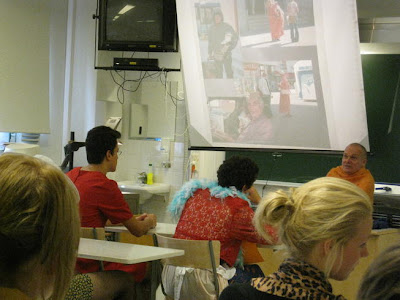
Tattvavada Prabhu gives a lecture to a class of high school students.

In addition a team of five devotees headed by Tattvavada Prabhu, ISKCON’s regional secretary for Finland, gives lectures in 100 high schools and colleges and in six of the country’s ten universities. Besides this, at least two or three classes visit the temple each week. One teacher of religion teachers brings his entire class once a year, and a class of nurses visits the temple once a year, as nurses need to be familiar with the different practices of their patients. Recently, a professor at the Helsinki University asked the devotees to write a curriculum for a course in the Krishna religion. Thus in the country of Finland the devotees are well respected for the knowledge that they share.

Harinama in Finland

We did harinama in Tampere with the book distribution and college lecturing party, which they occasionally do midweek.

We also did weekly two-hour harinama in a busy section of Helsinki. There they distributed hundreds of invitations to the Radhastami festival. They kindly let me lead the kirtana part of the time both place, and they had the cut-off harmoniums that Aindra Prabhu has especially made for harinama. It is three cities in a row that they have had those harmoniums, and I am happy to have the practice using them.

Book Distribution Stories from Finland

While researching my article on the academic programs done by ISKCON in Finland, I traveled for three days with their book and prasadam distribution devotees who worked Tampere, the same town as Tattvavada Prabhu gave his academic lectures in that week. Every day Avadhutacandra Prabhu, the party leader and one of the leading book distributors in Europe had a nice story to tell.

The first day he met a respectably dressed man who showed surprising interest in Prabhupada’s books. It turned out, when the man was a student, he had heard a lecture by Tattvavada Prabhu and even stayed after class to continue speaking with him. Now he eagerly discussed the philosophy with Avadhutacandra and ultimately bought a book.

In front of the library, Avadhutacandra talked with a student who had a heart condition so bad that he could actually die at any moment. He was convinced about the worlds’ miseries, and Avadhutacandra sold him both the Gita and the Bhagavatam, Canto 1. When the man made the payment for the books, Avadhutacandra threw in the Mahabharata for another five euros.

One boy really had an interest in Prabhupada’s books, but he had no money. Just then a girl who had previously purchased the books came up and told Avadhutacandra how much she liked them. Seeing her enthusiasm for the books, he asked her if she would be willing to buy a book for the boy who had no money. The boy was a little shy at first to take help from the girl, but ultimately he did, and received the book. Avadhutacandra also sold another book to the girl at
a discounted price.

Radhastami

I gave two lectures on Radhastami—one in the morning to the temple devotees, and one for the general Sunday feast crowd. In the morning, I talked about the feelings of separation of Radharani and how Lord Caitanya and Srila Prabhupada taught that devotees must learn how to love Krishna through feelings of separation following in the footsteps of the gopis. This is largely over my head, but I supported it with Prabhupada’s statements from Krishna book. It is the right time to talk of such esoteric topics. If not on Radhastami, when? We cannot neglect such an important part of the philosophy. I read my poem about Radha and the bumblebee, which is based on Krishna book, and it went well. In the evening I stressed how Srila Prabhupada would often say that it is easy to attain Krishna by the mercy of Radharani, and we should beg for Her mercy in this connection, especially on this day.

During the Radhastami feast I talked to a young couple who had hitchhiked from Germany to Finland. I could see they were not so interested in religion, but they did like music. I talked with them about mantras and the purifying power of the Vedic sound vibration, and they seemed interested. The boy was a guitar player, and I showed him the chords for the simple tune that Srila Prabhupada often chanted, demonstrating with the harmonium. He said that they like to sing while they hitchhike, and I hope they experiment with the maha-mantra, and that it wins their hearts. One enthusiastic devotee gave them two liters of halava to take with them on the road. That it itself might prove an inspiration for devotional service. I learned from the girl that there is a bus that you can take to India from Instanbul for forty euros. Apparently, you do not need visas for the intervening countries as you don’t get off the bus. She had never taken it but heard that it leaves from the main bus terminal there in Istanbul.

Harinama in Kharkov

Each venue we do harinama has a special flavor. I love the ones we do on the sidewalk near the university in Kharkov, Ukraine. What’s special there is the devotees roll out about 15 meters of carpet on the curb across from us for interested people to sit and hear the transcendental sound. Usually between five and twelve people are sitting listening at any one time, and for at least half an hour during the three or four hours we chanted there, twenty people listened. This time we came out with four devotees. Two more devotees, who attend the university, later joined us. We played the harmonium, the mrdanga, karatalas, whompers (the big karatalas), a tambourine, and a djembe. The devotees, headed by brahmacari preacher, Krishna Dvaipayana Dasa, display a table of books, DVDs, incense, sweets, temple invitations, and a photo album of devotional pictures for people to look through. [The DVD distribution program is interesting. The DVDs, which are either for sale or to borrow, include kirtana, lectures, and movies of India and devotional topics, and create an interest in the people receiving them.] One new Kharkov devotee, a university student in technology, told me that he hears the passersby the harinamasay things like, "These Hare Krishnas are very powerful. They pass out sweets and incense, and make you feel like you don’t want to go anywhere else." In Kharkov the devotees chant six days a week, at least three hours a day, either at the university, park, or downtown, depending on the day. I like to go there every year and become inspired. Sahasra Jit Prabhu, the temple president, tells me that each year they teach an introductory course to about twenty to thirty newcomers to Krishna consciousness, most having developed an interest as a result of the harinama program.

Some People I Encountered in Kharkov

There is Sahasra Jit Prabhu, the temple president, who always gets me at the train station, translates my Bhagavatam classes, finds a place for me to stay, and makes sure I can go on plenty of harinamas. There is Krishna Dvaipayana Prabhu, who is always jolly, and is a dedicated preacher. There is Drumila Dasa, who on harinama, closes his eyes and chants lively tunes with his whole heart. There is Bhakta Andre, the dentist, who kindly spent four hours replacing the fillings for eight of my cavities as a service, because he found my dancing inspiring at the Ukraine festival one year. There is householder Alexi, who invited the harinama party to lunch two days in a row. There was a five-year medical student from Malaysia who went to the Sunday feast there as a ten-year-old kid but decided to take devotional service seriously in Kharkov a few months ago and came out with us on harinama. There was a lady from Iran who teaches Farsi at the university, who developed an interest in Krishna consciousness in Kharkov, and came out on harinama along with her daughter. An English teacher from the university visited the harinama and decided she had to talk with me as I was an American. She blessed me to think good thoughts, say good words, do good activities, and to find God in my heart—all nice sentiments.

Bolo ‘krishna,’ bhajo ‘krishna,’ koro ‘krishna–siksa’.

Chant "Krishna!" worship Krishna, and follow Krishna’s instructions.

(from Bhaktivinoda Thakura’s Gitavali)

Thursday, September 25, 2008

Sadaputa Prabhu: Words of Praise

Sadaputa Prabhu: Words of Praise

I feel I should say a few words about Sadaputa Prabhu, on the occasion of his disappearance, as I worked for him from 1988 to 2005, assisting mostly with book and video production. Actually beyond it being an obligation, I took as both a great honor and a great pleasure working for him, and I take great pleasure in glorifying him and his achievements.

Srila Prabhupada said, "The more we kick on Darwin's face, the more [we] advance in spiritual consciousness. He has killed the whole civilization, rascal" (Morning Walk, May 12, 1973, Los Angeles). Through his strong words, Srila Prabhupada made it clear that Darwin's materialistic theory has created a so-called civilization in which the quest for self-realization, the goal of human life, will never arise, and he wanted the theory completed discredited. Sadaputa Prabhu dealt many great blows in this connection, which I personally appreciate.

Before I went to work with Sadaputa Prabhu, I thought that in the sense the scientists are presenting that life came to be without God, you could say that are cheating. In Forbidden Archeology, Sadaputa Prabhu and Drutakarma Prabhu show that even according to the ordinary dictionary definition of cheating, the scientists are cheating. By discrediting evidence that does not fit the theory instead of altering the theory to accommodate the evidence, as their scientific method requires, they maintain a false theory and claim objective evidential support. This is a first class example of cheating, elaborately exposed by the grace of Sadaputa and Drutakarma Prabhus, who describe dozens of cases in their book. I hope in the future they both get the recognition for exposing that great hoax of an idea, namely that humans have evolved from apes. In Sadaputa Prabhu's video, "Models of Natural Selection," he shows that the probability of evolution by natural selection of even the simplest organism is out of the question, to the extent of 1 in 10 to the 84th power! In Mechanistic and Nonmechanistic Science he points out that according to information theory there is a conservation of information, and one cannot explain the existence complex biological forms with the simple laws of physics alone. All are wonderful contributions.

His analysis of the Bhagavata cosmology as meaningful in at least four different self-consistent ways is brilliant as is his discovery that the geocentric orbits of the planets line up with the oceans and dvipas of Bhumandala, which provides evidence of advanced astronomical knowledge in India thousands of years ago, and shows the Bhagavata description is not mythology, but a model encoding astronomical and geographical information, well ahead of its time.

Analyzing Vedic star coordinates and the present star coordinates and rates of motion, Sadaputa Prabhu, gave evidence for exact measurement of star positions in India sometime about 30,000 or 40,000 years ago. Such advancement of civilization in ancient times is consistent with traditional Vedic ideas but revolutionary for Western scholars, even the most liberal.

Some people did not appreciate his book on UFOs, because that topic is considered disreputable. Sadaputa Prabhu, a true scientist, was more interested in empirical evidence which provides insight into reality than academic or public opinion. He wrote the book because he read in the Bhagavatam about so many vimanas (flying machines), and so many species of humanlike living beings, many with supernatural powers. He thought if this Vedic version is the truth, there must be some empirical evidence for it. He found in the modern UFO literature amazing parallels with ancient accounts from the Mahabharata, Ramayana, and Bhagavatam. One reviewer of his book, Alien Identities, described it as "the most honest UFO book ever written." Most UFO authors are true believers who bend the facts to support the existence of the UFOs or debunkers who try to explain away all the evidence as deriving from man-made or meteorological phenomena. Sadaputa Prabhu was just interested in the truth about the phenomena, and thus that reviewer and many others were impressed.

When asked by one devotee why he accepted the Vedic knowledge with all its peculiarities, Sadaputa Prabhu replied, Because it can explain so many things." Consciousness, the complexity of biological form, inspiration, out-of-body experiences, past life memories, psychic healing, mystic power, telepathy, psychokinesis, precognition, teleportation, UFOs, ETs, ghosts, and all kinds of natural and supernatural phenomena can be explained with the Vedic world view. On the contrary, modern scientists' attempts to explain all these are either full of fault or else nonexistence because of their firm faith the phenomena cannot exist despite abundant human testimony.

Sadaputa Prabhu was hardworking, brilliant in analysis, consummately fair, humorous, honest and sincere, and faithful to Srila Prabhupada and the Vedic version. He never really disappointed me. I felt sad when people attacked him or didn't appreciate him. He is one who deserves to be appreciated for his sincere efforts.

He was very humorous. In his Origins lectures series, discussing the faith the scientists have in their imperfect theories, he exclaims "And the scientists, they BELIEVE in their theories! They BELIEVE in their theories as much as any Baptist BELIEVES in Lord Jesus Christ!"

I left working for him not because of disagreement, but because at the end, I was just doing accounting and shipping, which I felt any secretary could do. What needed to be done was to promote his books, and I did not have the vision to do that, and unfortunately, I did not even have the determination to enlist someone who did. I felt out of place in Alachua--one brahmacari among a handful, in a household community. I think he understood. Perhaps if he were in my situation, he would have left too.

I still show his videos. I showed "Mind and Brain," "Natural Selection, " and "Mysterious Orbits" in Finland this month, and I showed the Russian version of "The Hidden History of the Human Race" last week at the Ukraine festival. They are valuable and devotees desire to get them to help with their academic programs. I thought he should get some royalties for the videos I distribute, and I asked if I could send money to his email address, but he never wrote me back.

On September 22, in Wroclaw, I met Karanam Prabhu, who published many of Sadaputa Prabhu's books in Polish. He sold at least 60,000, and maybe even 70,000 copies of the Polish version of the abridged Forbidden Archeology. Just this week, he told me, an order came for 300 more.

In February 2007, I sent Sadaputa Prabhu an article about about the Princeton Engineering Anomalies Research lab closing after nearly thirty years of fruitful research into the paranormal. He quoted from their studies, and so I thought he would be interested. Sadaputa Prabhu wrote me back the last email I ever got from him, "Thanks. The end of an era..." That too is how it feels for me now that he has disappeared, "The end of an era..."

As Sadaputa Prabhu is a faithful follower of Srila Prabhupada, playing a key role in his mission, I am hopeful of his attainment of Srila Prabhupada's full mercy, which he bestows on those who give their valuable human lives fully to his service. At least we can all pray for that.

I submit these words for the pleasure of the devotees. Please accept them.

In addition, I think a book and video should be produced telling of his life and his achievements. I do not have the determination to do it personally, but I am willing to suggest and contribute content and to proofread the book. I would like it if anyone interested in that might contact me. I have an account on PAMHO, where my user name is "Krsna-krpa SDG". Also perhaps at the Mayapur festival this year, some special program honoring him might be included.

Thank you for your kind attention.

Your servant,

Krishna-kripa das

a very imperfect servant of Sadaputa Prabhu and the other glorious followers of His Divine Grace A. C. Bhaktivedanta Prabhupada, founder-acarya, of ISKCON, BBT, and BI.

Monday, September 08, 2008

travel journal#4.16b: Czech Woodstock 2008


Diary of a Traveling Sadhaka, Vol. 4, No. 16b
By Krishna-kripa das
(August 2008, part two)
Czech Woodstock
(Sent from Helsinki, Finland on 9/8/08)

Where I Am and What I Am Doing

Reminded of my taste for encouraging people in kirtana at the Polish Woodstock, I decided to go to the Czech Woodstock instead of the Polish nama-hatta festival after the Polish festival tour.

Czech Woodstock

I had heard of the Czech Woodstock from my friends in recent years but was always busy when it was held. This year, however, it occurred just after the Polish festival tour, so it was easy to go to. I spent three days in between at our Wroclaw temple, where I learned a great Hare Krishna tune on the harmonium. My plan to take buses to the Polish border, walk across the border, and take a buses on the Czech side was foiled when the last Czech bus driver refused to accept my euros, saying firmly "Cheska koruny!" [Czech crowns] and pointing to the door of the bus. So much for the European Union! As it was last bus for the evening, I decided to hitchhike the 16 kilometers to Trutnov, the site of the 21st annual open air music festival, now attended by 20,000 people willing to pay the 40 euros to get it. After walking two kilometers I got a ride with a couple young ladies in their twenties, who were also going to the Trutnov festival. I gave the driver our Polish mantra yoga card in exchange for the ride. [Persons living near the border can mostly understand the language.] And I gave an invitation to Govinda’s to her friend from Prague. They showed me the VIP entrance where, after I had been waiting in line for fifteen minutes, Mother Vrindavana Priya of Prague, who schedules our kirtana tent at the Polish Woodstock arrived. I was eager to meet the devotees and know how to deal with the registration, and she was eager to avoid waiting for fifteen minutes in line, so it was fortunate we met.

The first night the Prague devotees led some lively kirtana for an hour.


Next Danavir Goswami arrived, and led a wonderful kirtana, chanting the simple Prabhupada melody for three hours. After half an hour, asking the audience to arise, he demonstrated the swami step from the stage, and I demonstrated it, facing him, in the front of the audience. He had between fifteen and forty people dancing at any one time. Most amazing for me was that probably about 80% of them also chanted. I noticed one girl chanted the entire four hours, smiling the whole time. I was glad to see Srila Prabhupada’s program of making hippies into happies is still effective.

The first full day of the festival, organizer Punya Palaka Prabhu, told the people waiting in our tent for the program to start, that we were going to chant around the festival site and downtown, and they were welcome to come.


About eight people, including a couple girls who had chanted almost the entire previous evening joined our party of about ten devotees. It was a great idea to engage the people like that, and they had a great time.


One girl carried the mantra sign the entire hour and a half.


To see about ten harinama pictures included in a gallery of an electronic newspaper, click here.

Punya Palaka explained the people who come are special. Like with the Polish Woodstock, some come to the Czech Woodstock only to attend the Hare Krishna camp. One year, when the devotees began setting up their sound system, the eager attendees waiting for them to play urged them to chant without it. When the devotees did not comply, the Woodstock attendees themselves took up the instruments and had their own Hare Krishna kirtana as the devotees continued setting up the sound!


The devotees have been attending the festival since 1999, when the organizer, who is very favorable, made Hare Krishna the theme of that year’s festival. Ever since then, the devotees have had their own stage at the festival site, and the organizer has put Lord Jagannatha’s face on the festival advertisement each year. In fact, Lord Jagannatha’s smiling face can be seen even the armbands that the festival goers received this year. And although dozens of bands played music at Trutnov, the Krishna hard core band, Shelter, was listed in the top four.


Realizing that I am not a good enough singer or musician to play on the stage with the other devotees, I danced to the music of the kirtana in front of the stage, off to the side. I smiled at the people in the audience, and using gestures, encouraged them to sing and dance, and I appreciated their attempts.

Danavir Goswami lead an electric kirtana the second night, accompanied by two devotees on electric guitars, one on the bass, one on a full drum set, and another on djembe. Maharaja would chant the lead, and point the microphone toward the crowd on the response, encouraging the people to sing along. It was very lively. Occasionally Maharaja would hold the microphone and let one of the guitar players chant the lead. The last half of this video shows what it was like.

Afterwards I saw one girl with hair having streaks of light blue, who had danced right in front of the stage in the middle and chanted with vigor the whole time. I later thanked her for her contribution, and she told me how the chanting gave her so much energy she was amazed and did not know what to do with it. Her friend expressed that although she was very tired, her feet could not stop dancing. I explained that that was all the result of contacting the spiritual energy. The girls, who were from Prague, had seen us on harinama there, and I told them the time and location of our harinamas in case they wanted join in. They loved both our food and our music and had been to Govinda’s. They did not know, however, about the Wednesday evening program at Govinda’s, so I told them that they could come and sing and dance and have a free prasadam meal.I later I saw the girl who had chanted for four hours, when she came up to me and thanked me for my encouragement. She had not originally planned to come back but to go to a punk rock festival the next day. I found she was from Brno, and I gave her a Brno invitation card I got when visiting there in June, and introduced her to Mayapur Chandrodaya Prabhu, one of the most active devotees in that center.


Three girls practically lived in our tent for the better of the four days, often chanting along. They are seen in the far left of this photo, in front, two sitting on the ground, chanting and smiling, and one behind on the bench. When I decided to pick up the trash during a break in the action, two of them helped me.

One young man, who likes to chant "Haribol!" loudly, throwing his arms in the air, wanted to give me his black leather wrist bands, appreciating my enthusiasm in the kirtana. Such things are not part of my natural wardrobe, and I declined them with the quite real excuse that, as devotees, we do not unnecessarily use leather products because of the violence behind them. I appreciated his sentiment and gave him a mantra card. A devotee told me that previously the man had purchased some books. One girl gave me some pakoras and a container of tissue paper in appreciation. For me, the appreciation of individual people made the festival especially sweet.

The devotee hardcore band, Shelter, from America, resurrected for Trutnov, played for about an hour, led by Raghunatha Prabhu, who now is a fulltime yoga teacher in upstate New York. In this video, you can see the glowing Jagannatha face on the stage above the band as they play! Raghunatha is very personable with the audience, who reciprocated nicely. He inserted different philosophical points from time to time, between songs. For example, he said that it is not how well you play the guitar but that you sing from the heart. He mentioned that he would be singing at the Krishna Camp the next day, and invited the people to come. I had not seen him since the Polish Woodstock five years ago.
Prasadam is very popular and the devotees served it at least three different venues. After one chanting session I saw two high school girls, who had chanted and danced nicely for almost an hour, eating some pakoras and chutney. I asked if they liked food. They smiled, saying they did, listing with joy all the preparations they had tried, culminating in the sweet rice with berries in it, which was also my favorite. Although they knew of the Govinda’s on Palmovka in their hometown of Prague, they had never eaten there. I told them of the other Govinda’s with their chanting and dancing and free dinner program on Wednesdays and gave them an invitation. They had seen the devotees chanting in Prague, and I told them how they meet at 4 p.m. at Republic Square on Wednesdays and Fridays, so they could also take part. In the course of talking I explained that we are spiritual beings who are by nature always happy but feel distress due to material identification. The mantra is a spiritual sound that elevates us to a higher level where the problems of the material world do not exist. Because they had chanted nicely in the kirtana, they could appreciate to some extent how that was true. Material solutions do not help but result in more problems, as in the case of one who takes shelter of drinking to avoid his miserable condition. He still has his previous ninety-nine problems, but now one more—a drinking habit. I gave them cards with the mantra to take with them. The two friends had a wonderful experience in our Krishna camp and promised to return later in the evening.

Another fan of prasadam was a one software tester who works in Prague and used to eat regularly at Govinda’s on Palmovka when her office was located there. Last year she went to India for two weeks and had such a nice time she wants to go again. I told her how I lived in India the last three winters and mentioned some of our projects there like Mayapur, Vrindavana, and Chowpatty, giving her the addresses of their web pages, and telling her about Krishna.com which lists all our centers worldwide. One who goes to these music festival programs may wonder how much benefit is gained by the people, who although they like to sing and dance with the devotees, are still drinking their beers and puffing on their cigarettes, sometimes all at once. In this regard, a nice point is made in The Nectar of Devotion in the beginning of chapter three: "On account of his association with mahatmas, or great souls one hundred-percent in the devotional service of the Lord, one may attain a little bit of attraction for Sri Krishna. But at the same time one may remain very much attached to fruitive activities and material sense enjoyment and not be prepared to undergo the different types of renunciation. Such a person, if he has unflinching attraction to Krishna, becomes an eligible candidate for discharging devotional service." From this it seems that if we can encourage the people to develop their attraction to Krishna to the extent that it is unflinching, they too may take up the practice of sadhana-bhakti in serious way and attain love of Godhead in due course.

From the three restaurants (two named Govindas and one called Balarama) and two weekly harinamas (four in the summer) in Prague, and from previous festivals, like Trutnov and the devotees’ Happy Days festival, many, many people in Czech Republic think favorably of the devotees and appreciate some kinds of devotional service. It was nice to meet these people and try to encourage them even more. I thank my friends from Czech who invited me to come, and Punya Palaka Prabhu for organizing our participation. For more information, you may want to see Punya Palaka’s article on the Czech Woodstock festival in general on Dandavats.com, or see the official Trutnov festival site. Czech devotees have their own article at http://www.harekrsna.cz/ with photos as well.

sanketyam parihasyam va
stobham helanam eva va
vaikuntha-nama-grahanam
asesagha-haram viduh

One who chants the holy name of the Lord is immediately freed from the reactions of unlimited sins, even if he chants indirectly [to indicate something else], jokingly, for musical entertainment, or even neglectfully. This is accepted by all the learned scholars of the scriptures. (SB 6.2.14)

Saturday, September 06, 2008

Srimati Radharani Talks to a Bumblebee


Srimati Radharani Talks to a Bumblebee

(a poem by Krishna-kripa dasa based on Srila Prabhupada's
Krishna, the Supreme Personality of Godhead)

Uddhava, servant of Krishna,
Entered the holy Vraja land.
Krishna sent him with a message
To give to the gopis by hand.

The gopis remembered Lord Krishna,
Hearing of Uddhava's mission,
So much so they forgot their homes
And their external position.

Sri Radha, mad with Krishna thought,
In touch through devotion complete,
Talked to a nearby bumblebee,
Who tried to touch Her lotus feet.

'When you're after honey, dear bee,
Each and every flower will do.
Now you convey Krishna's message,
For He's the same nature as you.

'Red kunkum adorns your moustache
As you most proudly let Me see.
It clung to Krishna's garland when
He embraced one other than Me.

'You have come here with His message,
And you're daring to touch My feet,
But I warn you sir, don't touch Me!
You cheating servant of a cheat!'

These sarcastic words of Radha,
Directed at the bumblebee,
Reveal Her doubts about Krishna
And His servant, Uddhavaji.

'Your nature is so like Krishna's
You take a flower's honey then leave,
As Krishna let us taste His lips,
Then, suddenly left us to grieve.

'Why does Sri Lakshmi serve Him so,
Knowing His real character.
We're smarter and won't be cheated
By Him nor by His messenger.'

As Krishna expands as Vishnu,
From Radha comes the goddess Sri.
Although she's goddess of fortune,
She wants to become a gopi.

'Dear bee, You chant Krishna's glories
Thus seeking a reward from Me.
Why this simply useless attempt?
It's foolish as foolish can be!

'We have left all our possessions
And our homes and families too.
We know this Krishna very well.
We all know Him better than you.

'Since Krishna moved to the city
And is known as friend of Arjuna
He now has many new girlfriends
Who think He's the ultimate boon.

'Happily blessed by Krishna's touch
They'll smile as you chant His glories.
Tricky friend of tricky Krishna,
Please go! Enough of your stories.

'Though you're great at solving conflicts,
Your words and Krishna's I can't trust.
We gave up everything for Him,
But He treated us just like dust.

'He can't live without young women,
But city girls aren't so naive.
Not like innocent cowherd girls,
Who charmed by His words, believe.

'Want to lead us to Mathura?
And then again, whatever for?
Krishna's smile is so enchanting
Any woman would just adore.

'Krishna smiles, His eyebrows dancing,
Enticing women all around.
Compare to those, led by Lakshmi,
We're just like straw upon the ground.

'He presents Himself, a noble,
And sages praise Him with respect.
One so great should show His mercy
For we are pained by His neglect.

'Foolish servant, you don't know Him.
He's been so hard-hearted and cold
In this life and in former ones.
The details Paurnamasi's told.

'She claimed He came as Rama, the king,
But His actions were a disgrace.
He killed Vali like a coward,
Without fighting him face to face.

'Attached to Sita's pure beauty,
He drove Surpanakha to tears.
Instead of appeasing her lust,
He chopped off her nose and her ears.'

'Next He came as the brahmana boy
Asking alms from Bali, the king.
Then displeased, He punished Bali,
Though Bali'd offered Him everything.

'We know that Krishna very well.
He's hard-hearted, restless, and mean.
How can we stop our talks of Him?
This certainly remains to be seen.

'Not only we, but great souls too
All have these same proclivities.
We can't see how we'll ever stop
Discussing His activities.'

Because Krishna is absolute
Both His kind and mean acts please.
Opportunities to hear of them
Great devotees will always seize.

Caitanya taught that Krishna's free
To leave us and bring dejection.
He may crush us or embrace us,
Still, we serve Him with affection.

'No one should hear these Krishna talks,
For if a drop goes in one's ear,
One's freed from all dualities
And things materially dear.'

Free of material desire,
One gives up family and home.
Wandering in search of Krishna,
Going here and there, he will roam.

To understand Krishna's nature
Is hard in actuality,
His name, form, comrades, and pastimes
Are of transcendent quality.

'Please don't speak anymore of Krishna.
Give us another topic to hear.
Krishna charmed us with His sweet words
As hunters' tunes entrance a deer.

'In our present doomed condition,
We think of His glittering feet,
And become lusty for His touch.
Please, from your talks of Him, retreat!'

All these talks of Radharani
With the messenger bumblebee
Which refer to Krishna alone
Symptomize topmost ecstacy.

These symptoms of mahabhava
In Radha and the gopis too,
Acaryas have closely studied
To explain the things that they do.

Radha acts as if bewildered,
And She talks in different ways.
This all comes from Her Krishna love
As from jewels come sparkling rays.

Sri Radha's talking with the bee
Cured Her woe of separation,
But then when the bee disappeared,
She went mad in desparation.

Thinking the bee went to Krishna
Telling Her words of demotion,
She feared that She made Krishna sad,
And thus She felt great emotion.

When the bee appeared before Her,
She felt Krishna to be most kind:
He ignored Her disruptive words
And sent the bee to calm Her mind.

Then Sri Radha spoke with great care
Thus addressing the bumblebee.
This time She was speaking sweet words
And not words full of infamy.

'My dear friend, you are most welcome.
To send you, Krishna is so kind.
He ignored My words against Him,
Though they couldn't have pleased His mind.

'Oh My friend, you're welcome to ask Me
Whatever you desire, dear bee,
For I shall give you anything
Because of your kindness to Me.

'You've come to take Me to Krishna
Because He cannot come to Me,
For there new girlfriends surround Him.
But you're too small to take Me, dear bee!

'How can you help Me meet Krishna?
For there He is taking His rest
Along with the goddess of fortune
And embracing her to His chest.

'Oh, never mind! Forget these talks
Of My going or sending you.
Tell Me how Krishna is faring.
In Mathura, what does He do?

'Does He miss His father Nanda?
And His most loving mother too?
What about His cowherd boyfriends?
And we gopis? Give us a clue!

'I'm sure He sometimes sings of us,
We who all served Him without pay.
We simply were His maidservants.
To embrace Him once more, we pray!

'Oh, when will His arms surround us,
Always fragrant with aguru scent.
Oh, please ask Krishna these questions,
Without Him we simply lament!'

This worship in separation
By the gopis of Their dear Lord
Is most praised by Lord Caitanya
As giving the supreme reward.

This reward of love of Krishna
Is certainly the highest goal.
It's this Caitanya came to teach,
And it is this He did extol.

Tuesday, September 02, 2008

travel journal#4.16a: Wroclaw, Leipzig, Berlin, Bremen


Diary of a Traveling Sadhaka, Vol. 4, No. 16a
By Krishna-kripa das
(August 2008, part two)
Wroclaw, Leipzig, Berlin, Bremen
(Sent from Tampere, Finland on 9/2/08)

Where I Am and What I Am Doing

After to the Polish festival tour, I went with Giridhari Prabhu to Wroclaw, where I spent three days, waiting for the start of the Czech Woodstock, which I will describe in the next article, as it requires a whole article itself. After that I went to Leipzig and Berlin, on the way to Bremen, Germany, where I caught a flight to Finland. Airport security threw out my less than 100 ml of sun screen merely because it was in a bottle marked 200 ml, although I showed them that the bottle was clearly less than half full! I plan to write the company for compensation. Fortunately there was a power outlet at the boarding gate, and I could work on this journal! Now I am in Finland, researching an article on the Finnish yatra, especially its programs for academia, for Back to Godhead and meditating on speaking on the glories of Radharani for Radhastami.

Devotional Meditations

Thoughts from Indradymuna Swami’s lectures:

Religion is meant to purify ourselves. If we do not become purified, we are either following a bogus religion or incorrectly following a real religion.

As a brahmana, Ajamila knew what was sinful and yet he acted sinfully. The holy name, however, delivered even him.

The holy name, like any incarnation of the Lord, is meant to protect the pious, to rectify the demoniac, and to reestablish the principles of religion.

Festivals like the Polish Woodstock are golden opportunities to share Krishna consciousness with many thousands of people. Such chances happen only a few times in our entire lives.

Tale from the History of Krishna Consciousness in Bulgaria

My friend Jagannatha Misra Prabhu, who led harinama this year on the Polish tour, told me some of the interesting history of Krishna consciousness in Bulgaria. After the Soviet Union collapsed, many religious groups appeared in Bulgaria. At one point, the Bulgarian parliament met for seven days to decide about prohibiting several of these “new” religions. Hare Krishna was first on their list. The devotees chanted in front of the parliament from early in the morning each day. They also distributed a statement of their philosophy and a list of their leading members and their occupations. This was so effective that by the end of the week, the parliament decided to ban all the new religions except Hare Krishna. The Bulgarian Orthodox Church was infuriated with this decision, and decided to put all their energy into stopping the devotees. However, on that very day, a split occurred in the church, and so instead, they put all there energy into fighting between the two divisions. That dispute continues even today. In this way, Krishna protected His devotees, who are able to carry on their distribution of spiritual knowledge there in Bulguria.

Wroclaw

Although there are not many devotees in Wroclaw, and I was one of the two or three at the morning program and evening kirtana, I was reminded how nice it is to do the devotional activities Srila Prabhupada has given us, even in the association of just a very few devotees.

Another Venue for Sharing the Mercy

Visvarupa Prabhu, a book distributor based in Wroclaw, told me of an innovative program he does in the lake filled region of northeastern Poland. He and a couple friends rent a boat, and go from one port to another, doing bhajanas and distribution of prasadam sweets for about two hours every evening. Since the boats are a bit expensive, he meets more upper class people. Sometimes the people even invite the devotees on their boats to play for them. It is a combination of a vacation and an opportunity to share spiritual nectar. The downside is it is a bit pricy; the most inexpensive boats rent for $1000 for two weeks.

Lots of Love in Leipzig

Taking four trains, two buses, and a tram, I traveled from Trutnov, Czech, to Leipzig, Germany, arriving in time for the end of the Prabhupada Vyasa Puja feast. I told the prasadam server I would take one of each of the sweets and received a plate with fifteen different desserts! Although half the devotees left for a program with Kadamba Kanana Swami in northern Germany, in that small, recently created temple ten devotees came on harinama with me one day and eight the next! I was so inspired by their enthusiasm, I decided to make the carob coconut burfi I used to make for harinama when I lived in San Diego and Alachua. One devotee took the trouble to roll it all into balls. They are a cooperative bunch of devotees there. On our second harinama, several people stood and watched for some time, several promised to come to the temple, one wanted her picture taken with us, another drew a sketch of our party (above), and yet another wanted the recipe for our sweet. All in all, I was pleased both by the response of the pubic and enthusiasm of the devotees, and I hope to return to Leipzig during the first half of June next year, during which they participate in two well-attended public festivals, doing a lot of kirtana and prasadam distribution. Kadamba Kanana Swami also likes the Leipzig temple since the youthful devotees are very enthusiastic, their minds free of the complaints which sometimes haunt those who have lived through decades of temple life.

Bliss in Berlin

Both days I was in Berlin we did harinama, and I made carob-cocnut burfi for distribution. The first day, one mataji surrendered to driving four brahmacaris to Alexanderplatz, a crowded area great for harinama. One man who saw us chanting was impressed with our sincerity and called the temple about our program the next day. As it turns out, we met him again on harinama the next day and gave him a ride back to the temple for the program. His story is that he came to the temple in Berlin twenty years ago. I talked to him after the program led by Kadamba Kanana Swami, and he said he had a good time. On the second harinama, nine men, mostly brahmacaris went out. We met someone from Scotland, and he also came to the Saturday program. The practicality of harinama as a way to interest people in coming to the temple could not be more obvious than we experienced in Berlin. We also realized it was a great idea to do harinama just before the weekly feast program to generate interest, and even bring people to the temple. My thanks to the Berlin and Leipzig devotees for encouraging me by doing harinama for four days out of my five-and-a-half-day visit to Germany.

ekala malakara ami kahan kahan
yaba
ekala va kata phala padiya vilaba
ekala uthana dite haya parisrama

keha paya, keha na paya, rahe mane bhrama

ataeva ami ajna dilun sabakare

yahan tahan prema-phala deha’ yare tare


Lord Sri Caitanya Mahaprabhu said, “I am the only gardener. How many places can I go? How many fruits can I pick and distribute? It would certainly be a very laborious task to pick the fruits and distribute them alone, and still I suspect that some would receive them and others would not. Therefore I order every man within this universe to accept this Krishna consciousness movement and distribute it everywhere.” (Cc. Adi 9.34-36)

“Here Sri Caitanya Mahaprabhu indicates that the distribution of the Hare Krishna maha-mantra should be performed by combined forces. Although He is the Supreme Personality of Godhead, He laments, “How can I act alone? How can I alone pick the fruit and distribute it all over the world?” This indicates that all classes of devotees should combine to distribute the Hare Krishna maha-mantra without consideration of the time, place or situation.” (Cc. Adi 9.34, purport).