Saturday, October 28, 2006

Airport Meditation

I am sitting on the floor in the departure lounge at Borispil airport in Kiev . I came to the airport with Niranjana Swami who is traveling to Moscow as I travel to Delhi. I scanned a 900-page book for him with a digital camera with some help from some other devotees, and we stopped at a store on the way to the airport because he wanted to buy me a digital camera as gift because I didn't have one. He couldn't find a model that had a matching flash card, so it didn't work out, but I appreciate his kind sentiment. I ended up only sleeping two hours the last night as I wanted to complete the scanning of the book before I left.

The Ukrainian devotees had a very lively kirtana for Niranjana Swami 's departure, and they packed nice prasadam for both of us. I praised him for his training the devotees to be so respectful and having such a serving attitude to the senior devotees. I told him I was thinking of doing a seminar at Odessa, and I proposed to speak on the first four verses of Nectar of Instruction. He thought that was a good idea. Bhagavad-gita is often discussed, but Nectar of Instruction, although highly relevant to our lives, is less so.

It was nice to meet some very nice disciples of Niranjana Swami who came to Kiev to spend this holiday season of Karttika with their spiritual master.

Niranjana Swami walked past me on his way to his plane. He said he made one last attempt to find me a digital camera in the airport, but they did not have any there. He gave a little devotee girl, who is also going to India with her parents, a sweet from his lunch, and he also gave one to me. And he told me to keep in touch with him.

Notes on Dhanesvara Prabhu's class on Srimad-Bhagavatam 1.10.3

Now that there is an increase in communications, there is talk of a world government. International treaties are the beginning of this. Generally, however, many people protest such treaties. People are distrustful because of the corruption of the government.

Historically the brahmanas, the intellectual class, abused their power and become degraded. Then the ruling class abused their kingly positions, and were overthrown. Now the productive class is trying to exercise governmental power, but they are also corrupt. Thus the laborer class will try to take control as they did with communism. Democracy is destined to fail due to lack of spiritual vision. All these ideologies for ruling society are imperfect and will fail because of neglect of the supreme truth. Srimad-Bhagavatam offers of a description of a perfect God-centered government. When people read Srila Prabhupada's books, they can learn of the actual qualifications for true leaders and demand them.

In the CIS countries there are many people looking for a superior ideology. So there is an opportunity to interest these people in the God-centered society described in Srimad-Bhagavatam.

Srila Prabhupada said that history will record how the Krishna consciousness movement saved the world in its darkest hour.

Q: If all but the five Pandavas were killed in the Battle of Kuruksetra, who was there left to play the role of leaders.
A: It is a fact that most of the administrator class was killed in the war, but the brahmanas recreate the administrative class when it becomes dysfunctional or nonexistent.

Government does not need to be complicated to take care of the material needs of society. But due to selfishness, we make things unnecessarily complicated. We cannot elect better leaders, because it is our karma to get the corrupt leaders we have, but if we give up our sinful activities, we will deserve better leaders. Srila Prabhupada said a Vaishnava leader would immediately close all the slaughterhouses, gambling casinos, and liquor shops, and thus put an end to all these sinful activities.

Thursday, October 26, 2006

Srila Prabhupada's Disappearance Day in Kiev

Notes on Srila Prabhupada's Disappearance Day Lecture by Krishna-kripa Dasa

There were three Prabhupada disciples in Kiev , but all declined to give the morning lecture, two being sick and the other feeling unqualified, and so I got to speak again about Srila Prabhupada. I was enthusiastic from the previous night, although I had only slept a total of at most five hours, one and a half of them in the van coming back from Charnigov. The class went for almost two hours, but I can only remember some of it now. I went through the different verses of Gurvastakam relating them to Srila Prabhupada's life. For the second verse, I told how Prabhupada had been feeling ill, but participated in the London Ratha-yatra, dancing ecstatically the entire 4 km route. To see Prabhupada dancing, made the devotees even more wild than usual. A policeman realized this and told Prabhupada's servants to stop him from dancing, but the devotees did not like the idea of a policeman telling such a liberated spiritual personality as Prabhupada what he should do, so they did nothing and Prabhupada danced the whole time. For the fourth verse, I told about how Prabhupada came into the middle of a kirtana when the devotees were chanting the Gurvastakam prayers, and he mentioned that he liked verse four the best. That verse tells how the guru is pleased that the devotees offer nice food to the Lord, and they are satisfied to take the Lord's remnants as prasadam. I also told how Srila Prabhupada kept a jar of gulabjamons, or ISKCON bullets, as the devotees call them, in the storefront temple, to keep his followers from frequenting the ice cream and doughnut shops. The fifth verse tells how the spiritual master relishes the loving affairs between Radha and Krishna . I mentioned that some people look to other sources for more realization about Radha and Krishna, but before they do that they might consider how dear Srila Prabhupada is to the divine couple for establishing Their worship in a hundred temples all over the world and how great his realization of Their glory must actually be to be blessed with that service. I also included some points I made the previous night in Charnigov, as no one had heard that lecture. It was very nice to remember Srila Prabhupada and to help others remember him on his disappearance day, and I was grateful that I was given the rare opportunity to speak about Srila Prabhupada on that auspicious day.

Several Devotees Speak in the Evening about Srila Prabhupada

Niranjana Swami said Srila Prabhupada prayed to Krishna in a mood of helplessness, “I wish you to deliver the people, but whatever is your will.” Srila Prabhpuada created ISKCON and left the boat of his teachings which will benefit humanity for years to come. Srila Prabhupada was confident that anyone who chants sixteen rounds of the Hare Krishna mantra and gives up the four sinful acts will attain Krishna 's mercy in this life. We have to follow Srila Prabhupada back to Godhead. Although Srila Prabhupada's disappearance was a cause of lamentation, he left his teachings in his books.

Dhanesvara Prabhu explains how Srila Prabhupada was everything for his devotees who felt that their parents, their government, and their society had let them down. The devotees mostly were under thirty and felt greatly dependent on Prabhupada's guidance. Prabhupada gave them permission to pray, “Dear Krishna, if it is your desire, keep Srila Prabhupada here with us.” Personally Srila Prabhupada was indifferent to staying or going. Srila Prabhupada once said, “You cannot imagine the bliss I was experiencing in Vrindavana.” Yet he came to the West and so many people became devotees because he desired it. Similarly, we must also desire that people be delivered.

Sri Nataji Prabhu, a senior brahmacari, knows Srila Prabhupada through his books and followers. Sri Nataji felt bad when his guru left, but hearing the pastimes of Srila Prabhupada which the devotees told at Krinnitsa, he felt a personal connection with him. Seeing his compassion we should be inspired to spread his movement. I read Srila Prabhupada's books and hear his tapes, and I love them.

Bhagavatacarya Prabhu, temple president of our Danesk temple, recalls Prabhupada said, “If you want my association, read my books.” He laments the decline of book distribution in recent years, and he prays to Srila Prabhupada to be able to help his mission.

Acyuta Priya Prabhu, regional secretary for Ukraine , reminds us that we should always meditate on great souls like Srila Prabhupada. He tells a story related by a priest at a temple in Santipura at Advaita Acarya's residence. The priest said that one gentleman would come regularly who wore a white dhoti and would chant very intently, bow down, and thank the priest for his service. He stopped coming for a while, and then later came as a sannyasi. The priest inquired about him and he explained that his spiritual master had given him an almost impossible mission to spread Lord Caitanya's teachings in the West and that the next day he was leaving Calcutta by boat to America . Later the priest saw some Western devotees, which was a new sight for him. One showed him a BTG magazine and the priest saw a picture of Prabhupada in it and recognized that he was the gentleman who had visited his temple. He came to Mayapur and told the devotees that story.

Wednesday, October 25, 2006

Visit to Charnigov, the Northernmost City in Ukraine

While at the Odessa festival, some devotees from the congregation in Charnigov invited me to come to their temple, and so I said I would come if there was time in my schedule. Charnigov is north of Kiev almost two hours by bus. To get there we took a trolley to the metro, to the bus. I was given a guide to put me on the bus, and the leader of the Charnigov congregation, Giridhari Prabhu, kindly picked me up. I chose to speak about Srila Prabhupada as tomorrow is the anniversary of his disappearance. I mentioned how Lord Caitanya predicted back in the 1500s His holy name would spread all over the world. In the 1800s Bhaktivinoda Thakura predicted that in a short time that prophecy would be fulfilled. He also prayed to the Lord for a son who could help him in his mission. That son, Bhaktisiddhanta Saravati Goswami, encouraged many of his disciples to preach in the West, but Srila Prabhupada because of his great faith and determination, was able to succeed. So Srila Prabhupada is a very dear devotee of Lord Caitanya who assisted Him in His mission just like Haridasa Thakura, Rupa Goswami, and the other eternal associates of the Lord we hear about in Sri-Caitanya-caritamrita. Prabhupada said he was successful in his mission because of his faith in his guru and in the holy name. I read some quotes from Prabhupada Nectar describing Prabhupada's thoughts on education, his preaching spirit, the power of his books, and his explanation of how we can serve him personally although physically separated from him. I also told a story of how a siksa guru of mine had some difficulty, and I had bowed down to Srila Prabhupada's murti in the temple and prayed to Prabhupada to give me solace in that situation. A couple days later a godsister of mine said she had a dream of Srila Prabhupada and that I was also in it. In the dream, Srila Prabhupada said, “Krishna-kripa is my disciple.” That godsister had no way of knowing I had prayed to Prabhupada as I rarely spoke with her and I hadn't told her about my prayer. In this way, I can see that Srila Prabhupada is present and will reciprocate with us if we approach him, and therefore we should not lament thinking we have no access to Srila Prabhupada. He is still here in his books, in the association of his followers, and in his murti in the temple, and he will reciprocate with us.

Dhanesvara Prabhu, who was looking for land in the area to build a varnasrama community, arrived at the end of my lectures, and I invited him to speak about Srila Prabhupada. He told about the context of a Srila Prabhupada quote I had heard many times, “All of you have joined because of prasadam. Even you! [he said pointing to the temple president]” Prabhupada had been talking about prasadam with the Radha-Damodara devotees and others. The devotees told him about a pakora-eating contest in which one brahmacari had put twelve cauliflower pakoras in his mouth and was chewing them when someone came from behind and slapped his cheeks and the half-eaten pakoras came out of his mouth. It was after hearing many such stories that Prabhupada had made that famous quote.

The first time Dhanesvara Prabhu met Prabhupada, when Prabhupada chanted the “Jaya Om” prayers after the kirtana, Dhanesvara Prabhu alone did not bow down, because the small temple room floor was packed full. Prabhupada made some indication to him, and he responded with a gesture, to indicate there was no room to bow down.

When Dhanesvara Prabhu got gayatri in Atlanta in 1975, Srila Prabhupada described to him how to wrap the sacred thread about his thumb three times, but somehow or other, he couldn't follow the explanation. Then Srila Prabhupada grabbed his thumb and wrapped his sacred thread three times around it. Dhanesvara Prabhu considered that it was his life's perfection to be touched by Krishna's pure devotee.

Tuesday, October 24, 2006

Brahmacari Darsana with Niranjana Swami

Mandala-pati Prabhu’s Receiving Brahmacari Cloth Ceremony

Maharaja jokes that it is like a press conference, because there are seven recording devices on the floor in front of him, yet his audience is supposed to be renounced brahmacaris.
The occasion is that one devotee is putting on saffron. He mentions that the senior brahmacaris are always happy to see new brahmacaris taking up the vows because they appreciate the value of the vow—the beauty and simplicity of brahmacari life. He mentions Srinathaji and Svarupa Damodara Prabhus, two very old senior brahmacaris. We have to experience real love for our guru and the other brahmacaris if we are going to give up the false love of the male and female relationships of this world. There are also householders who love the guru, and household life has helped get them to that point by showing them the illusory nature of male and female relationships.
Niranjana Swami tells how the early ISKCON brahmacaris had all their possessions in a BTG box in their sankirtana van. Until he was in charge of a nama-hatta program later on, he kept up that standard.
Keep your life simple. Do not keep too many possessions. Give up the consciousness that “this is mine.” The guru gives the brahmacari what he needs for his service. In household life it is difficult to understand the difference between what is needed and what is wanted. If you actually appreciate the great opportunity of the vow of brahmacarya affords for spiritual development, then you will rejoice when he receives his saffron clothes.

Damodara Caran Prabhu asked the senior brahmacaris to give the new man some advice.
My contribution was:
1. If you want to remain a brahmacari, you should be convinced of the truth of the verses describing the great misery, illusion, and bondage of male-female relationships (SB 3.31.35 and SB 11.14.30).
2. Service to guru is the sole occupation of the brahmacari.
3. A brahmacari’s day is composed of nothing but sadhana and service.
4. Inquire from sannyasis about how to remain steady in your vows.
5. Learn to love the sankirtana of the holy names.

Sri Nathaji Prabhu: Brahmacari vows are of two kinds: (1) naistika (never involved with women) and (2) who have been through male-female relationships, not being aware of the degradation. One can be a naistika brahmacari only if he has a taste for spiritual things. I came to KC at 39. When I heard that family life and sex life were not necessary it was a great joy. We had protection from temptation by performing sankirtana.
Visvasena Prabhu (In Saint Petersberg asrama, he was one of two out of forty who remained brahmacari.): Bhakti Vikas Swami quoted about brahmacaris that they are interested in the Absolute Truth. A disciple prays to his guru, “Bring me from darkness to light, ignorance to knowledge, death to eternal life.” Doing nama-hatta preaching, the householders reveal to me their suffering.
Svarupa Damodara Prabhu: My guru said, “One can remain brahmacari if he has hot kirtana, nice prasadam, and good association.” Marry Srimad-Bhagavatam.
Damodara Carana Prabhu: We have to love service. We have to work on developing our relationship with Krishna. We serve all other asramas and appreciate all devotees.

Notes on Doyal Gauranga Prabhu’s class on Srimad-Bhagavatam 1.9.49

We can learn from the chapter on the passing of Bhimsadeva, that we should preach even in difficult circumstances, as Bhimsadeva did to Yudhisthira from his bed composed of arrows shot through his body. We can learn from Yudhisthira not to be disturbed even if we lose everything.
It is said that Krishna does not give us tests that are too hard to pass.
When preaching Doyal Gauranga finds sometimes people think we are monks who do martial arts. He tells those people we have a stick and every day with beat our mind with it.
There is saying “what starts with anger ends with defamation.”
Great souls like Bhimsadeva and Yudhisthira were capable of seeing how Krishna is behind everything.
When Krishna came to Bhimsadeva who was sitting on a bed of arrows, Bhismadeva did not complain to Krishna, “How is it I am suffering with all these arrows through my body? It is not fair!”
One story illustrates how to see Krishna’s mercy: The King lost his finger in a hunting accident, and his minister said that it was Krishna’s mercy. The King was so upset with his minister’s opinion that he threw the minister in jail. Later the King was in the woods and was captured by a gang of thieves who wanted him for a human sacrifice. They washed his body and dressed him for the sacrifice, but the priest noticed that his finger was missing, and said that he was not suitable for the sacrifice, and so they released him. The King rejoiced and released his minister from jail, apologizing for imprisoning him. The minister did not take offense, saying, “That too was Krishna’s mercy. Otherwise I would have been accompanying you and the thieves would have sacrificed me!”
One devotee didn’t like the strict life in the temple, so he moved to an apartment and kept up with the chanting. Whenever he made some plan for enjoyment, he saw the image of Srila Prabhupada or his spiritual master, and he could not do it. Ultimately he moved back to the temple, very inspired, and shared his realization with the devotees.
Sacinandana Swami gave three ways to enhance our Krishna consciousness. One is to think when we look in the mirror, “This is not me, it is just my body.” The second is to step out of our situation and look at what we are doing from another point of view. The third is to try to see the hand of Krishna in everything.
Q: As a leader, I have to be aware of the faults of the devotees, but that is not good from the spiritual point of view.
A: Try to encourage the devotees in a positive way.

An incident from yesterday shows how this can be done. The kids came to the Govardhan Hill cake to get some before it was served out. The devotee slicing the cake knew that if he tried to keep them out, they would just become more determined to get in. Instead, he told the kids that they could have a very special service of guarding the cake and making sure people didn’t get in to take any before it was served out. The kids took that service very seriously and appointed one of the girls to be in charge of their security team. They had a lot of fun doing the service. In this way, they were positively engaged.

Monday, October 23, 2006

Govardhan Puja Festival in Kiev, Ukraine

We had a great harinama for the hour or so before the evening Govardhan Puja festival. We went to a place were many buses and trolleys stop and there are lots of little stands with people selling things. Many people walk by there to go to their buses. There were about twelve of us sitting down on a rectangular piece of carpet we had brought. We had harmonium, mrdanga, and karatalas as well as an amplifier. I danced to the side and back of our party. I was amazed by the number of people who put donations in the harmonium cover we set in front of the party. In America, we always have to put a few dollars in at the beginning to encourage the people to give, but here all kinds of people were giving some donation.

Notes on Niranjana Swami’s lecture on Govardhan Puja: Many great saints of the past have taken shelter of Govardhan Hill. Krishna is behind the worship of Govardhan Hill. This is why it has been going on for thousands of years and why we are observing it today. Krishna appreciates the roles that Govardhan Hill plays in His pastimes. Govardhan provides grass for the cows, water for bathing, minerals and ointments for decorating the body, and grassy fields to rest on.
Garga Samhita describes that Radharani did not want to come to the material world with Krishna when He invited Her. He had to promise that Vrindavana, Govardhan Hill, and the river Yamuna would also come as well. Govardhan appeared in this world as the son of Drona Acala, a mountain in Samalidvipa, and he was celebrated as the king of mountains. Pulastya Muni wanted to bring Govardhan with him to Kasi as a nice place to meditate, but it was agreed that Govardhan would come with Pulastya Muni only until that great sage set him down and there he would stop. When he came as far as Vrindvana, Govardhan manifested great heaviness and the sage was obliged to set him down, where he remained. Angered, the sage cursed him to be reduced in height by the size of one mustard seed each day, and thus the hill is getting shorter and shorter.
Govardhan is both Krishna and a devotee of Krishna.
The day after Govardhan Puja is a day when in Vedic culture sisters traditionally cook a feast for their brothers. Krishna has a humorous brahmana friend named Madhumangala. On that day Madhumangala’s sister cooked him a feast that even surpassed the Govardhan Puja feast the day before. He was so satisfied that he inquired, “Why is it that only one day a year, sisters cook for their brothers? Why is it not every day?”

Notes on Dhanesvara Prabhu’s lecture on Govardhan Puja: Lessons we can learn from the Govardhan pastime:
1. Krishna protects His devotee from undesirable reactions.
2. Krishna defeats the demons but merely removes the pride of his devotees.
3. The Vrindavana residents teach by their example to have no shelter but Krishna.

Notes on Srila Prabhupada lecture, SB 2.3.15, June 1, 1972, Los Angeles

Krishna consciousness is natural. It is already in everyone's heart. "Natural. Just like the children here, they are also dancing with their parents. They are offering flower, trying to imitate how to chant. Naturally. And they are very much pleased."

We should regularly attend the temple to hear about Krishna. Prabhupada tells how in one rich family's temple in Kanpur, the mother would fine the members of her family if they did not go to the temple. He says we should also do like that. "Anyone who is not attending mangala-arati should be fined. And the fine should be that he must sell one Krishna book."

He explains children born in such families where worship is practiced, imitate the worship, and become attracted by it, so much so they do not give it up.

"So nitya-siddha means he does not get covered by the influence of material nature about his natural devotional tendency to serve Krishna. . . . This is difference. Krishna gives him chance to get birth in such a family. Just like Pariksit Maharaja, that he never gets the chance of forgetting Krishna. So one who does not get the chance of forgetting Krishna is called nitya-siddha."

"A child cannot become a jnani. A child cannot become a yogi. But a child can become a bhakta. Therefore this is the easiest process. Pleasing. Everyone is pleased to execute this process."

He concludes by quoting the verse (SB 10.1.4) which describes that the animal killer or one who is killing himself will not be attracted to this simple, joyful process of hearing the glories of the Lord. Thus we prohibit animal killing as it is the greatest disqualification for understanding the Lord's glories.

Sunday, October 22, 2006

Niranjana Swami's Sunday feast lecture

Although God is the supreme controller, He takes pleasure being controlled by His devotee. This is hard for one who is not a devotee to understand, but anyone who desires to understand will be able to understand.
It is not possible to be without desires. To desire to be in a state of desirelessness is also a desire. One who desires only devotional service is peaceful because he is without material desires. Because the devotee does not want anything from the Lord, the Lord gives Himself to the devotee. "If you want me to be your boy and chastise me with your stick, I will be afraid of your stick. I will really be afraid." The devotees can understand the pastimes because they can understand the power of love. Krishna does not enjoy by exploiting His servants, as goes on in the material world. Krishna enjoys by serving his devotees. Sometimes Krishna even cries out of love of his devotees. Krishna has the desire that all people love Him, although he is satisfied in himself. Thus love is most powerful because it can even control God. Krishna is easily obtainable by spontaneous devotional service. If we understand the holy name is Krishna, then we can easily have His association and there is nothing more valuable.
Q: What doesn't Krishna fulfill the desires of those who want to cease to exist?
A: Because the living entities are part of Krishna, they can not cease to exist.
The realization that there is no difference between Krishna and His name is the highest realization.

Dhanesvara Prabhu, Srimad-Bhagavatam 1.9.48

"Thereafter, Maharaja Yudhisthira at once went to his capital, Hastinapura, accompanied by Lord Sri Krishna, and there he consoled his uncle and aunt Gandhari, who was an ascetic."
Even advanced personalities require consolation in the case of the death of a close relative.
When he was in a plane that had a malfunctioning motor, he kept thinking "If it crashes, who will take care of my kids?", although he knew that ultimately Krishna will take care of his kids.
To console people we help them understand the actual situation because in their distress they see if from their own limited perspective.
We tend to take shelter of our property, social position, and relatives, and when we lose them we experience loss. As devotees, this is a test for us to see if we will take shelter of Krishna in that situation, for at the time of death, if we take shelter of Krishna, we can attain the eternal spiritual world.
One devotee practiced devotional service nicely for seven or eight years, but left the association of devotees for much of the rest of his life. Then he got some incurable disease and took up his devotional practices again. His disease was so painful he had a grimace on his face most of the time. Then at one point he got a smile on his face, looked around the room at the devotees present and exclaimed, "Prabhupada has not cheated us!" and left his body.
Natural superiors should encourage their subordinates to be the best persons they can be. To do this they must be free from envy (malice). We can best serve our subordinates by freeing ourselves from false ego and attaining the brahma-bhuta platform.

Friday, October 20, 2006

Krishna-kripa dasa, Srimad-Bhagavatam 1.9.46

O descendant of Bhrigu [Saunaka], after performing funeral rituals for the dead body of Bhismadeva, Maharaja Yudhisthira was momentarily overtaken with grief.

1 Yudhisthira was sorry for the separation of a great soul, and not for the material body which Bhismadeva relinquished.
a. The wise lament neither for the living nor for the dead (Bg. 2.11).
b. Prabhupada describes the relationship between Yudhisthira and Bhismadeva to help us understand Yudhisthira's feeling of separation at Bhismadeva's death.
"But Bhismadeva was always a sincerely sympathetic well-wisher, grandfather, friend and philosopher to Maharaja Yudhisthira, even up to the last moment of his life."
c. Narottama Dasa Thakura's Saparsada-bhagavad-viraha-janita-vilapa
[Lamentation Due to Separation From the Lord and His Associates (from Prarthana)]
1. the Vaishnavas he laments being separated from have qualities headed by
mercy
2 Bhismadeva waited for Yudhisthira's victory to depart this world.
a. He knew because Krishna protects His devotee, Yudhisthira's victory was certain.
3 Generally, the son performs the funeral ceremony.
4 It is a benediction to have highly qualified person perform the funeral ceremony.
a. Qualified sons are putra (delivers from hell) and unqualified are compared to mutra.
b. Ravana was killed by Lord Ramacandra and was destined for hellish life, but by Lord Ramacandra's advice, Vibhisana, Ravana's [pious] brother, performed all the duties prescribed in relation to the dead. Thus Lord Ramacandra was kind to Ravana even after Ravana's death (SB 9.10.29).
c. Gokarna story tells the value of having a pious brother who could save the sinful one.

My translator was Doyal Gauranga Prabhu, a friendly Ukrainian devotee I met in Mayapur last winter. He told me about his preaching in Munich, Germany, after class. It is nice to meet so many people I know here.

I talked to Niranjana Swami. He encouraged me in my plans to preach in America and Eastern Europe, especially in those places where I appear to make a difference and where people appreciate what I have to offer. I gave him a donation of 100 rubles ($4), which is truly insignificant, but a gesture of gratitude. He can use it when he goes to Russia next.

Dhanesvara Prabhu told a funny story how the visiting Radha-Damodara bus party brahmacaris were so hungry they ate the homemade vegetarian dog food he had in his refrigerator, not understanding what it was. They later mentioned that it didn't taste very good and inquired what it was.

Thursday, October 19, 2006

Tapas Dasa from Norway living in Stockholm, Sweden, Srimad-Bhagavatam 1.9.47

"All the great sages then glorified Lord Sri Krishna, who was present there, by confidential Vedic hymns. Then all of them returned to their respective hermitages, bearing always Lord Krishna within their hearts."
Lord Caitanya can be pleased by one who is simply eager to accept His mercy. Lord Caitanya is freely giving His mercy, but even if something is given for free, one must still come forward to receive the gift.
Krishna is very kind to create this variegated world for us who have rejected His spiritual world. He also gives the Vedas and the sages to help the people get out of this miserable place. Normally to experience an intimate relationship with Krishna, one first as to surrender, but Lord Caitanya and Lord Nityananda would freely mix with everyone to inspire them in devotional service.
Kadamba Karana Swami used to make a yearly pilgrimage to India before becoming a devotee. He once met a Buddhist master and asked him some questions but he didn't answer, and Maharaja decided that it wasn't for him.
Students had to dress up as members of a certain religion for their religion class. Some of them dressed up as Hare Krishna devotees, to ridicule them and joined the harinama party. Later one of them went through a period of depression and came across a Hare Krishna book. At first, he didn't read it because he had ridiculed the devotees, but as his depression got worse, it read it, and ultimately joined the brahmacarya-asrama.
The maha-mantra is given in the Kali-santaranya Upanisad and the brahmanas' objected to Lord Caitanya's program of allowing the people in general to chant because they considered it was an Upanisadic mantra meant to be chanted by brahmanas. However, it is written there with the Hare Rama first, so Lord Caitanya chanted it in the reverse order, so the brahmanas couldn't complain about His teaching it to the masses.
Some Kali worshipers didn't like that Lord Nityananda's consort, Jahnava, was promoting Vishnu worship, so they decided to kill her and her followers. They armed themselves with weapons and ran toward Jahnava Mata's camp, but although they ran the whole night, they remained the same distance from the camp. They decided they failed because they did not worship Kali enough, so they performed more worship. That night Goddess Kali appeared to them in a dream and chastised them for offending Mother Jahnava who is her master and promised to kill them all if they did not surrender to Mother Jahnava and become her disciples, which they then did. This story shows how Goddess Kali sometimes directly promotes devotional service to Lord Vishnu in addition to fulfilling material desires and punishing rebellious souls.
His fifteen years on book distribution convinced him of the mercy of Lord Nityananda, and he recommends that those engaged in book distribution continue to be so as long as they can.
Srila Prabhupada says in Nectar of Instruction that if we remember three things we can always be enthusiastic in spiritual life:
1 we are conditioned souls
2 we are searching for material happiness in vain
3 through Krishna consciousness we can attain eternal happiness

We had a wonderful harinama today in downtown Kiev for an hour and a half or so. There were about ten male and ten female devotees. The venue was a street that was blocked off from traffic. We set down a piece of carpet right on the street and four and five men sat on it, including the singer who played the harmonium, two drummers, and karatala players. We had a microphone and sound system. The ladies danced nicely in patterns on the left side. The rest of the men danced on the right side. I danced with the men, until I became frustrated that their steps were sometimes so hard to follow it took my concentration away from the chanting. Then I decided to dance my own dance in the middle, behind the kirtana party. I also passed out invitations three times during the kirtana to onlookers, 70% of whom took the invitations, including one guy who told me he was from Chicago and was aware of our temple there.
I was amazed to see a crowd beginning to gather as the devotees were setting up, and by the time we were playing, until the end, we always had at least a hundred people in a semicircle in front of us watching. It was so nice to see so many people interested in watching and hearing the kirtana. We are hoping we can go out again tomorrow, after the Sunday feast.
Later a devotee told me four or five people came to the feast because of the harinama.

Niranjana Swami, evening class
Krishna displays His pastimes to show His external devotees like Brahma, etc., their reality.
When we hear of Krishna pastimes we are reminded there is a whole transcendental world beyond this one and an attachment for it gradually awakens within us.
In the spiritual world, sleeping is dreaming, and the dreams are about Krishna. And Krishna dreams of His devotees.
When Uddhava told Maharaja Nanda that is son is God, Nanda Maharaja argued with him, saying "God is self-satisfied, but Krishna steals butter. God is the Supreme Worshipable Deity, but Krishna carries my shoes on his head."
When Narada was looking for the devotee that had the most mercy from Krishna, each devotee he was recommended to see spoke convincingly that he actually had not attained Krishna's mercy, but he, in turn, convincingly recommended another devotee as the true recipient of Krishna's mercy.
Visvakarma created a replica of Vrindavana near Dvaraka called Nava Vrindavana where there were images of the residents of Vrindavana, such a Nanda and Yasoda, etc. Brahma brought Krishna there from Dvaraka when He was feeling separation from Vrindvana. Radharani was there in Nava Vrindavana, and when She did not move when Krishna spoke to Her, He figured that She was upset because She knew what He had been dreaming. Krishna had been dreaming that He was the husband of many wives in Dvaraka where He had been performing duties to please the demigods. He told Her it was only a dream, and went to play with the cowherd boys. When he was taken to the Yamuna, which turned out to be the limitless sea, He began to doubt if he really was in Vrindavana. At that point, Balarama reminded Him that His devotees were being unnecessarily harassed and that He should come to Dvaraka to protect them. As soon as He heard His devotees were in danger and needed protection He hurried back to Dvaraka.
Krishna told Narada that actually all the devotees, who he met during his search for the devotee who had received the most mercy, had received His mercy in the way they had desired it.
Narada asked Krishna for the benediction, "Let the nature of Your pastimes be such that anyone who hears them and understands them can enter into them." Krishna said, "So be it."

Quote from Best of Niranjana Swami, Lecture 8:
The goal of all of one's work for maintaining this body is to have a body to hear about Krishna.

Niranjana Swami gave me a task to put a book of his in digital form so he can read it during his travels without having to carry it around. I will see if a digital camera has enough resolution.

Niranjana Swami, evening class, Damodarastaka prayers

All the Lord's pastimes are transcendental, and by hearing them our consciousness becomes transcendental. We can create holy places by invoking the Lord's presence by hearing and chanting about the Lord in different places all over the world. Prabhupada referred to such places as embassies of the spiritual world. But not everyone who goes to an embassy is allowed to visit the country it represents. One must become qualified. By regular hearing and chanting of the Lord's glories on becomes qualified.
Krishna says:
naham tisthami vaikunthe
yoginam hridayeshu va
tatra tisthami narada
yatra gayanti mad-bhaktah
"I am not in Vaikuntha nor in the hearts of the yogis. I remain where My devotees engage in glorifying My activities."
If we can understand the mercy of the Lord upon the devotee, we can reconcile all apparent contradictions in the Lord's character. The Lord appears to risk His own reputation to bestow mercy on His devotee. This is His most attractive quality for His devotees. The nondevotees cannot appreciate this.
Hearing about the Lord's pastimes awakens a desire to become qualified to participate in them.
Bhakti-nistha means the devotee's complete dedication to serving and hearing and chanting about the Lord without interruption. Krishna bestows His mercy when He sees the devotees' endeavor to the point of fatigue to serve Him. Visvanatha Cakravarti Thakura explains that Mother Yasoda's complete dedication to binding Him filled in the two-finger gap in the rope. Since Krishna was thinking that He did not want to be tied because He wanted to steal more butter and play with His friends, His vibhuti and satya-sankalpa saktis manifested to fulfill His desire and thus Yasoda could not tie the rope. Because of Yasoda's strong determination, she was successful, since when the Lord and the devotee have different determinations, He allows His devotee's determination to prevail. Yasoda said, "I am determined to see the extent of my son's waist." And thus all the ropes from the village were brought to attempt to tie up Krishna. This manifestation of bhakti-nistha on the part of Yasoda, inspires the Lord's kripa-sakti to manifest and allow Yasoda to tie Him up. Krishna's sva-nistha is His determination to always reciprocate the devotees love and bestow His kripa-sakti.
As the Bhagavatam says, "How can one who has no inside or outside be bound with a rope?"
Discussing endeavor in devotional service to the point of fatigue, Niranjana Swami tells of a devotee who would offer obeisances before taking rest, after 12 hours of distributing books. Maharaja would wake up in the middle of the night and find the devotee still bowing down, having fallen asleep in that posture.
Damodarastaka Verse 2: "[Seeing the whipping stick in His mother's hand,] He is crying and rubbing His eyes again and again with His two lotus hands. His eyes are filled with fear, and the necklace of pearls around His neck, which is marked with three lines like a conchshell, is shaking because of His quick breathing due to crying. To this Supreme Lord, Sri Damodara, whose belly is bound not with ropes but with His mother's pure love, I offer my humble obeisances."
Because the Lord is conquered by His devotee's love, He is a plaything in the hands of the devotee. A devotee who can thus control the Lord has no conception of the Lord as being Supreme.
"The Supreme Personality of Godhead, Krishna, the son of mother Yasoda, is accessible to devotees engaged in spontaneous loving service, but He is not as easily accessible to mental speculators, to those striving for self-realization by severe austerities and penances, or to those who consider the body the same as the self" (SB 10.9.21).
Q: How can we tell if we are endeavoring properly in devotional service?
A: Krishna will give us intelligence from within. "Devotion, direct experience of the Supreme Lord, and detachment from other things—these three occur simultaneously for one who has taken shelter of the Supreme Personality of Godhead, in the same way that pleasure, nourishment and relief from hunger come simultaneously and increasingly, with each bite, for a person engaged in eating" (SB 11.2.42).

Dhanesvara Prabhu, Srimad-Bhagavatam 1.9.45

Bhimsadeva, although appearing as a human being, was on the level of Lord Brahma and Lord Siva because he was a mahajana. Bhimsadeva was so detached, to facilitate his father's desire, he renounced his kingdom and took a vow never to marry. Even though Parasurama, who was on the level of his guru, tried to convince him to marry, he maintained his vow and fought Parasurama, who was ultimately pleased with him.
Lord Kapila advises, "For his income a devotee should be satisfied with what he earns without great difficulty" (SB 3.27.8). This is hard to follow because rent is so high it is half one's income, and the rest is consumed by other necessities. People get married later and later and have fewer children for economic reasons, and thus they end up in engaging in illicit sex and become degraded. Thus it is difficult for one to maintain vows of celibacy. Bhimsadeva was great because he could make vows and keep them, but now we have difficulty keeping vows.
The world is a mess. Pollution of the environment by chemicals from plastics causes children to attain puberty early. Half the Afro-American girls in America attain puberty by the age of eight. This does not help people keep vows of celibacy in human society.
In 1992 1,600 leading scientists in society reported that human activities and natural resources are incompatible and we have to have a new morality and change our lifestyle. Five years later they issued a warning saying progress has been inadequate. In 2001 a group of 100 Nobel laureates issued similar warnings.
The Srimad-Bhagavatam gives solutions to such problems, but we have to live according to it and encourage others.

Wednesday, October 18, 2006

Notes on Niranjana Swami's evening lecture

Niranjana Swami praises Dhanesvara Prabhu for his attempts to introduce Vedic economic ideas to the devotees and the general populace of Ukraine for the last year as a new resident of the country.
Maharaja has decided to travel on a limited basis and stay longer in each place. He proposed to the GBC that he would stay in Ukraine for four months next year.
Every day during Karttika we should chant the "Damodarastaka" prayers. Even an insincere person who renders regulated devotional service to Lord Damodara in Mathura or Vrindavan during the month of Karttika attains the platform of pure devotional service. We generally do this by chanting the "Damodarastaka" by Satyavrata Muni which describes two moods, mostly, the parental rasa of Yasoda and briefly, the conjugal rasa of Radharani. He tells that in ISKCON we have our Radha-Damodara in Gitanagari. They were so named because originally they were on the Radha-Damodara traveling bus program and for safety reasons had to be tied in place, thus Srila Prabhupada named them Radha-Damodara, because Damodara means bound around the abdomen with a rope. He said that once Prabhupada briefly rode on that bus, and the devotees present then have colorful stories to tell about that.
Mother Yasoda personally churned the yogurt into butter for Krishna's pleasure although she had many servants who could do the work. She chose the milk from the cows that grazed over the choicest grass on Govardhan Hill because she wanted the best for Krishna. She would sing Krishna's glories as she churned. Prabhupada said that formerly people who wanted to remember someone's activities would turn them into songs.
Despite Yasoda's affectionate care, Krishna sought butter elsewhere. And thus He became a thief and a liar. He is the supreme autocrat and can do whatever He wants. And the people are spontaneously attracted to whatever He does. He does not have to think how to satisfy people, although He does, since His activities are naturally attractive.
Kunti was bewildered that Krishna was genuinely afraid of his mother and was crying out of fear. Had Krishna pretended to cry to please Mother Yasoda, that would be understandable, but He was really afraid and really cried, and that was bewildering.
The elderly gopis were laughing as they watched Yasoda trying to tie Krishna with a rope because every day she easily puts a belt around His waist when she dresses Him. Yasoda asked them to bring all the ropes in the village to bind him up. Finally because of her love, yogamaya arranged that Yasoda successfully bind Him.
Krishna uses His omniscience and other kinds of opulence to protect His Vrindavana devotees, but otherwise His opulence is covered.
He tells how Mother Saci was always thinking of Nimai [Lord Caitanya] as Mother Yasoda was always thinking of Krishna. Once Nimai, in a rowdy mood, destroyed everything in the house and even the house itself, and Saci was worried how she could continue to serve Him without any resources. A couple days later, Nimai appeared with two tolas of gold.
Krishna would cause all kinds of trouble in the village, and when the villagers came to Yasoda to accuse Krishna, Krishna would act like He knew nothing about it and they were all false accusations. When Yasoda would punish Krishna, He would take shelter of His father, Nanda Maharaja, who would reprimand Yasoda for siding with the gopis and daring to chastise his sweet son, Krishna.

Tuesday, October 17, 2006

On the train from the Ukraine border to Kiev

Notes on Niranjana Swami (lecture#4 on the best of Niranjana Swami CD)
Apparently Reagan was one of the candidates for president while Prabhupada was present, and when Prabhupada heard that a movie actor with no political training was running for the office of the U.S. President, he found it very hard to believe.
There is only one political party in the universal government, the servants of the Supreme Lord. Because the universal government is actually qualified, the suffering of the people is due to their own sinful activities. Persons are meant to perform sacrifice to please the Supreme Lord, and when they do not do that, there are so many anomalies (Bg. 3.9-16).

I see some cows out the window of the train, grazing in back of some houses. Cows were always special, but as devotees we remember their connection to Krishna and it makes them even more special. There are also small plots of vegetables as well. The trees vary from green, to yellow, and to orange in this autumn season. It is a peaceful, rural scene.
This is the first unheated train I have been on recently. The other Russian and Ukrainian trains were sometimes even too hot. I pointed to the radiator and said to the conductor lady, zimno, the Polish word for cold, hoping it bares some resemblance to the Ukrainian or Russian words for cold and is thus understandable. The first lady didn't help me, but the second escorted me to berth X, which has a working heater. A nice feature of the Ukrainian and Russian trains is that the 1 st class compartments have a 220-volt outlet to plug in electric shavers, which can be used for computers. I am not sure how authorized it is so I keep the door locked and cover the computer with a jacket when I use the bathroom. It is only $15 from Chop, the border of Ukraine, 16 hours to Kiev. I hope to get completely caught up on my journal, so I can meditate on serving Niranjana Swami, who connected me to this Krishna consciousness movement 27 years ago, and who arrives in Kiev today by plane.
The Kiev devotees kindly picked me up at the train station. By Krishna's grace, they were waiting in front of my wagon (as they call them in Ukraine) as I stepped out of the train. The driver of our car kindly stopped at his house on the way to the temple and gave me some new shoes to make up for the ones I lost on the Hungarian train, and some socks to go with them as well. That was so thoughtful of him. The devotees gave me a nice big plate of prasadam, which was refreshing after eating bread on the train for two days, especially since the next day was a fast day, Ekadasi. I am relieved to be back at the Kiev temple in the care of such friendly devotees for my fourth visit.

Tuesday, August 01, 2006

Woodstock Istagosthi

Indradyumna Swami talked about the success of festival with the devotees:

The media were favorable. They were favorable about Woodstock in general. As far as our presentation, they liked the food, the cleanliness, and the bands. They mentioned how the Krishnas and the Jesus people got along so well. Their articles referred to us as a religion not a sect.

The shops and books did well. Yoga was popular, so was astrology. Ratha-yatra was extraordinary. He talked about the boy who got the special mercy. It only rained when it got too hot.

It was a resounding success.

When Prabhupada was present, he would see how things were going on, and the devotees would await Srila Prabhupada's reaction. His appreciation made the years' austerities worthwhile. Indradyumna Swami is convinced that Prabhupada, Gaura-Nitai, and Radha-Krishna were overjoyed. And he is sure the demigods were watching our Woodstock sacrifice from the heavens. He tells how Srila Prabhupada asked in a London kirtana one day if anyone had seen Narada Muni there, and how he said the demigods sometimes come to witness the congregational chanting. He even had the devotees put a special seat on the altar for Narada Muni.

Sankirtana means to bring the kirtana out to the streets. And Lord Caitanya predicted that the chanting will spread to every town and village. "I am sure everyone made leaps of advancement by the mercy descending from above."

The kids were more inquisitive and had more respect for the devotees. We are no longer listed as a sect or a cult in this country but a religion. "Is it because we told them? No, it is because we showed them." Srila Prabhupada said, "We will take the whole world by culture." Now the world culture is American culture, Levis, McDonalds, and whiskey.

Jurek Oswiak said to IDS before Woodstock:

You and me have worked together to put this Woodstock together for 11 years.

The Jesus people want to cooperate this year.

Their poll said 80% of the people come to Woodstock find solutions to life's problems.

We have a solution to offer them.

Maharaja thanks Nandini and Jayatam for single-handedly organizing the Krishna's Village of Peace. The devotees distributed 112,000-113,000 plates of prasadam thanks to organizer, Rasakendra Prabhu. Thanks go also to Dominik who built the whole village and dismantled it.

By the mercy of Lord Caitanya, the inspiration of Srila Prabhupada, and under the direction of Indradyumna Swami, many devotees from many countries cooperated together to so that hundreds of thousands of souls could come in touch with the name, form, pastimes, and prasadam of Lord Krishna and thus become free from sinful reactions and make permanent spiritual benefit. Thus I am always inspired to be in this association of those who put on the Krishna's Village Peace festival. While summarizing Dhruva's pastimes in the Srimad-Bhagavatam for MIHET, I came across a quote about the destination of such workers.

"Only persons who constantly engage in welfare activities for other living entities can reach the Vaikuntha planets [which constitute the spiritual world]. Persons who are peaceful, equipoised, cleansed and purified, and who know the art of pleasing all other living entities, keep friendship only with devotees of the Lord; they alone can very easily achieve the perfection of going back home, back to Godhead" ( Srimad-Bhagavatam 4.12.36-37).

May we always engage in such auspicious activities in such association.

Sunday, July 30, 2006

Realizations After the Polish Woodstock Festival


I left my bag at the site and so had to return the next day. I was fearful of returning as I might get engaged in physical labor which has never appealed to me, but I did not want to ask the devotees to get my things for me so I decided to go myself. It turned out to be Krishna's mercy on me that I could distribute the five Krishna—Reservoir of Pleasure which I had in my bag and collect three emails.

It is always an emotional experience to go to the site the next day. The torrent of mercy has become a trickle. The last day of Woodstock, hundreds of thousands of people were hearing about Krishna and getting Krishna prasadam, and now it was down to only hundreds of people getting prasadam, a very few at a time. It is simultaneously exhilarating to think how so many people benefited in a spiritual way, and depressing to think that such a large event will not happen till next year, so I always end up crying on the bus upon as I reflect on the abundant mercy of the festival and see the partially dismantled site.

I went to the few people taking prasadam and asked them how the food was and showed them the Krishna—Reservoir of Pleasure, telling them they could have it if they read English and they promised to read it. I try to choose the people who eat all the food on their plates since I think they are more appreciative. They are also less distracted by eating.

The previous day Indradyumna Swami engaged us in picking up trash in front of our festival. I found 12.10 zlotes while doing that and decided to use it to pay for food for the occasional people I meet who could not afford the 3 zlote (90 cent) meal. One boy liked the prasadam so much he wanted I second plate but didn't have enough money, and he was so grateful when I bought it for him. He said he could read English so I gave him a Krishna—Reservoir of Pleasure and took down his address.

I told one young girl in Polish, that if she could read English, I would give her this English book I had on Krishna. She agreed. Questions I couldn't ask her in Polish, I asked in English and she answered in Polish. I think I got more practice speaking Polish that day than the rest of the trip. And this girl was so liberal as to say I spoke Polish well. She was from Koszalin, a city on the Baltic coast, and I told her about the summer festival tour. She asked when the festivals were, I said I could email her the times. When she wrote her email address in my book she also wrote Hare Krishna and a bunch of hearts, and when I chanted kirtana to myself, she chanted along. She wanted to get a Krishna music CD, and I told her about our web sites in Polish and English where she might find some music. She seemed charmed by the devotees.

A boy from Gdansk, also on the Baltic coast, was also interested in hearing about our summer tour and considered that Kolobrzeg was not too far to travel for another Krishna experience. He also expressed interest in CDs of Krishna music.

A young architectural student and her boyfriend from Krakow who spoke English nicely inquired if we had a center there. I said we have no temple, but that they could write Trisama Prabhu about regular devotional gatherings in their area. I encouraged her to use her architectural skill to build at least one building for the glorification of God in her lifetime and that would be her perfection, and I told her about our proposed city of Mayapur. They also got my final Krishna—Reservoir of Pleasure.

Out of books, I was less inclined to stay and talk with people, so I took the next ride back, happy that by Krishna's grace I was able to cultivate a few more souls as Krishna's Village of Peace 2006 came to an end.

The remaining 9.10 zlote I gave to pay for the books I distributed.

I asked different devotees to tell me their experience of Woodstock:

Kavicandra Swami always likes opportunities to spread spiritual wisdom and so came back to the Woodstock festival once again. He felt there were less violence and better questions than before. "When we talk of Krishna we create an atmosphere where people can take shelter. Some devotees are always asking for mercy, but if you look up mercy in the dictionary, you find that it is something that is given. Actually we have so much mercy already, we do not need any more. We need to give out the mercy we already have and if we do that, we will find that we get more mercy."

Caturatma Prabhu came from Alachua for his second Woodstock festival, and it was nice for me to connect with one of my friends from there. He loved leading harinama, answering questions, and the association of Indradyumna Swami, so he was very happy at Krishna's Village of Peace. I asked him about his realizations, and he shared them with me:

"The most enlivening thing was the appreciation of the devotees by the young people there. They all either liked the devotees, liked what the devotees were doing, or liked the food." Caturatma served the prasadam (spiritual food) on several occasions and saw the positive reactions of the people, especially the universal "thumbs up" mudra. "These Polish kids are intelligent, and they can even think when they drink." He mentions that beer drinking is so popular in Poland the people have developed the ability to function normally after a few beers to the extent of still being able to ask intelligent philosophical questions. Also their questions indicate they have some prior knowledge of Eastern philosophy. I asked him what he would tell about his experience to his friends, and he said he would like to bring his whole Sadhu Sanga men's group there. They are mostly Prabhupada disciples with a lot of talent and could contribute in many ways and would have a great time, but it is probably not practical to organize.

Caturatma Prabhu also felt that Krishna was individual arranging experiences for him to help him in specific ways where he needed help and that was very powerful.

Nirguna Prabhu, who came to the last Woodstock, returned again, this time teaching yoga in addition to answering questions. He felt that the young people there accepted the devotees as authorities more this year.

Mahaprabhu Prabhu, a disciple of Radhanatha Swami from Mumbai, found the young people inquisitive and tolerant of other views. He is optimistic that just as the some of the hippies who came in contact with Prabhupada became devotees, some of these young people will become devotees by contact with Prabhupada's followers. In this world, no one wants to benefit you, without demanding anything in return. If we befriend these people, and they appreciate that we sincerely want to benefit them, they will be attracted.

Radhe Govinda Prabhu was in charge of the garbage this year and doing that was the high point of the festival for him. Once he just finished with the garbage as the Ratha-yatra returned, and he offered obeisances to Lord Jagannatha and felt satisfaction. He also reflected on watching the devotees and the nondevotees at the end of the festival. The nondevotees were wiped out and appeared disappointed, but the devotees were wiped out but smiling.

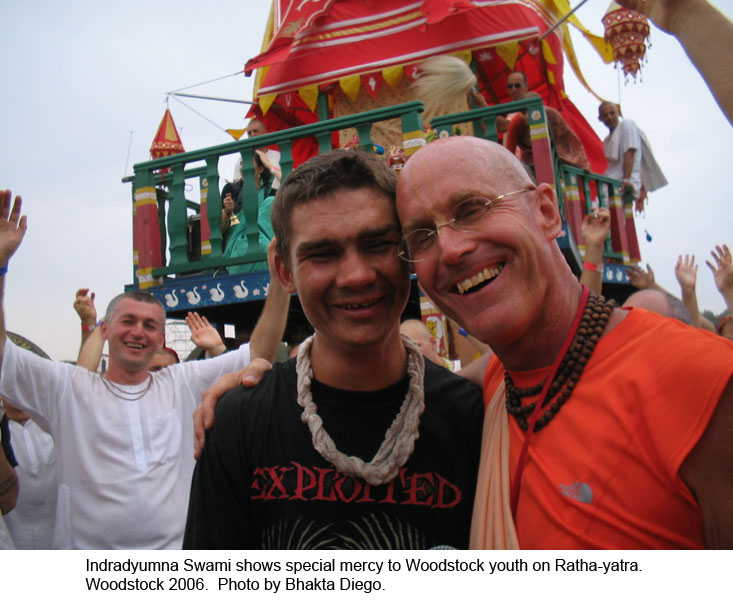
Nanda Kumara Prabhu recalls seeing how much love the boy Maharaja gave special mercy to showed for Maharaja as he participated in the final kirtana. Nanda Kumara starting picking up trash during that kirtana , and some of the appreciative young people helped him. People were always coming up to the devotees at all times in all places asking nice questions. We need more Polish speakers everywhere to answer them for next year.

Our security department had the realization that if you have bands play music that is too heavy, it brings out anger in the drunken people, and results in fights. Apparently there were two such bands like that, who were good musicians, some of whom were devotees, but whose music stirred up some people's anger. Once someone attacked the speaker in the questions and answers booth, late on the final evening. So for next year some adjustment will have to be made.

As for my realizations, they are spread throughout this story. The quote from Mother Theresa from Kolkata painted on the stairwell of the Kostrzyn school again comes to mind. "The greatest joy is to give to others." And what to speak of if the gift is love of God, the eternal gift, and the way to attain it. Lord Caitanya has descended to give the highest benediction of love of God to the most unqualified people. To be connected with His auspicious mission is the supreme benediction.

"The fruits [of devotional service] ripened and became sweet and nectarean. The gardener, Sri Caitanya Mahaprabhu, distributed them without asking any price. All the wealth in the three worlds cannot equal the value of one such nectarean fruit of devotional service. Not considering who asked for it and who did not, nor who was fit and who unfit to receive it, Caitanya Mahaprabhu distributed the fruit of devotional service. The transcendental gardener, Sri Caitanya Mahaprabhu, distributed handful after handful of fruit in all directions, and when the poor, hungry people ate the fruit, the gardener smiled with great pleasure" ( Sri Caitanya-caritamrita 9.27-30). So my realization is that the great gardener Sri Caitanya Mahaprabhu smiled with great pleasure to see the otherwise unfortunate, drunken people singing and dancing and pulling the cart of Lord Jagannatha, and by His smiling glance, everyone connected with the event became blissful.

Saturday, July 29, 2006

Questions and Answers: What is it like in Heaven?


We had Ratha-yatra at 11:30 a.m. which turned out to be the final one. As is often the case with Ratha-yatra, it was rainy lightly minutes before we were to leave, but it cleared up and was even sunny. I realized it was possible to chant, dance, and distribute flyers at the same time, so I was doing distribution probably half of the time. I know how people benefit from our festival, and thus I took pleasure in promoting it.

The Ratha-yatra went late and Maharaja decided to cancel the second Ratha-yatra altogether, not even replacing it with a harinama. Some of us who like harinama were disappointed, so we organized another harinama anyway. We knew Maharaja would not mind if we went out and distributed a few more thousand flyers and gave tens of thousands of people the chance to hear the holy name and dance in kirtana again. I wanted to do my questions and answer slot, so I could not go when the others had felt it best to schedule it, but I was happy just to encourage the devotees to do it. They went out for an hour or so and continued chanting for an hour and a half in front of the Ratha-yatra after they returned to our site. At the site, many young people, and an occasional older person, chanted and danced with us in great happiness. It was so nice to see.

My second day in questions and answers someone asked about what it is like in heaven. I explained to the audience that there is a difference between heaven and the kingdom of God. Heaven has a better standard of enjoyment than we have. Even in this world, there are heavenly places. For Americans, Hawaii is such a place, where it is always warm, there are many fruits, and beaches, etc. So heaven is like Hawaii but much, much better. But in heaven, the conception of being the enjoyer is still present. In the kingdom of God, everyone gives pleasure to God, and that is their great pleasure. In heaven, service to God exists, but there is also a sense of being an independent enjoyer. Then a young man asked, "Why perform so many austerities to go to a place that is just like here although with a better level of enjoyment?" I said, "You are intelligent. You have understood. It is much better to strive to go to the eternal kingdom of God." As in past years, someone always has some impressive realization, not something you would expect from a drunken youth, and it makes the service inspiring just to witness it. I am sure I wasn't smart enough to pick up on something like that at that age.

Izabela and Mikal came to questions and answers every day and listened to the bhajanas we had in the bhajana tent. On the last day Mikal inquired from me about the difference between the two Bhagavad-gitas we had, and I encouraged him to get the unabridged Bhagavata-gita As It Is or as they say here, Bhagavad-gita Taka Jaka Jest. He considered that 60 zlote ($18) is a small price for such a book. In the U.S.A . we sell them for $10, perhaps because we print a large quantity in English, and so they are cheaper. Mikal surprised me by saying he would like to travel with our tour for a couple of weeks next year. I didn't realize how much he was attracted to our programs. I said we had certain standards like no meat eating, intoxication, illicit sex, and gambling, and I thought some commitment to chanting was required, so I suggested he get to know the local Krishna group in his area first, and went to find Trisama Prabhu, nama-hatta leader. He came and talked to Mikal. Apparently Mikal is from the same town as Dorota, my translator from my first Woodstock festival in 2001. I told him Dorota's hours in questions and answers and her email address so he could get in touch with her, and later noticed that Mikal and Izabela came to hear her speak in the Q & A tent.

After the final kirtana by Indradyumna Swami which had caught the rapt attention of one-third to one-half our large tent, engaging most in dancing, I went to the bhajana tent to hoping to continue till 5:00 a.m. We just had chanted for ten minutes, and got the microphones and harmonium set up when our security people said we had to stop because it was not safe enough. I was aware we had security people guarding our place the whole night and I thought that was sufficient, but there were more incidents of physical violence this year, so they wanted to be strict about it. It was a great disappointment to me because I always like to stay up till sunrise (5:00 a.m.) as we did three and four years ago. The people who come always appreciate it and for me it is a small sacrifice to give grateful people a little more mercy.

Just minutes before we left someone stole my shoes, which is indicative of the mood of some of the more drunk people. The loss of the shoes was a benediction as they did not fit properly and gave me so many blisters I only wore them half the time. Now I will be forced to buy some new ones.

Friday, July 28, 2006

Singing and Dancing at Woodstock Festival


I slept three hours as it is hard for me to sleep when day has come and others are up. I was able to chant my rounds, take breakfast, and use the Internet for half an hour before Ratha-yatra. That Indradyumna Swami lead kirtana a lot was a nice feature of this year's Ratha-yatra. All the devotees were really enlivened and the Woodstock youth picked up on the mood, many of them dancing with the devotees. Maharaja showed some special mercy to one guy who looked really out of it, and the guy miraculously became really enlivened. Maharaja engaged him in sweeping in front of the cart, in dancing, and Maharaja finally embraced him. That boy came to all the Ratha-yatras and the final kirtana on the last day, and appeared very happy and in a sober condition.

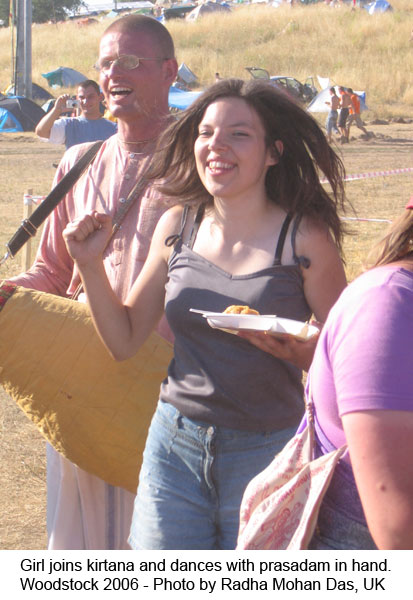
After the Ratha-yatras the kirtana would continue for some time. One girl had just gotten a plate of prasadam, when she saw the kirtana in front of the Ratha-yatra cart. She ran over to the cart and began dancing ecstatically with the devotees, with a big smile on her face, still holding the plate of prasadam in her hand!

Later in the day I talked to one girl who was committed to her Catholic religion but a little curious as well. She could understand English, but could not speak English. I would talk to her in English, and she would talk to her friend in Polish, and her friend would talk to me in English. She asked about our purpose in coming here. I said our main purpose was to people to benefit spiritually. We were not just trying to convince people of our spiritual path, but if they didn't have one, we would advocate ours. I mentioned about the Catholic Saint Francis who considered that the animals were his brothers and sisters, and that we thought it would be better if Christians adopted that exemplary mentality. In the course of the discussion she made the point that the giving up intoxication and meat eating is consistent with the actual teaching of the Bible, but it is hard to follow so no one does. I made the point that that is the main problem with religion. People claim to belong to a certain religion but do not actually follow the principles of the religion, and thus they do not get the promised spiritual advancement.

On Friday, we had an evening harinama instead of Ratha-yatra, probably because of the crowded conditions. Many young people chanted and danced as usual. Once we went back and forth through rows of tables crowded with people drinking beer. As our lively party of dancers passed, two girls dressed in black, eagerly got up from their table, beer cans in hand, and began dancing with the devotee girls at the front of our harinama party. They learned the dance steps by imitation, and after twenty minutes or so, they had either finished their beers or through them away to concentrate on their dancing. When our party stopped in one place for fifteen minutes or so, the girls followed the movements of the female dancers from Bali, this year's attraction at our stage shows at our festivals, and learned them as well. I had to take a break to go to the questions and answers service, which I found was preempted by more ambitious devotee, but when I got back after the half an hour or so, those two girls were still dancing with our party. At one point, the devotee girls' gave them their own flower garlands to wear. They ended up staying until we returned to Krishna's Village of Peace and continued chanting there for twenty minutes or so until the kirtana ended. While we chanted and danced before Lord Jagannatha and his brother and sister atop their chariot in the center of our village, Indradyumna Swami sprayed the hot chanters and dancers with a mist of water from the hose, enlivening them and cooling them off.

I was dancing to the final kirtana on the main stage, and a boy approached me with great feeling and said, "Remember me?" I have such a bad memory for faces, so I didn't and so just stared blankly. Then he said, "You gave me a plate of food last year." Then I remembered. I was dancing in kirtana and this boy wanted something. The volume of the music was so loud, I could not understand what he wanted, so we went outside to talk. He told me he wanted some free food, so I made a plate of whatever the devotees had for lunch and gave it to him. I was delayed for sometime, but he was still waiting for food, and he was very thankful. This year he remembered the event with the same gratitude. He said of all the Americans he knows, I am the best. (Of course, he does not know Indradyumna Swami.)

In previous years when we had more space, we had continuous kirtana in both a temple tent and a meditation tent. This year, neither were planned, thus some of us felt a lacking. Even some of the people coming to our festival wondered where the temple and meditation tents were and lamented their absence. At Shanti Parayana Prabhu's suggestion and with his encouragement, we turned the yoga tent into a bhajana (devotional songs) tent from 9:00 p.m. to 3:30 a.m. We often had between thirty and forty people, with five to fifteen dancing in the center. Several people chanted the mantra for over an hour, some smiling the whole time. Indradyumna Swami came by around 3:00 a.m., after Black Summer Crush, a band he had invited from America, had finished on the Woodstock main stage. Their final song was a Hare Krishna tune, heard by hundreds of thousands of people. When Indradyumna Swami came by our tent a peaceful devotee lady named Jana was singing. Later he told me he liked her singing. I hoped to continue our singing in the yoga-turned- bhajana tent to 5:00 a.m. (sunrise) on the final day, and I promised some of my friends we would do this.