Diary
of a Traveling Sadhaka, Vol. 9, No. 9
By Krishna-kripa das
(May 2013, part one)
By Krishna-kripa das
(May 2013, part one)
Holland,
London, The North of England, Northern Ireland
(Sent
from London, England, on June 13, 2013)
Where
I Went and What I Did
After
the Queen’s Day harinama,
I
stayed in Amsterdam and did harinama
for
three days. Then I went to Rotterdam for two days of harinama
and
a Saturday feast program. Next I went to Den Haag (The Hague) for an
afternoon of harinama
and
a Sunday feast. Finally I returned to Amsterdam for harinama
in
Vondel Park. Then I did a day of harinama
in
London, harinama
and
a nama-hatta
program
in Sheffield, and went back to Newcastle, my summer base, where I
stayed for four days of harinama
and
the Sunday feast lecture. Then I went on to Northern Ireland, where I
chanted with Ananta Nitai Prabhu in Belfast for one day, and with
both Ananta Nitai and Bhagavata Dasi in Lisburn, Bangor, Newry, and
Hillsborough, all cities within an hour of Belfast, for the next four
days. Thus it was a very busy time for me.
I
share notes from Srila Prabhupada’s wonderful lectures and books.
This month I had the opportunity to hear several classes by
Kavicandra Swami, who remained in Amsterdam as long as his schedule
would permit at the request of Kadamba Kanana Swami, who is always
desirous of developing our outreach there. Kavicandra Swami is very
perceptive and made lots of beautiful points in his classes which I
share.
Thanks
to
Sanatani Devi Dasi for the photo of our Amsterdam harinama,
onlooker
John Doherty for the Hillsborough, Northern Island, picture of our
harinama
party, the web site http://www.discovernorthernireland.com
for the picture of the Hillsborough Tourism Centre,
and an unknown passerby, who took our picture in Lisburn, chanting in
front of the party shop.
Harinama
in Amsterdam
I
went on harinama
for
the entire week I spent in Holland, and only on the final day did I
have go out alone. The weather was practically perfect the whole
time. The first day we went out with Kavicandra Swami, who came out
every day, and with some devotees from Scandinavia, who had come for
the Queen’s Day harinama.

Another
day on harinama
two
people joined our party at different times and chanted and danced
with us. Tulasi Prabhu, a brahmacari
book
distributor from Bulgaria, later talked to one of these young men,
who commented that he was curious what it was all about and purchased
a Bhagavad-gita.
Those
are my favorite harinama
experiences,
when people become so interested they want to read the books.
The
final day I spent in Amsterdam. I went out alone. I chanted as I
walked through the streets for an hour and a half as went to and from
Vondel Park, which Srila Prabhupada visited and in which gave a
lecture many years ago. I chanted in the park itself for another
three hours. One policeman called me over as soon as I got there, and
I worried that I was not allowed to use my amplifier or I had done
something else wrong, but he had no issues with me. While we talked,
he mentioned he liked it on Queen’s Day when the group of us
chanted together there by the museum where all the people were. I was
pleased to hear a rare appreciation of the chanting from a cop.
Rotterdam
and Den Haag
Sivananda
Sena Prabhu and his wife, Moksa Lakshmi Devi Dasi, are disciples of
Janananda Goswami, and like him, they have a fondness for promoting
the congregational chanting of the holy name of the Lord in public.
Thus they invited me for three harinamas
and
two programs in Rotterdam and Den Haag.

They
regularly do two hours on chanting in Rotterdam on Fridays starting
at the central train station at 7 p.m. They go to a crowded section
with lots of shops.
Different
onlookers were attracted and participated in dancing with the party.


I
led half the kirtana
at the Saturday feast program in Rotterdam
to
let some of the others have some of the action.

In
Den Haag there are two ISKCON temples. One I went to back in 2010,
and the other I went this year. Before the Sunday program, we did
harinama for
over an hour in a local park, and several people happily danced.

The
weather was excellent, and many people were happy to encounter the
happily chanting devotees.
A
Muslim family enjoyed dancing with us.

And
other individuals did too.


London
In
London one young French lady came to the temple one evening, and
Erzsebet from Hungary, who is enthusiasm personified in outreach,
sold her a book which she read that very night. She returned to the
temple the next day and came to the lunch program lecture which I
gave. Later I asked the devotee lady who talked to her during the
lunch if the class had been beneficial for her. She said the French
lady said she really liked the idea that we can have one of five
relationships eternally with Krishna. The devotee lady asked her
which one she liked, and she said she would like to be the friend or
lover of Krishna eternally. I had spoken on the verse where Krishna
states that he will reciprocate with us according to how we surrender
to him. In his purport Srila Prabhupada writes, “One devotee may
want Krishna as his supreme master, another as his personal friend,
another as his son, and still another as his lover. Krishna rewards
all the devotees, equally according to their different intensities of
love for Him.” (Bg. 4.11, purport) I will keep this verse in mind
as a good one to give introductory classes on that might attract one
to Krishna. The French lady lives in Paris and shared contact
information with devotee who spoke to her at lunch, so hopefully her
interest will develop, and she will visit our temple there.
Sheffield
I
chanted in Sheffield alone before the Wednesday nama-hatta
meeting.
Some people appreciated but one lady harassed me so much to give her
a pound fifty for the bus, that I finally did so just to get her to
go away.
It
was nice to see a couple new people had become regulars at our
Sheffield program since last year.
Leeds
Farmers Market Harinama
My
bus from Sheffield to Newcastle had a forty-minute rest in Leeds, and
as we pulled into the coach station there, I noticed it was right
next to the Leeds Farmers Market. When the bus stopped I learned of
the break, and the bus driver advised me to go to the farmers market
to get a bite to eat. I decided to go, not to shop, but to sing.
As
soon as I sat down to saing, someone said, “Haribol!” And someone
very soon gave a donation.
Newcastle
Area Harinamas
I
chanted in Newcastle, and different devotees would come out with me
at different times. I would put out a hat to collect donations when
we stayed in one place, and I would offer invitations and books to
those who gave something, no matter how small. Because not everyone
would take a book, I got enough in donations to pay for the books
that were distributed. It was nice to always see books going out

The
weather was wild. Some days were in the 40s F (5 to 10 C), and with
winds from the north at 20 mph (32 kph).
In
Sunderland we had four devotees, three singing and one distributing
books. In addition, I was able to distribute three books myself by
asking people who put money in the hat if they wanted one. We chanted
about an hour and forty minutes. I like Sunderland because there are
lots of people and always a few favorable ones. Kadamba Kanana Prabhu
from Hungary had not been on harinama
for
ten years, and he was very happy he came out. One young lady who
chanted with us got a call from a friend in London who asked if she
was singing in Sunderland because someone had taken a video of her
singing and put it on Facebook. Her friends from her hometown of
Sunderland did not know much about her relationship with Hare
Krishna, at least until now.
In
Newcastle on Sunday, Bhakti Rasa and his wife, Kirtida Prabhu, came
out, and we happened to meet Ekacakranatha Prabhu on the way.
We
chanted three hours all together. People danced to the music, like
these four guys below.

Harinamas
in North Ireland
When
my friend, Caitanya-candrodaya Prabhu, was temple president of
Belfast, I got in the habit of going there and doing harinama.
Devotees
had occasionally talked about us chanting in different places around
Belfast, but it did not happen until this year.
Monday
Ananta Nitai Prabhu, who traveled by bus from Dublin, and I who
traveled by plane from Newcastle, arrived at the Belfast temple
within five minutes of each other. We were greeted by Bhagavata Dasi,
our harinama
partner
from Govindadvipa, who moved back to Belfast and promised to take us
out on harinama
in
her car the next four days. We were also greeted by all kinds of
maha-prasadam,
the
opulence of a small temple. That day just Ananta Nitai and I went out
to Belfast city center to chant for three hours. While traveling
there by bus, the sun was shining, but as soon as I got off the bus,
it started to rain. We found a sheltered spot to chant, and were
greatly relieved when the sun shone again. But that was not for long.
Soon it rained again. But again we were relieved when the sun again
shone. During that harinama,
the
sun came out four times and it rained five times! As I walked back to
take the bus home, chanting on the way, it was raining, but on the
bus itself, the sun came out! That was the craziest weather I had
experienced recently, but we were able to keep the chanting going the
whole time, and collect donations and give out books and invitations
as well.
On
Tuesday, Bhagavata took us to Lisburn, about 15 minutes from the
temple. We chanted on a main street and several groups of people
stopped to watch at different times. At one point, we chanted under
the sign of former birthday party shop underneath its sign “Pure
Party.”
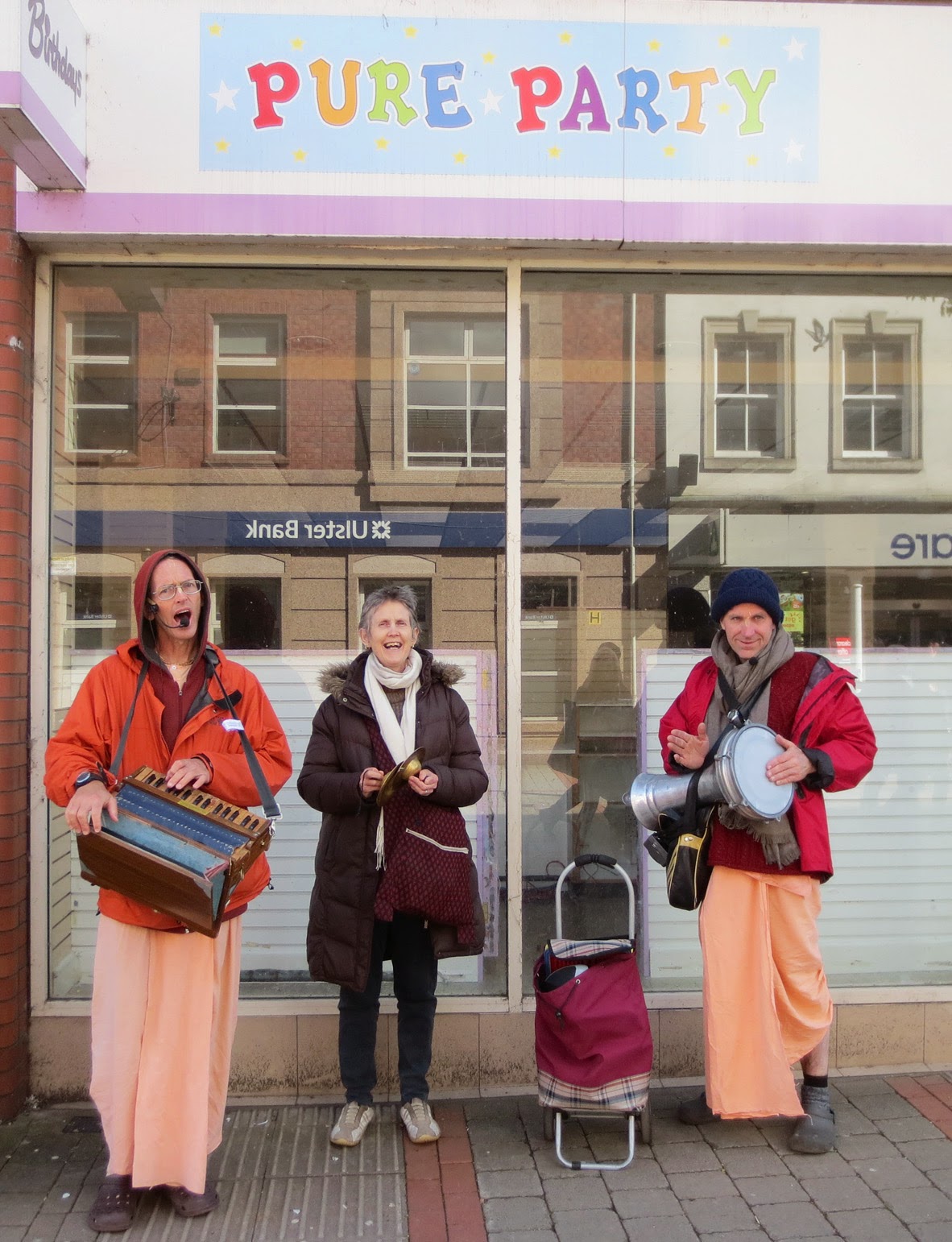
The
congregational chanting is glorified by Lord Caitanya “cleansing
the mirror of the mind,” and being “the nectar for which we are
always anxious.” It is described by Narottama Das Thakura as
imported from the spiritual world. For these reason, I thought “pure
party” was a great description of harinama.
We
found some teenage kids hanging out, and we sang in their midst for a
while. I would have never done it myself, but the other devotees were
better at dealing with kids than me, so I went along with it. At one
point, the kids decided to harass us. Some of the more rowdy ones
placed some nearby road construction barricades to surround our
party, and they started throwing empty plastic bottles at us. We just
kept chanting, and one of them decided to remove the barricades and
throw the bottles in the trash so the other kids could not through
them at us any more. Later someone asked us about our philosophy and
one girl, who took pleasure in singing the whole mantra with us, gave
us each some candy when she left. On the whole, the kids became more
favorable as time marched on.
Since
we had stopped chanting before we finished my quota of three hours,
Ananta Nitai and I chanted in the parking lot of a store while
Bhagavata did some shopping for the temple. We chanted for half an
hour, and no authorities asked us to move, and some favorable people
came by.

Wednesday
we chanted in Bangor, and a passerby gave 10 British pounds for a
Bhagavad-gita
and
a Sri
Isopanisad. We
chanted next to a butcher shop, and employees came out of the shop
and looked at us from time to time but said nothing. After we chanted
two and a half hours, a policeman came and explained that he had no
problem with our singing, but some local vendors were complaining,
and he told us of a couple other places where we could sing and would
not get into difficulty. He was the most polite policeman who had
ever asked us to move, and Ananta Nitai Prabhu gave him a small book
which he accepted.
Thursday
we chanted in Newry on a day where rain often threatened but was
never so severe we had to stop. At several times groups of teenagers
would sit behind us and move with the music.
On
Friday we chanted in Hillsborough, a town of 3,400 people, where
there was that day the Garden Show Ireland, an open house at the
gardens of the Queen’s Hillsborough Castle.

John
Doherty, an open-minded man, with both Catholic and Protestant
connections, was attracted by our party and its chanting,
appreciating its religious connection, and he took pictures of us,
which he later send to me by email.
Often
I give my business card to photographers who take pictures of us and
ask them to send me the photos. They actually send me the photos 20%
of the time at the very most, but in North Ireland and the Republic
of Ireland people sent me the pictures two out of three or four times
I asked for them.

A
man behind the counter at tourist office, said to me, “Hare Krishna
is from North India, isn’t it?"” I explained that the
chanting we do in the streets, which we were doing outside his office
for the last hour, started in Bengal. He inquired further, “And
what is the name of the town in Bengal?” And I replied, “Mayapur.”
And he said with a smile of recognition, “Oh yes, Mayapur!” Wow!
I couldn’t believe it! In this tiny town in this remote land
someone had heard of Mayapur, the birthplace of Sri Caitanya
Mahaprabhu! Apparently the man spent some time in Kolkata and had
eaten at our Govinda's Restaurant there. It is a small world!
The man also knew of Inis Rath island and their Sunday feast, and the lady in the office lived in Dunmurry, the Belfast suburb where our temple is, and she knew of our Sunday program there.
The man also knew of Inis Rath island and their Sunday feast, and the lady in the office lived in Dunmurry, the Belfast suburb where our temple is, and she knew of our Sunday program there.
After
Hillsborough, Ananta Nitai Prabhu and I boarded a bus for Dublin to
continue our harinama adventures
there
Insights
Srila
Prabhupada:
from
Srimad-Bhagavatam
4.28.31,
purport:
“We
have already started the International Society for Krishna
Consciousness, and many thousands of Europeans and Americans have
joined this movement. Indeed, it is spreading like wildfire. The cult
of Krishna consciousness, based on the nine principles of devotional
service (sravanam
kirtanam visnohsmaranam pada-sevanam/ arcanam vandanam dasyam sakhyam
atma-nivedanam
[SB 7.5.23]), will never be stopped. It will go on without
distinction of caste, creed, color or country. No one can check it.
from
a lecture on Srimad-Bhagavatam
5.5.2 given in London on September 17, 1969:
“The
devotee aspires only to make friendship with Krishna. . . . The
devotee’s only lovable object is Krishna.”
from
a conversation in Durban, South Africa, in October 1975, printed in
Back
to Godhead, Volume
47, No. 4, p. 44:
Disciple:
The
scientists always say,“Last
year we made a mistake, and now it’s all right.”
Srila
Prabhupada: Hmm.
“Now we are advanced.” And what is the guarantee that your
present theories are correct? You will advance again. That means you
are always incorrect.
Jiva
Goswami:
from
his Gopala Campu:
Krishna
stole the gopi’s
cloth and their hearts and only returned their cloth. He did not
return their hearts but hid them.
Srila
Bhaktisiddhanta Sarasvati Thakura:
from
his Amrita
Vani, quoted
in Back
to Godhead, Volume
47, No. 4, p. 67:
We
should show compassion toward all living entities, develop a taste
for chanting the Lord’s names, and serve Vaishnavas. These are
Mahaprabhu’s three principal
instructions.
Kavicandra
Swami:
Another
one of my godbrothers, Kesava Prabhu, left his body the other day. He
is famous for book distribution. As president of the San Francisco
temple, when he heard that Buddhimantra Prabhu had distributed twenty
Krishna
books
one day, he sent Buddhimanta with a van loaded with Krishna
books,
saying, “Do not return until the van is empty.”
One
dying devotee told some elementary school students, “I am dying”
which was a shock to them. Then he continued, “but you might die
before me” which shocked them even more [although it was certainly
possible].
Ramachandra
Khan wanted to defame Haridasa Thakura by sending a prostitute to
break his vow of celibacy, but when Haridasa Thakura remained
undisturbed and engaged the prostitute in pure devotional service to
the Lord, he became more famous than before. Thus Ramachandra Khan
was foiled in his attempt.
Ruci
means
having such a taste that you cannot stop chanting.
I
watched many people from the crowd who were chanting at Queen’s
Day.
In
Tel Aviv many people dance with us.
In
Puri Lord Caitanya sent people in groups of five to chant in front of
people’s homes.
Although
one newspaper article spoke critically of the devotees, Srila
Prabhupada liked it because “Hare Krishna” was mentioned so many
times. The offense is temporary, but the benefit of chanting the holy
name is eternal.
The
parents of one girl from Greece studied in London and heard the
devotees chant on Oxford Street every day. Her father would sometimes
bang on pots and jokingly say “Hare Krishna.” Later when she grew
up, that girl was attracted to join the harinama
in
Greece and became a devotee.
Srila
Prabhupada wanted many pictures to illustrate the Krishna
book.
He called them “windows to the spiritual world.” We would just
show people the pictures in the books and tell the people, “these
are windows to the spiritual world” and people would be amazed and
buy the books.
Q:
What gives us the taste for devotional service? What causes us to
lose it?
A:
Sadhu
sanga sadhu sanga . . . By
the mercy of the devotees one gets a taste for devotional service,
and by offenses, especially offenses to devotees, one loses his
taste.
The
reasons a person falls down are the same, whether one is a sannyasi
or an ordinary person.
When
the Fifth Canto came out, many people left the movement. Some say it
was because of the cosmology of the Bhagavatam,
but
I think it was the verses and purports that destroy the illusion of
the pleasure of material sex life, which are great to read for one
who actually wants to be renounced.
I
think that the word “bloop” which in the Hare Krishna movement we
use to mean to leave the spiritual path and return to materialistic
life comes from the phrase “one falls down again into the material
pool,” the word “bloop” being used in comics when an object
falls into a pool of water. That phrase comes from a description of
process of degradation in Bhagavad-gita
2.62–63:
“While contemplating the objects of the senses, a person develops
attachment for them, and from such attachment lust develops, and from
lust anger arises. From anger, complete delusion arises, and from
delusion bewilderment of memory. When memory is bewildered,
intelligence is lost, and when intelligence is lost one falls down
again into the material pool.”
People
recognize that anger is bad and so they have classes to control
anger, but unfortunately they do not have classes to control lust,
which according to Bhagavad-gita
2.62,
is the cause of anger.
In
an art museum, when you see a beautiful piece of art, you glorify the
artist, but when we see the beauty of nature, we do not glorify God,
who is the artist. That is not right.
We
are supposed to love people and use things, but in this degraded age,
we love things and use people.
If
you are facing the sun, you do not see the shadows, but if you face
away from sun the shadows will be there. Similarly if one is facing
Krishna, there will be no illusion for him.
Bhaktisiddhanta
Sarasvati Thakura said some people say that Haridasa Thakura missed
out on so many of the Lord Caitanya’s pastimes because he was
always chanting, but because the holy name contains all the pastimes,
that was not a fact.
In
Japan when I would sell books, everyone said, “I am in a hurry. I
have no time.” So I would say, “I am in a hurry too. Give me a
donation quickly.” Many times people quickly gave me a donation.
If
any other avatar of Krishna asked the demons for the nectar of
immortality they would have fought Him for it, thus He appeared as a
most attractive woman, and the lusty demons eagerly gave Her the
nectar voluntarily desiring to please Her.
It
appears that the devotees are also dying, but they do not have to
accept another material body or suffer hellish punishment. They go to
Krishna and live with Him forever.
The
Hare Krishna mantra is the sword to cut the knot in the heart binding
us to this body and this world.
Different
people interact with the harinama
party
for different reasons, but they all are benefited.
When
people get back from their vacations they have seen Hare Krishnas in
London, they have seen Hare Krishnas in Amsterdam, and they have seen
Hare Krishnas in Berlin.
Success
means getting what you want. Happiness means wanting what you get.
If
someone experiences a trauma they cannot get beyond, going to another
place that does not remind them of the trauma helps.
Before
Jahnava Mata, the eternal consort of Lord Nityananda Prabhu, would
leave to travel to a new place, she would always ask the permission
of the deity.
It
is an important teaching of Lord Caitanya and all other spiritual
teachers that one is judged by his qualities and activities, as
Krishna mentions in Bhagavad-gita,
and not by one’s birth. In Vrindavan, there are still brahmanas
who
will not eat with us Western mlecchas
or eat grains cooked by us.
One
of the first pollutions of the age of Kali is that the brahmanas
say that one is a brahmana
by
birth and that a non-brahmana
can
never become a brahmana.
Sarvabhauma
Bhattacharya tried to teach Mayavadi philosophy to Lord Caitanya, but
Lord Caitanya ended up teaching Vaishnava philosophy to him.
The
nondevotees cannot see Krishna so they take for granted that the
devotees’ activities and their own activities are the same.
Both
Bhakti Tirtha Swami and Devamrita Swami read Srila Prabhupada’s
books and liked them, but when they first encountered the devotees,
they thought the devotees were crazy.
Some
say japa
is
just for ourselves, but a real Vaishnava does not think like that. He
sees that his sadhana
is
meant for becoming empowered to help others.
Here
in Amsterdam the people appreciate us. They do not know what we are
doing, but they like it. Someday in the future, maybe a future
lifetime, they will become devotees because of that appreciation.
Satyaraja
Prabhu:
Many
people don’t know this, but John Paul II confirmed that
according to the teachings of Christianity that animals do indeed
have souls. In 1990 he said that all creatures were given the “breath
of life” by God, just like humans were. (See
http://www.dreamshore.net/rococo/pope.html)
Urmila
Devi:
from
her article “The Swirling Smoke of Fragrant Love” in Back
to Godhead, Volume
47, No. 4, p. 48:
“The
most opulent
arcana
[worship of the Lord in his deity form] consists
of sixty-four items; the most simple, five items.” In every list,
offering incense to Krishna is included. Incense is part of worship
of the Lord and His representatives in the scriptures of many of the
world’s traditions. For example, when Jesus was born, the wise men
brought the child gifts of frankincense and myrrh.
Ananta
Nitai Prabhu:
Kirtana
means
glorification of the Supreme Lord, Vishnu, not any demigod.
Qualified
personalities curse people for their benefit not for revenge.
On
the harinama
yesterday
the kids did strange things like surround us with barricades and
throw bottles at us, but one of the them, who was more pious, removed
the barricades and put the bottles in the recycling bin so his
friends could not keep throwing at us. Some of the kids ultimately
chanted, gave us sweets, and inquired about what we were doing. So by
association, they came up to a higher level of consciousness and
activity.
On
book distribution one lady claimed she had so many spirituals books
she did not need a Bhagavad-gita,
so
I asked her if she would give me a banana in charity. As she went to
get the banana, because she knew I was monk, she asked if I accepted
donations, and I said, “Yes.” She returned with two bananas, two
apples, and five-pound note. I presented her with a Bhagavad-gita,
telling
her to read at least the introduction and chapter two. And she smiled
and said, “Thank you.”
from
a conversation:
The
worst anartha
[undesirable
quality] is to think you have no anarthas.
I
have a couple devotee friends from England who were getting married
about the same time and loved harinama.
They
both told their respective wives-to-be, “I like harinama
so
much that if you are not interested in it, you should go and marry
someone else.” Both wives accepted the condition, and both couples
have gone on harinama
practically
every weekend for the past eight years and are really empowered
because of it.
Navina
Syama Prabhu:
from
his article, “Sherlock Holmes and the Limits of Modern Knowing”
in Back
to Godhead, Vol.
47, No. 4, (Jul/Aug 2013):
“For
one exploring religion and seeking
absolute knowledge, this uncertainty [of knowledge based on
induction] is unacceptable. If it turns out that my theory about the
migration
pattern of humpback whales is wrong, I might be a little embarrassed,
but life will go on. If my understanding of God is off, on the other
hand, the fate of my eternal soul hangs in the balance.” (p. 14)
“It
is interesting to note that reliance on knowledge from authority is
commonplace in modern society (e.g. students listening to teachers at
school, viewers listening to news reporters on television), but that
the approach is generally abandoned in spiritual matters.” (p. 15)
-----
etavan
eva loke ’smin
pumam
dharmah parah smritah
bhakti-yogo
bhagavati
tan-nama-grahanadibhih
“Devotional
service, beginning with the chanting of the holy name of the Lord, is
the ultimate religious principle for the living entity in human
society.” (Srimad-Bhagavatam
6.3.22)


