Diary
of a Traveling Sadhaka, Vol. 10, No. 5
By Krishna-kripa das
(March 2014, part one)
By Krishna-kripa das
(March 2014, part one)
Mayapur,
Rishikesh, Delhi
(Sent from Kolkata, India, on March 27, 2014)
(Sent from Kolkata, India, on March 27, 2014)
Where I Went and What I Did
The
first four days of March I stayed in Mayapur participating in Kirtan
Mela, harinamas, and the
elephant procession. Then I had
a very eventful journey to Rishikesh with a lot of unexpected kirtana
opportunities. In Rishikesh,
Navina Nirada Prabhu had arranged a program of a week or so of up to
six hours of harinama, book
distribution, and prasadam distribution
each day. Next I spent a couple days at ISKCON Punjabi Bagh in Delhi,
chanting on the train, the train station, and temple the day I
arrived and for three hours in Rohini with a group of devotees the
day before Gaura Purnima. I also gave a lecture on Lord Caitanya,
which some people really liked, and which you can hear at this link:
https://docs.google.com/file/d/0B8G_-3HDls9WSlBaM0Z0UXlpdVU/
I
share many, many beautiful quotes from Srila Prabhupada’s books and
lectures, excerpts from Satsvarupa Dasa Goswami’s journal, notes on
lectures given in Mayapur by Lokanath, Niranjana, and Radhanath
Swamis and Dravida Prabhu, and notes from lectures given in Rishikesh
by Ekalavya, Janardana, Mahabhavi, and Caitanya-candrodaya Prabhus.
Thanks
to Navin Shyam Prabhu (Philadelphia) for his kind donations from his
federal and state tax refunds. Thanks to Caitanya-candrodaya Prabhu
(Dublin) for his kind donation and his purchasing of many clothes and
other supplies to make up for what I lost by leaving my bag on a
train. Thanks to Mohnish Goel (Delhi) for his kind donation and for
assisting me at Punjabi Bagh. Thanks to Navin Nirada Prabhu for
paying for the Radha-Madhava maha-prasadam I distributed to,
from, and at Rishikesh. Thanks to Punjabi Bagh temple commander for
the box of maha-prasadam sweets he gave me when I left.
March 28 – March 30 - Kolkata
March 31–April 13 - Mayapur
April 15–16 - Mumbai
April 17–24 - Dublin, Belfast, etc.
April 25 - London
April 26 - Kings Day, Amsterdam, The Netherlands
April 27–30: The Netherlands
May 1–2: Manchester, England
May 3–5: North UK Retreat
May–July (first two-thirds) – The North of England, Birmingham 24-hour kirtana, London Ratha-yatra, Stonehenge Solstice Festival
July (last third)–August (first two-thirds) – Baltic Summer Festival, Polish Woodstock, Czech Woodstock
August (last third)–September (first half) – The North of England September (rest) – New York
Itinerary
March 28 – March 30 - Kolkata
March 31–April 13 - Mayapur
April 15–16 - Mumbai
April 17–24 - Dublin, Belfast, etc.
April 25 - London
April 26 - Kings Day, Amsterdam, The Netherlands
April 27–30: The Netherlands
May 1–2: Manchester, England
May 3–5: North UK Retreat
May–July (first two-thirds) – The North of England, Birmingham 24-hour kirtana, London Ratha-yatra, Stonehenge Solstice Festival
July (last third)–August (first two-thirds) – Baltic Summer Festival, Polish Woodstock, Czech Woodstock
August (last third)–September (first half) – The North of England September (rest) – New York
Mayapur
Kirtan Mela
To
have many enthusiastic devotees from all over the world singing
together in front of Panca-tattva is certainly a recipe for a
successful event. The organizers did a good job trying to make it
comfortable for everyone. For those who found it too crowded in the
temple room, video of the event was displayed on TV monitors and
projection screens in the courtyard. You could get as much drinking
water as you wanted, whenever you wanted. At the end of the evening,
there were bags of puffed rice, if you were hungry. I look forward to
the new temple which will have more room to dance. Some of my friends
wished the Kirtan Mela could go forever. I appreciate their glorious
devotional sentiments. I am always physically exhausted by such
events, so it is difficult for me to desire they go on forever, until
I actually attain a spiritual body, although I like the chanting and
dancing and to see others also engaged in it.

Here
devotees delighted in swinging each other.

They
even danced while raised above the crowd by their friends.
The
Vanipedia devotees displayed a poster listing 64 benefits from
chanting Hare Krishna which Srila Prabhupada mentioned in his books.
The list is also to be found on their web site, along with the
context: http://vaniquotes.org/wiki/64_results_of_chanting_Hare_Krsna
More
Harinamas in Mayapur
The
regular Mayapur Harinama Party, which I have been involved with many
years, has a rickshaw with beautiful Gaura-Nitai deities, a
harmonium, and a sound system. During the Mayapur Festival,
additional devotees join their party from time to time.

Here
three girls take pleasure in dancing for Gaura-Nitai.

One
time Prithu Prabhu sang with the Mayapur Harinama Party.

Once
an elephant passed by us.
My
friend Deva Krishna Prabhu, a book distributor in America, brought
his college graduate daughter from Florida to Mayapur for first time.


The world harinama party, with singer and accordion player, Syama Rasa Prabhu, also did harinama every day.

One time they joined the Mayapur Harinama Party.
The world harinama party, with singer and accordion player, Syama Rasa Prabhu, also did harinama every day.
People would watch from the Chakra Building balcony above. Lots of people danced.

While moving through the Mayapur campus, the world harinama party met the Mayapur Harinama Party, doubling the ecstasy!

After passing them, we encountered the Padayatra harinama party with their oxen and cart with large Gaura-Nitai deities. All kinds of wild dancing ensued between the two parties. Thanks to Bhakta Brandon for taking the picture with me in it.
Mayapur
Hati (Elephant) Procession
The
festive Mayapur Hati (Elephant) Procession is part of Saturday night
life in Mayapur in the winter.

The small Radha-Madhava deities ride on the elephant.

The
big Gaura-Nitai deities are on a cart pulled by two bulls.

This
time some Chinese ladies danced in formation in front of the
party.

One beautiful feature of the festival is the colorful mandalas on the pathway made of dyes and flower petals.

One beautiful feature of the festival is the colorful mandalas on the pathway made of dyes and flower petals.

My
world harinama party friends
participated in the kirtana this
time, and they kept singing after the deities returned to the temple
and the procession had ended. Lots of people danced to the music.
Maha
Abhiseka of Panca-tattva
There
was a quite a queue to watch the
Maha Abhiseka
(Great Bathing Ceremony) of the Panca-tattva on the tenth anniversary
of their installation. The queue was at least half an hour long,
stretching all the way over to Vamsi Bhavan. People in the queue
could not view the abhiseka
very
long. It reminded me of viewing Balaji in Tirupati. Actually, there
were some devotees from Tirupati in the queue, and I joked with them
that this queue was insignificant compared to the 24-hour queues in
Tirupati. Some people stayed inside the temple, once they got in, and
they got a longer
view.
I just caught the bathing of the deities with water and drying off,
but still it was satisfying. Then I stood outside the door of the
Panca-tattva temple, in a place where you could see the deities and
where some devotees were dancing, and I danced in back of them.

While we were waiting in line to see the maha-abhiseka, several people brought us the tasty water made of dairy products, fruit juices, and sweeteners from the partially completed bathing ceremony to drink – a nice gesture of friendship that eased our waiting. Later also, people offered each other that caranamrita (bathing) water. The most striking thing is that there was a great feeling of purification after the event, as if a burden had been lifted from us, and the feeling continued that day and extended through the next. I shared that final perception with Krishna Ksetra Prabhu, who also agreed.
Bizarre
Journey to Rishikesh
I
booked a ticket from Bandel to Haridwar, and I made it to Nabadwip
Dham station in time to catch the Katwa Bandel local train to Bandel
so I thought I was doing really well. I had doubts about the platform
for Bandel and asked the person who sold me the ticket, and he told
me platform two. I recalled when I had come from Bandel on the same
train on the way to Navadvipa that we had come to platform two, so I
had a doubt that the train going in the other direction would be on
the same track. When the next train came, I said “Bandel?” to the
people and they indicated the affirmative, so I got on the train. One
couple with Vaishnava tilaka,
apparently
returning home from pilgrimage helped me find a seat and situate my
largest bag. I decided to play the harmonium and sing Hare Krishna
for awhile and then the Gaura arati
song. The
lady especially appreciated both and sang along. Because it was dark
and because I was playing the harmonium I was unable to monitor the
stations that we passed. The couple got off at the next to last stop,
and at the last stop I got off. I was shocked when the people told me
were in Katwa, almost an hour in the wrong direction.

I was so much in anxiety to find the next train to Bandel, I left with just three of my four items, leaving behind the largest, the bag with all my clothes. As I was boarding the train to Bandel realized this, and I went back and looked through the previous train in all the new carriages with the blue seats which I had been sitting in. I do not know why I could not find the bag. I looked twice, but when I returned to the Bandel train platform I found I missed it, and thus all hope of catching my train to Haridwar. I reported my lost bag to the police, and I decided to go to the internet cafe and check the alternative trains. In the process, I distributed maha-prasadam to those led me to the internet cafe and its owner as well. A lot of people said “Hare Krishna” to me when they saw me in Katwa. I found that the train my friends would be taking leaves from Howrah, five hours away. As I am not accustomed to staying in hotels, and I could not find a Hare Krishna temple or Gaudiya Math in Katwa on the internet, so I decided to try for a sleeper train, in hopes of sleeping the five hours to Howrah. It was too late to reserve a seat or bed, so I decided to buy a general ticket and upgrade it. Unfortunately, the train did not arrive until 1:00 a.m., an hour and a half late, and all the beds were allocated. While I was waiting for that train, a guy who was eager to “talk with an American” talked with me. In the course of talking, I explained how Katwa was a special place because Sri Caitanya Mahaprabhu, who he had known of, had accepted the renounced order of life, sannyasa. Actually I had never been to Katwa, and by accident I had come to this special city. Although no beds were available on the train, a railway policeman secured a seat for me, and I probably slept at most two of the five hours. After some people woke up and did not need their beds, I got half an hour of sleep in a free upper berth. At Howrah, I arrived just before 6:00 a.m. and found the booking office did not open until 8:00 a.m. I decided to take the bus to Fairlie Place where the international tourist ticket office is because that would give me more chance of getting a seat on the train my friends were traveling on. I arrived about 7:15 a.m. and sat on the steps playing Hare Krishna on the harmonium as others arrived to wait for the opening of the main booking office. I found the international tourist office did not open until 10:00 a.m., after the four-hour period prior to the train’s departure necessary to get a reservation. The Tatkal (emergency seats) were sold out, but there were five seats freed up from canceled reservations available for purchase which were considered guaranteed seats, and so I could buy a ticket for a reserved seat. One man behind the counter saw I was a Hare Krishna devotee, and he gave me special assistance. When I was all done and had the ticket in hand, he invited me behind the counter and explained how I was to find the seat I was assigned on the charts posted at the front of the train platform. Then he asked me to play a Hare Krishna tune on the harmonium. I played a three-part tune, just one mantra for each part, and he and the other rail employees appreciated. I distributed maha-prasadam to about seven of the people behind the counter, a few who had also helped me. In analyzing the unexpected sequence of events beginning with taking the wrong train, I found that people got to hear Hare Krishna, chant Hare Krishna, and take maha-prasadam who otherwise would not, so my difficulty with the trains increased my service to the Lord. Also I got to travel with my friends to Haridwar and Rishikesh, which was better than traveling alone as we could chant together both on the train and the longer stops on our journey and help each other in other ways. It was Krishna’s mercy we ended up in the same carriage out of the seven sleeper carriages and just ten feet (three meters) apart!
I was so much in anxiety to find the next train to Bandel, I left with just three of my four items, leaving behind the largest, the bag with all my clothes. As I was boarding the train to Bandel realized this, and I went back and looked through the previous train in all the new carriages with the blue seats which I had been sitting in. I do not know why I could not find the bag. I looked twice, but when I returned to the Bandel train platform I found I missed it, and thus all hope of catching my train to Haridwar. I reported my lost bag to the police, and I decided to go to the internet cafe and check the alternative trains. In the process, I distributed maha-prasadam to those led me to the internet cafe and its owner as well. A lot of people said “Hare Krishna” to me when they saw me in Katwa. I found that the train my friends would be taking leaves from Howrah, five hours away. As I am not accustomed to staying in hotels, and I could not find a Hare Krishna temple or Gaudiya Math in Katwa on the internet, so I decided to try for a sleeper train, in hopes of sleeping the five hours to Howrah. It was too late to reserve a seat or bed, so I decided to buy a general ticket and upgrade it. Unfortunately, the train did not arrive until 1:00 a.m., an hour and a half late, and all the beds were allocated. While I was waiting for that train, a guy who was eager to “talk with an American” talked with me. In the course of talking, I explained how Katwa was a special place because Sri Caitanya Mahaprabhu, who he had known of, had accepted the renounced order of life, sannyasa. Actually I had never been to Katwa, and by accident I had come to this special city. Although no beds were available on the train, a railway policeman secured a seat for me, and I probably slept at most two of the five hours. After some people woke up and did not need their beds, I got half an hour of sleep in a free upper berth. At Howrah, I arrived just before 6:00 a.m. and found the booking office did not open until 8:00 a.m. I decided to take the bus to Fairlie Place where the international tourist ticket office is because that would give me more chance of getting a seat on the train my friends were traveling on. I arrived about 7:15 a.m. and sat on the steps playing Hare Krishna on the harmonium as others arrived to wait for the opening of the main booking office. I found the international tourist office did not open until 10:00 a.m., after the four-hour period prior to the train’s departure necessary to get a reservation. The Tatkal (emergency seats) were sold out, but there were five seats freed up from canceled reservations available for purchase which were considered guaranteed seats, and so I could buy a ticket for a reserved seat. One man behind the counter saw I was a Hare Krishna devotee, and he gave me special assistance. When I was all done and had the ticket in hand, he invited me behind the counter and explained how I was to find the seat I was assigned on the charts posted at the front of the train platform. Then he asked me to play a Hare Krishna tune on the harmonium. I played a three-part tune, just one mantra for each part, and he and the other rail employees appreciated. I distributed maha-prasadam to about seven of the people behind the counter, a few who had also helped me. In analyzing the unexpected sequence of events beginning with taking the wrong train, I found that people got to hear Hare Krishna, chant Hare Krishna, and take maha-prasadam who otherwise would not, so my difficulty with the trains increased my service to the Lord. Also I got to travel with my friends to Haridwar and Rishikesh, which was better than traveling alone as we could chant together both on the train and the longer stops on our journey and help each other in other ways. It was Krishna’s mercy we ended up in the same carriage out of the seven sleeper carriages and just ten feet (three meters) apart!
There
were still over four hours before the train, so I waited across the
street from the booking office for the bus to Minto Park, the area
where our Kolkata temple is situated. One young man gave up his seat
at a cafe, and invited me to sit and play on the harmonium. I did and
he appreciated and gave me some tea as a donation, which I could not
really accept. Then another man came to get some tea, and seeing me
with my harmonium, asked me to play a Hare Krishna tune, and so I got
to place again. I also distributed maha-prasadam
to
those who wanted it.

At
the Kolkata temple, I took prasadam.
Both
the soup and the khichari
were wonderful. Then I took a nap and a shower, and bought four books
from the temple shop, two each in Bengali and Hindi, to distribute on
the train. I was happy to join my friends, Vishnujana, Harinamananda,
and Nrsimha Caitanya’s Prabhus at Howrah to wait for our train.

On
the platform, I saw a beautiful sign on a fruit vendor’s cart.


On
the train I sat in the upper berth, using my harmonium as a desk for
my netbook. In this way, I was a little bit detached from the
craziness of the train ride, the only virtues of which are the price,
just $9 to go over 1000 km, and the chance to share the holy names
through kirtana.

On the train, we chanted for an hour that night. One lady with Vaishnava tilaka, who raised up her arms and said “Radhe Radhe” and “Haribol,” especially appreciated.

Ten
people clapped along with us in three adjacent compartments of the
train, and others listened appreciatively.


One
man took a book and gave 100 rupees as a donation. That man and a
younger one talked to the devotees afterward.
The
other devotees
shared
their compartment with a young couple and their young child. At the
beginning of the journey I considered that such a situation could
give the young devotees some practical realization about what married
life is actually like. During the journey, the kid, who wore a shirt
but no pants, ended up passing urine on Harinamananda Prabhu’s
orange wool cadar,
the
bed it was on and the bed below it,
and
later passing stool, beginning on Harinamananda’s kurta
and
finishing on the floor of the train. It was completely disgusting.
When I praised Harinamananda Prabhu for his tolerance, he said that
there was nothing else he could do. It was ironic that I had
predicted they might get some realizations of married life. I also
better understand why they use diapers in the West, as it keeps such
problems more contained.
When
the train stopped a longer time at a couple of the larger cities, we
chanted on the platform. Both times we were surrounded by an
audience. Once I took a few pictures and a video (http://youtu.be/Zak9FIpK97g):
I
was happy traveling with my devotee friends as we got to do a lot of
chanting together.
Harinamas
in Rishikesh

Navina
Nirada Prabhu had arranged a program of a week or so of up to six
hours of harinama,
book
distribution, and prasadam
distribution
each day. Ekalayva Prabhu, the world harinama
party,
a group of devotees from Scandinavia, and my friend, Caitanya
Candrodaya Prabhu comprised the party. Many Westerners and Indians
visiting Rishikesh, as well as some of the locals, appreciated the
chanting, books and spiritual food.

Mahabhavi Prabhu, who is based in Norway, made and distributed halava prasadam.

Before
going on harinama
we
would have a morning program at Nigah Tourist Resort, at Laksman
Jhula, where we stayed.
The
first day alone I had so many nice experiences.

One smiling young lady from Bristol, happy to see us on harinama in Rishikesh, recalled seeing Hare Krishnas at the Stonehenge Solstice Festival, which I attended the last four years.

One Czech couple remembered Hare Krishna from the Trutnov (Czech Woodstock) festival I attended the last five years, and I gave them a card I still had for the Prague temple and restaurant. A middle-aged lady was happy to see us, recalling Hare Krishna from many places, especially her home town of Gastonbury, where we have a booth at a mammoth music festival and have a Ratha-yatra which she has sometimes attended. She told us to go on with our wonderful chanting and said, “Haribol!” as we left. A Brazilian couple who danced with us said that Hare Krishna is big in Brazil and thanked us for sharing our joy in Rishikesh. Roon, a young book distributor, told me everyone he spoke to in Rishikesh was favorable. I showed people the mantra on the cards and had them say each word. I said they could keep the card if they promised to chant the mantra once a day and many did. All these wonderful experiences and more happened my first day in Rishikesh, situated at the foot of the Himalayas, along the Ganges River, where it is against the law to sell meat and where yoga ashrams of all descriptions abound.
One smiling young lady from Bristol, happy to see us on harinama in Rishikesh, recalled seeing Hare Krishnas at the Stonehenge Solstice Festival, which I attended the last four years.
One Czech couple remembered Hare Krishna from the Trutnov (Czech Woodstock) festival I attended the last five years, and I gave them a card I still had for the Prague temple and restaurant. A middle-aged lady was happy to see us, recalling Hare Krishna from many places, especially her home town of Gastonbury, where we have a booth at a mammoth music festival and have a Ratha-yatra which she has sometimes attended. She told us to go on with our wonderful chanting and said, “Haribol!” as we left. A Brazilian couple who danced with us said that Hare Krishna is big in Brazil and thanked us for sharing our joy in Rishikesh. Roon, a young book distributor, told me everyone he spoke to in Rishikesh was favorable. I showed people the mantra on the cards and had them say each word. I said they could keep the card if they promised to chant the mantra once a day and many did. All these wonderful experiences and more happened my first day in Rishikesh, situated at the foot of the Himalayas, along the Ganges River, where it is against the law to sell meat and where yoga ashrams of all descriptions abound.
Some
people who were involved with Hare Krishna in other parts of the
world and who were visiting Rishikesh came out with us almost every
day.

These included a very enthusiastic girl from Saint Peterburg, Russia, (left), and a Slovakian guy with a beard and dredlocks (center) and his Spanish girlfriend (right). One Italian devotee lady was very happy to join us one day to distribute books. An Indian man from Rishikesh played a one-headed drum with us several times.

A man from the Italian part of Switzerland, who knew the devotees there, played his small accordion with us a few times.

A Prabhupada disciple from Montreal took pleasure in playing the flute with us at least a couple times.

These included a very enthusiastic girl from Saint Peterburg, Russia, (left), and a Slovakian guy with a beard and dredlocks (center) and his Spanish girlfriend (right). One Italian devotee lady was very happy to join us one day to distribute books. An Indian man from Rishikesh played a one-headed drum with us several times.
A man from the Italian part of Switzerland, who knew the devotees there, played his small accordion with us a few times.
A Prabhupada disciple from Montreal took pleasure in playing the flute with us at least a couple times.
Many people clapped to our music, some watching from above.


One lady named Aneta from Germany rode up on her motorcycle and stopped in front of the harinama party, She looked at the joyous chanting for ten minutes or so with a smile on her face. She recalled seeing the devotees in Cologne. I told her how I had passed through our temple in Cologne three times and had chanted in front of the large cathedral in the city which she said is called the Dom. She was pleased I gave her the address to our temple and restaurant there so she can connect with the devotees again.


Other
motorcyclists were also entranced by the devotees’ chanting.

So were people in cars.

People
often watched our chanting party from a restaurant on the hillside
above us and the steps leading up to it.
One
lady who was watching the chanting came from a town an hour south of
London which she said was the oldest in England. I told her how I
spent a lot of time in Newcastle in the summer, and she said that she
has a friend who lives in Newcastle and that the people there are
very friendly, but their accent is the most difficult you ever will
encounter, something I also experienced. I said our temple in
Newcastle is very lively, and the devotees sing for eight hours
straight the last Saturday of the month. She found it inconceivable
that Geordies, the natives of that region of England, who she
described as working class people, would ever become Hare Krishna
devotees. I smiled and said that one or two of them have become Hare
Krishnas, and I added, “That shows how universal Hare Krishna is!”
As she lived near London, I asked if she would like an invitation for
our center there, and she said she would. I told how the devotees
there sing for two hours on Oxford Street every afternoon. I gave her
an invitation and explained that we also have an Indian vegetarian
restaurant at the same location, which she would probably like,
having come to Rishikesh.


All
kinds of people were happy to see our party.


All
kinds of people were happy to dance with us.

One
scholarly devotee initiated by Srila Prabhupada enjoyed dancing with
us.


Caitanya-candrodaya
Prabhu delighted in getting the Indian guys to dance.

A
few people took mantra cards and chanted along.

Once
we passed a music shop, and a guy inside played the drum along with
us.

A
couple of times our party entered a shop, and chanted through it one
time. Usually the owners were pleased with the attention.
Once we chanted under an awning in front of a shop when it rained briefly.
Once we chanted under an awning in front of a shop when it rained briefly.

We
also chanted by a Shiva fountain.

One
day we chanted down by Ram Jhula, where we were based two years ago.
More younger Westerners are to be found around our new location of
Laksman Jhula.

Navina
Nirada Prabhu, Janardana Prabhu from Denmark, and Bhakta Roon, also
from Denmark, enthusiastically distributed many books, and the
donations paid for all the expenses of the party.
When the world harinama devotees were with us, there was extra intensity, and many people vigorous danced with us as you can see in this video (http://youtu.be/cXaPTWztABM):
After the world harinama devotees left, it was more mellow (http://www.youtube.com/playlist?list=PLGerEnGdI0xI3oPyCpQ9nnyMn6iASe733):
The
last couple of days, since people were leaving our party to their
next destinations, we did not have scheduled harinamas,
so
I would have some of my own, getting one or two people to join me.
When I was chanting alone, I had some nice experiences. A swami from
another mission chanted several mantras with me on a couple
occasions. A group of Gaudiya Vaishnavas from Bulgaria chanted with
me for ten minutes. A couple of young Indian men played the shakers
and sang vociferously with me for twenty minutes. Their white
girlfriends had no interest at all in the kirtana,
and were eating and talking with each other as the guys sang. The two
guys said they had gone to the Vrindavan gurukula,
and
their names were Lalita Das and Jagan Mohan Das. I was happy to see
their enthusiasm for the chanting, but amazed to see the apathy of
their girlfriends. After lunch, I went out chanting with
Caitanya-candrodaya Prabhu. A man from the Italian part of
Switzerland, who had previously played his miniature harmonium with
us, played with us again. In the course of our chanting procession we
encountered the Indian gurukulis
who
were happy to see us. This time in addition to the guys chanting, one
of the girls chanted Hare Krishna with us and the other took a photo
of the whole scene. It was interesting to see the increased interest
of the girls in the kirtana.
As
we continued onward, the Hare Krishna girl from Saint Peterburg
joined us.
The
last day I went out for 40 minutes before lunch. I did not even make
it to Laksman Jhula, the bridge where we usually chant.

I met the Indian gurukula boys and their girlfriends, who I then learned were from Switzerland, Nandulal, a gurukuli who remembered me from America, a lady and a kid, and a old man from Vrindavan, and they urged me to stay and sing with them. So I stayed there singing, and Jagan Mohan and Lalita Prabhu bought fresh orange juice for everyone in the party. One of the Swiss girls both chanted and danced and the other took pictures. An older man from Rishikesh who had joined us on harinama a few times before played his one-headed drum. Nandulal borrowed a two-headed drum from a vendor to play along with the chanting. It was very lively, and we must have chanted for half an hour. A group of Indian pilgrims came by, and sat with desiring to have their picture taken with us. I encouraged the gurukuli kids to chant Hare Krishna every day during their travels. They were having such a good time, perhaps they will.
I met the Indian gurukula boys and their girlfriends, who I then learned were from Switzerland, Nandulal, a gurukuli who remembered me from America, a lady and a kid, and a old man from Vrindavan, and they urged me to stay and sing with them. So I stayed there singing, and Jagan Mohan and Lalita Prabhu bought fresh orange juice for everyone in the party. One of the Swiss girls both chanted and danced and the other took pictures. An older man from Rishikesh who had joined us on harinama a few times before played his one-headed drum. Nandulal borrowed a two-headed drum from a vendor to play along with the chanting. It was very lively, and we must have chanted for half an hour. A group of Indian pilgrims came by, and sat with desiring to have their picture taken with us. I encouraged the gurukuli kids to chant Hare Krishna every day during their travels. They were having such a good time, perhaps they will.
The
Sacred Ganges

This
year I first crossed the Ganges River on my way from Navadvipa to
Mayapur coming to Mayapur. I played my harmonium and chanted Hare
Krishna during the boat ride. One devotee sprinkled auspicious Ganges
water on us as we waited for the boat to get underway. Then on the
way to Rishikesh, I crossed the Ganges from Mayapur to Navadvipa to
catch the train. This time it was approaching dusk, and I played
harmonium and sang the Gaura Arati song, our evening prayer, in
addition to Hare Krishna. When I missed my connecting train, I had to
go all the way into the city of Kolkata to buy a ticket for the train
my friends were taking the next day. As I crossed the bridge from
Howrah to Kolkata, I saw an old man place his palms together. At
first I did not understand why he was doing that. Then it occurred to
me that it might be out of respect for the river. I thought it was a
little quaint, and then I remembered that it was not any ordinary
river, it was the same Ganges, just a little downstream and more
polluted than in Mayapur. Thus I also put my palms together in
respect, and another man followed me. However, when I returned from
the Kolkata temple to Howrah to catch the train, I crossed the Ganges
River in ignorance, not being reminded by anyone of her glory. After
our train reached Haridwar, some twenty-seven hours later, and we
were riding by motor rickshaw to Rishikesh, I was happy to see the
Ganges River again both near the beginning and end of our journey. It
was quite a bit narrower and faster flowing. At the Nigah Tourist
Resort, one of the better of budget guest houses at Laksman Jhula,
the Ganges was both visible to our eyes and audible to our ears
because of being near its rapids. When I would chant Hare Krishna on
beads looking and listening to the Ganges I found it to be a most
wonderful experience.
I
chanted extra japa on Ekadasi looking at and hearing the rapids of
the Ganges River. . . . I thought how Queen Kunti, the mother of
Krishna’s friend, Arjuna, prayed for constant attraction to Krishna
without diversion as the Ganges inexorably flows to the sea. . . .
King Pariksit desired to leave his body on the bank of the Ganges. .
. . For thousands of years, sages have been meditating on its banks
here at Rishikesh. . . . There is a feeling of peace and
timelessness. It is one of my favorite places to chant.
Almost
everyone likes to swim and the devotional practice of bathing in the
Ganges is one of the easier ones for most people to follow. Somehow I
have never developed a taste for swimming or bathing in natural
bodies of water. I know some of it has to do with the sand, the feel
of which I do not like on my feet. In 1988 I lost my glass bathing in
the Ganges in Mayapur, and subconscious impressions of that
inconvenience may play a role. I was planning to bath in the Ganges
at least once, and by the influence of Navina Nirada Prabhu I finally
did, two hours before leaving Rishikesh. It was very cold, which is
not surprising as its source is a glacier not so far away, and I just
quickly dunked my head in the water. It was refreshing, although I
did not find it as refreshing as my friend, Caitanya-candradoya
Prabhu, who said bathing in the Ganges is as refreshing as a
five-hour nap! While discussing the Ganges with friends, Nanda Kumar
Prabhu, who takes tours to Rishikesh, told about one lady tourist who
was very bossy and was never satisfied with any situation. Her
occupation is to be in charge of two hundred nurses. After she bathed
in the Ganges, she developed a positive attitude, and when the tour
continued to Vrindavan, she became attracted to donate to help one
project there. Nanda Kumar Prabhu was surprised to see such a marked
change for the better in her personality. From the books of revealed
knowledge, we understand that bathing in the Ganges frees one from
sinful reactions, and thus it is reasonable to consider one might
advance in good qualities by such a bath. I wonder what other stories
exists offering evidence of this. If you know any, please write me. I
love to collect stories that offer evidence consistent with the
truths of the Vedic literature. As Caitanya-candrodaya Prabhu and I
took a taxi to Rishikesh to catch our train, we sang the Gaura Arati
song while passing the Ganges on our left. The song tells of arati
ceremony
performed by great souls in worship of Lord Caitanya. The setting of
the beautiful ceremony which attracted the minds of the whole
universe is the bank of the Ganges River. It was wonderful to connect
with the Ganges many times in the last couple of weeks, and I have a
sense that it increased my devotion, especially while chanting Hare
Krishna on beads in Rishikesh while seeing and hearing her.
Chanting
on the Train from Haridwar to Delhi
On
the night train from Haridwar to Delhi, I arose and started chanting
at 5:00 a.m. At 5:15 a.m. an older Indian man arose, put away his
bedding, and sat staring out the window. See him wasting his time, I
gave him a mantra card and said, “Best use of time: Chant Hare
Krishna.” He moved his head in equivocal Indian way, and read the
words from the card. He sang it softly to himself for a whole hour.
As he left, I gave him and his wife Radha-Madhava maha-prasad,
which they gratefully accepted, and I told him to chant the mantra
every day, prati-din.
In my experience, it is rare a few words of spiritual instruction go
so far as my first words to him. I hope he follows my final
instruction with the same enthusiasm.
Punjabi
Bagh Delhi Temple
For
the third time, I went to the Punjabi Bagh temple in Delhi. It was
wonderful to see many congregational people at the temple throughout
the day. There were twenty or thirty singing in the late morning just
before the raj bhoga [lunch
offering] that swelled to fifty for the noon arati. There
must have been eighty for the evening arati, and
they do a full hour of kirtana in
the temple after that arati. It
is wonderful to see such enthusiasm for the chanting, which is the
yuga-dharma, the
spiritual practice of the age.

Some
of the guys got into dancing in the evening kirtana.

They
were so enthusiastic they continued dancing outside during the Nrsimha
prayers!
Rohini
Harinama
Devotees
tell me that Srila Prabhupada wanted to have twelve temples in Delhi.
We have eight, and four are under construction, one of these being in
Rohini. Rohini is an expansion of the nearby Punjabi Bagh West
temple. Kesava Murari Prabhu, a leader at Punjabi Bagh, plays a role
in the development of the Rohini project.

He invited me to go on harinama with him in Rohini. In two weeks, on March 30, they plan for Ratha-yatra in Rohini, an event I attended two years ago as I happened to be traveling through Delhi that day. This year they decided to do harinama on Gaura Purnima and the day before and follow the exact route of the Ratha-yatra distributing invitations to it. That sounds like such a practical way to advertise a Ratha-yatra, I am surprised I never heard of doing it before.

He has an awesome bas
relief of Radha-Krishna in his office.
He invited me to go on harinama with him in Rohini. In two weeks, on March 30, they plan for Ratha-yatra in Rohini, an event I attended two years ago as I happened to be traveling through Delhi that day. This year they decided to do harinama on Gaura Purnima and the day before and follow the exact route of the Ratha-yatra distributing invitations to it. That sounds like such a practical way to advertise a Ratha-yatra, I am surprised I never heard of doing it before.

They
have small Gaura-Nitai deities who ride the carts.

They
are equipped with one of the loudest sound systems of that size I
have ever heard. The back of cart has a diesel generator just to
power it.


We
went through the busy streets of Rohini.

We
ended and were served a feast of puris, sabji, and
halava.
There
was also to be another three-hour harinama in
Punjabi Bagh later in the day, but because the Rohini one got a late
start and I had to go to the New Delhi International Tourist Bureau
to book a train to Mathura for the Gaura Purnima, I had to skip it.
Scenes
You Don’t See in America

On
the Delhi Metro so the ladies can be free of harassment by men, they
have their own carriage at the front of the trains. The platforms are
marked to make that clear.

Lays
potato chips are also a favorite of the monkeys of Laksman Jhula bridge
at Rishikesh.

In America, hair is styled in a salon, while liquor is sold in a saloon. That understanding is not always present in India. In India, the name of Krishna is everywhere, even at the hair stylist.

I
cannot imagine a auxiliary generator in America with a brand name of
Bliss!

Part
of true yoga is celibacy, so some ashrams advocate dress and behavior
that does not stimulate sexual attraction.

Even
bearded, saffron-clad swamis find it difficult to renounce the
Internet!

Why
not try cheddar cheese made from the milk of a yak?
I
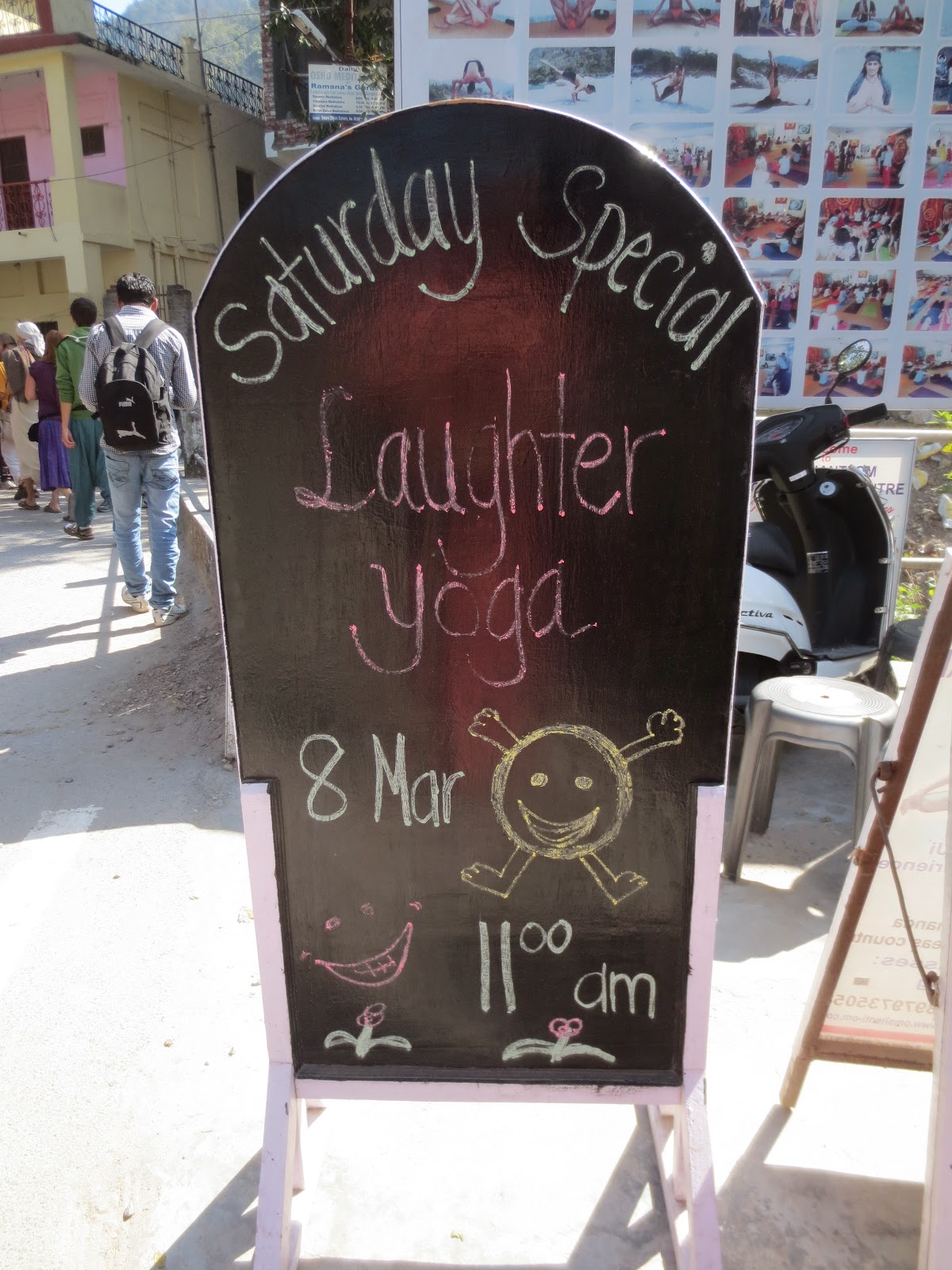
have heard of different kinds of yoga, but laughter yoga?
Insights
Srila
Prabhupada:
[Prahlada
Maharaja continued:] “An expert geologist can understand where
there is gold and by various processes can extract it from the gold
ore. Similarly, a spiritually advanced person can understand how the
spiritual particle exists within the body, and thus by cultivating
spiritual knowledge he can attain perfection in spiritual life.
However, as one who is not expert cannot understand where there is
gold, a foolish person who has not cultivated spiritual knowledge
cannot understand how the spirit exists within the body.”
(Srimad-Bhagavatam
7.7.21)
from
The Nectar of
Devotion, Chapter
14:
“Vedic
knowledge means ultimately to understand the Supreme Lord, and the
process of entering into His kingdom is devotional service. That is
accepted by all authentic scriptures. Mental speculators neglect the
process of devotional service, and by simply trying to defeat others
in philosophical research they fail to develop the ecstasy of
devotion.”
“Actually,
a person who is developing Krishna consciousness and still has some
attachment to material enjoyment will soon be freed from such a
tendency by regularly discharging devotional service under the
instruction of a bona fide spiritual master. Srila Rüpa Gosvami,
then, recommends that oneshould not be attached to material sense
enjoyment, but should accept everything enjoyable which is in
relationship to the Lord. For example, eating is necessary, and one
wants some palatable dishes to satisfy his sense of taste. So in that
case, for the satisfaction of Krishna rather than for the
satisfaction of the tongue, some palatable dishes may be prepared and
offered to Krishna. Then it is renunciation. Let the palatable dishes
be prepared, but unless they are offered to Krishna one should not
accept them for eating. This vow of rejecting anything which is not
offered to Krishna is actually renunciation. And by such renunciation
one is able to satisfy the demands of the senses.”
from
The Nectar of
Devotion, Chapter
15:
“And
only when affection comes to the platform of spontaneous love is it
counted in the category of pure devotional service.”
from
Srimad-Bhagavatam
7.7.39,
purport:
“The
pure souls are eternally in love with Krishna, and this permanent
love, either as a servant, a friend, a parent or a conjugal lover, is
not at all difficult to revive. Especially in this age, the
concession is that simply by chanting the Hare Krishna mantra (harer
näma harer näma harer nämaiva kevalam [Cc.
Ädi 17.21]) one revives his original relationship with God and thus
becomes so happy that he does not want anything material.”
from
The Nectar of
Devotion, Chapter
16:
“According
to the regulative principles, there are nine departmental activities,
as described above, and one should specifically engage himself in the
type of devotional service for which he has a natural aptitude. For
example, one person may have a particular interest in hearing,
another may have a particular interest in chanting, and another may
have a particular interest in serving in the temple. So these, or any
of the other six different types of devotional service (remembering,
serving, praying, engaging in some particular service, being in a
friendly relationship or offering everything in one’s possession),
should be executed in full earnestness. In this way, everyone should
act according to his particular taste.”
from
Sri Caitanya-caritamrta,
Madhya
13.139:
“A
devotee constantly engaged in Deity worship according to the rules
and regulations laid down in the sastras
and given by the spiritual master realizes gradually that he is in
direct contact with the Supreme Personality of Godhead. Thus he loses
all interest in so-called meditation, yoga practice and mental
speculation.”
from
Srimad-Bhagavatam
7.7.45,
purport:
“Krishna
consciousness, devotional service to Krishna, is the ocean of eternal
bliss. In comparison to this eternal bliss, the so-called happiness
of society, friendship and love is simply useless and insignificant.
One should therefore not be attached to temporary things. One should
take to Krishna consciousness and become eternally happy.”
from
Srimad-Bhagavatam
7.7.46,
purport:
“Asuras
[atheists] generally cannot understand that the objects of sexual
pleasure, the so-called pleasure of materialistic life, depend on
extremely hard labor.”
from
The Nectar of
Devotion, Chapter
18:
“In
the Nrisimha
Purana it
is stated, ‘If a person has completely engaged his mind, body and
activities in the service of the Supreme Godhead, but externally he
is found to be engaged in some abominable activities, these
abominable activities will surely be very quickly vanquished by the
influence of his staunch devotional force.’”
from
The Nectar of
Devotion, Chapter
19:
“In
the Narada-pancaratra
Lord
Shiva therefore tells Parvati, ‘My dear supreme goddess, you may
know from me that any person who has developed the ecstasy of love
for the Supreme Personality of Godhead, and who is always merged in
transcendental bliss on account of this love, cannot even perceive
the material distress or happiness coming from the body or mind.’”
from
Srimad-Bhagavatam
7.8.10,
purport:
“One
who thinks that he has many enemies is an ignorant man, whereas one
who is in Krishna consciousness knows that there are no enemies but
those within oneself—the uncontrolled mind and senses.”
from
The
Nectar of Devotion, Chapter
20:
“Without
relishing some sort of mellow, or loving mood, in one’s activities,
no one can continue to perform such activities. Similarly, in the
transcendental life of Krishna consciousness and devotional service
there must be some mellow, or specific taste, from the service.
Generally this mellow is experienced by chanting, hearing, worshiping
in the temple and being engaged in the service of the Lord. So when a
person feels transcendental bliss; that is called ‘relishing the
mellow.’ To be more clear, we may understand that the various
feelings of happiness derived from discharging devotional service may
be termed the ‘mellows’ of devotional service. This relishing of
transcendental mellow in discharging devotional service cannot be
experienced by all classes of men, because this sweet loving mood is
developed only from one’s previous life’s activities or by the
association of unalloyed devotees. As explained above, association
with pure devotees is the beginning of faith in devotional service.
Only by developing such faith in the association of a pure devotee,
or by having in one’s previous life executed devotional activities,
can one actually relish the mellow of devotional service. In other
words, this transcendental bliss is not to be enjoyed by any common
man unless he is so extraordinarily fortunate as to be in association
with devotees or to be continuing his previous birth’s devotional
activities.”
“The
gradual process of development to the stage of devotional service is
explained in Srimad-Bhagavatam,
First Canto: ‘The beginning is to hear about Lord Krishna in the
association of devotees who have themselves cleansed their hearts by
association. Hearing about the transcendental activities of the Lord
will result in one’s feeling transcendental bliss always.’”
from
a lecture on Srimad-Bhagavatam 1.2.22
given in Vrindavan on November 2, 1972:
“Those
who are grossly in ignorance, they are thinking in terms of bodily
concept of life; those who are little more advanced, they are
thinking in terms of mental or psychological concept of life; and
those who are still more advanced, they are thinking in terms of
spiritual concept of life.”
Satsvarupa
Dasa Goswami:
from
Obstacles on the
Path of Devotional Service:
“Even
if Krishna does not appear to us in His holy name, and we cannot seem
to overcome our offenses, still we will go on chanting. By
surrendering to Krishna, we become satisfied with the service itself.
At least we do not become hopeless. We are thankful for the mercy of
being able to always do some kind of service for Krishna and guru.
This surrendered attitude prevents one from becoming hopeless.”

“Today’s
drawing shows four
bhaktas dancing and chanting
with upraised arms.
They are smiling and
moving with grace.
They are modern-day
representatives of Lord Caitanya’s
associates for whom congregational
chanting was their heart
and soul. They are the
fulfillment of the
Lord’s prediction that
one day His names would
be heard in every town
and village in the world.
They are performing in
your town today.
In their multicolored
sport clothes, they
are appearing before
your eyes. Wake up
and take note of the harinamas!
It is your rare chance
to stop the bondage of material suffering.
Look up and receive them favorably.”
bhaktas dancing and chanting
with upraised arms.
They are smiling and
moving with grace.
They are modern-day
representatives of Lord Caitanya’s
associates for whom congregational
chanting was their heart
and soul. They are the
fulfillment of the
Lord’s prediction that
one day His names would
be heard in every town
and village in the world.
They are performing in
your town today.
In their multicolored
sport clothes, they
are appearing before
your eyes. Wake up
and take note of the harinamas!
It is your rare chance
to stop the bondage of material suffering.
Look up and receive them favorably.”

“Today’s
drawing shows three
devotees dancing and chanting
with upraised arms.
They are ecstatic and moving gracefully.
The ecstasy comes from
chanting the Hare Krishna mantra
which cleanses the mirror
of the mind and increases
the ocean of transcendental bliss.
It helps one to get a taste of the nectar
for which we are always anxious.
By chanting in public
these devotees are doing
the greatest welfare work
for humanity.
The casual passersby may
not appreciate at first,
but if the devotees are determined
and go out every day, the people’s minds
will be changed. They will find themselves
singing Hare Krishna to themselves
and opening to the Lord who gives them bliss.”
devotees dancing and chanting
with upraised arms.
They are ecstatic and moving gracefully.
The ecstasy comes from
chanting the Hare Krishna mantra
which cleanses the mirror
of the mind and increases
the ocean of transcendental bliss.
It helps one to get a taste of the nectar
for which we are always anxious.
By chanting in public
these devotees are doing
the greatest welfare work
for humanity.
The casual passersby may
not appreciate at first,
but if the devotees are determined
and go out every day, the people’s minds
will be changed. They will find themselves
singing Hare Krishna to themselves
and opening to the Lord who gives them bliss.”

“Today’s
drawing shows three
devotees dancing and chanting
with upraised arms.
They are happy and moving gracefully.
People who don’t sing or recite
the holy names of God are
missing out on the great benediction.
In former ages it used to
be that you had to perform
prolonged meditation or
pay for costly sacrifices
with expert priests or
worship in the temples.
Now it has been made
easy because we are so
short-lived, poverty-stricken
and impure. By the grace
of Lord Caitanya all we have to do
is chant the Hare Krishna mantra. But
most people are so unfortunate
they don’t take it. By the kindness
of the harinama party the
devotees give them the chance to hear.”
devotees dancing and chanting
with upraised arms.
They are happy and moving gracefully.
People who don’t sing or recite
the holy names of God are
missing out on the great benediction.
In former ages it used to
be that you had to perform
prolonged meditation or
pay for costly sacrifices
with expert priests or
worship in the temples.
Now it has been made
easy because we are so
short-lived, poverty-stricken
and impure. By the grace
of Lord Caitanya all we have to do
is chant the Hare Krishna mantra. But
most people are so unfortunate
they don’t take it. By the kindness
of the harinama party the
devotees give them the chance to hear.”
Lokanath
Swami:
Good
times are here. Take advantage of these good times.
In
Mahabharata,
King
Yudhisthira was asked many questions. One was, “What is the news?”
His response was that all the living entities in the material world
are attacked by three kinds of fire or miseries and are becoming
fried as if in a pot of oil.
We
cannot be free from sanga
or association – this one or that one, take your pick!
Here
we learn that simply by chanting Hare Krishna one can achieve all
perfection.
We
are born to spread Krishna consciousness all over the world.
“Therefore
this [Navadvipa] is the best among all the places in the universe.
The Krishna consciousness movement has established its center in
Mayapur, the birthsite of Lord Sri Caitanya Mahaprabhu, to give men
the great opportunity to go there and perform a constant festival of
sankirtana-yajna, as recommended herein (yajnesa-makha
mahotsavah).” (Srimad-Bhagavatam 5.19.24)
Niranjana
Swami:
Bhaktisiddhanta
Sarasvati Thakura lists many material reasons not to chant the holy
name and concludes that to attain the Lord’s service is the only
reason to chant, other reasons being useless. To ask anything for
ourselves is an offense.
The
goal of chanting is to attain love for God.
Devahuti
says, “Anyone whose work is not meant to elevate him to religious
life, anyone whose religious ritualistic performances do not raise
him to renunciation, and anyone situated in renunciation that does
not lead him to devotional service to the Supreme Personality of
Godhead, must be considered dead, although he is breathing.”
(Srimad-Bhagavatam
3.23.56)
Not
asking anyone for anything maintains one’s devotional service.
The
Lord cannot neglect a devotee who tolerates all insults without
seeking revenge.
The
Lord explained to Durvasa Muni that he could not consider the Muni’s
suffering for He had given His heart to His devotee. Therefore
Durvasa should approach Ambarisa for the Lord’s heart.
Although
the devotee does not want anything from the Lord, the Lord feels He
must give the devotee something that the devotee will appreciate, and
so He gives the devotee His heart.
Lord
Nityananda gives one the strength to chant the holy name without
material motivations.
Koloveca
Sridhar is an example of one who chanted without material motivations
and pleased Lord Caitanya so much.
Lord
Nityananda was simply desiring to increase faith in the holy name in
the people in general. His meditation was to do this to serve Lord
Caitanya. He did not even begin to do his outreach work, although
traveling for 20 years on pilgrimage, until He came to Navadvipa and
received Lord Caitanya’s order.
Here
in the Kirtan Mela we are collectively praying to the Lord for
opportunity to serve Him.
It
is said that Lord Nityananda is the guru for the masses, and
Radharani is the guru for the inner circle.
Radhanath
Swami:
Finding
the birthplace of Caitanya Mahaprabhu was part of Bhaktivinoda
Thakura’s master plan to bring everyone there to glorify Caitanya
Mahaprabhu.
We
are eternal servants of Krishna. We have love for Krishna in our
hearts. By chanting the holy names, especially the Hare Krishna
mantra, that love will become manifest.
The
first temple in San Francisco was a storefront. That was the standard
of the time.
Tamal
Krishna Goswami would go from temple to temple organizing the street
harinama
parties.
Many
people tried to help Srila Prabhupada get the land in Mayapur and
failed, but Tamal Krishna Goswami was actually able to do it.
On
Tamal Krishna Goswami’s last visit to Mayapur, after the GBC
meetings, when the GBC are usually exhausted, he started
congregational chanting in his room each night. They kirtanas
were
deep, devotional, and connected, and each evening more and more
people came, and they had to move the kirtanas
to
the temple. This continued for about a week, and it can be seen as a
forerunners of Kirtan Mela.
Bhakti
comes when you become the servant of the servant of the Vaishnavas,
and Lord Caitanya performed the pastime of transforming from an
argumentative scholar to the ultimate devotee after meeting Isvara
Puri.
Lord
Caitanya considered, “Time is so precious. Why do we waste our
nights sleeping? We should have kirtana
all
night.”
The
pious residents of Navadvipa, who where not permitted to join the
nocturnal kirtanas,
would
bring Nimai gifts every morning. He would accept them and teach the
people the maha-mantra
and
tell them to chant a fixed number of times each day on beads, and to
have kirtana
in
their homes. They did this, and seeing the residents of Navadvipa all
chanting Hare Krishna made him very happy.
Everyone
ran out to chant and dance with the Lord in his massive
chanting
party, forgetting their material identities and relationships. The
thieves were overjoyed that everyone left home with their doors wide
open. But when the thieves ran to plunder them, they heard the
chanting, and the thieves forgot that they were thieves, and they
joined the chanting party.
Some
had two torches, and yet chanted and clapped their hands. How is
that? They had become four-handed residents of Vaikuntha, and yet
they did not recognize they had become four handed.
The
demigods had not seen so much joy in the history of Brahma’s
creation, and they came disguised as humans to join.
The
Kazi accepted everything Lord Caitanya said, after some argument.
from
a class at Sivananda Asrama in Rishikesh:
Once
I was asked to give a class at this very place. I was asked to speak
by Swami Citananda on a very specific verse by Caitanya Mahaprabhu,
Siksastaka 3. In memory of that I will speak on that verse again.
Caitanya
is Krishna coming with the bhava (emotions) of Radha and
distributing that love through the chanting of the holy names.
If
our mirror is covered with dirt, and if we try to see ourselves in it
we will see the dirt.
We
are the sad-cid-ananda [eternal, blissful, and cognizant] soul
in the body.
We
will see that we are meant to love God in every condition.
Lord
Caitanya prayed to Krishna, “You have invested your beauty, power,
and sweetness in all Your names.”
Tolerance
and humility make fertile soil for the creeper of devotion to grow.
We
do not even consider the grass when we step on it. It bends over and
back up for the next person to step on it.
The
mango tree has not got a drop of water for 7 or 8 months, and yet it
gives dozens of juicy ripe mangoes.
When
we take pleasure in respecting others, we can always be happy.
Everyday
Nimai Pandit would walk to Simantadvipa and stop by a fruit seller
named Sridhara, who did not even have any bananas, just banana leaves
and banana tree bark. He spent half his income on worshiping the
Ganges. He was so respectful that he would calculate his price so he
would just barely survive and not inconvenience his customers. Nimai
would ask for the price of bananas, Nimai would say he would give
half, and then end up taking them for free. Once Nimai asked him why
he was serving Krishna when the atheists and the demigod worshipers
are often more well off. Sridhar said he was very happy serving
Krishna, and he did not have any needs unmet. He explained both a
king and a bird are situated similarly. They are both sometimes happy
and sometimes distressed, and they both get what they need. Although
Sridhar did not recognize Lord Caitanya was Krishna, he loved Him
like Krishna, and would always look in the direction of the path
Nimai would come from. Nimai once told His mother I will never eat
food that was not on a leaf plate made by Sridhar.
Sridhar
did not want any benediction, but Lord Caitanya insisted. Sridhar did
not want anything.
“Please
be peaceful my Lord,” Sridhar said.
“I
will be peaceful, you just accept one gift,” the Lord replied.
Sridhar
asked to always remember Nimai in His form as a child stealing
bananas. Lord Caitanya blessed him, “Anyone who hears the story of
your love will get love of Krishna.”
In
the British House of Lords I spoke and included the line, “You can
understand how rich you are by counting the number of things you have
that money cannot by.” That line is what they most appreciated.
Yoga
is for attaining the treasure that money cannot by. We can be an
instrument of God’s love for giving that love to others.
We
must go from indifference to compassion, from darkness to light.
Dravida
Prabhu:
from
a lecture on Srimad-Bhagavatam
6.3.22
given in Mayapur on March 3, 2014:
We
should understand and preach that devotional service begins with the
chanting of the holy name.
The
purpose of bhagavata-dharma
is
to develop love for God.
In
the U.S.A. people practically worship the constitution, but it is
found to be insufficient and needs to be amended. Furthermore it
cannot help to achieve the ultimate spiritual abode.
In
Srimad-Bhagavatam
2.9.33,
Krishna says He exists before the creation of the universe and after
its annihilation. Who else can say that?
Sankirtana
[the
congregational chanting of the holy name] is a sufficient dharma, but
the deity worship is necessary for purity.
In
the beginning of the Hare Krishna movement, there was just the
chanting at Tompkins Square Park, the Bowery loft, 26 Second Avenue,
etc.
Verse
8 of the Nectar
of Instruction is
the perfection of Krishna consciousness: “The essence of all advice
is that one should utilize one’s full time— twenty-four hours a
day—in nicely chanting and remembering the Lord’s divine name,
transcendental form, qualities and eternal pastimes, thereby
gradually engaging one’s tongue and mind. In this way one should
reside in Vraja [Goloka Vrindavana dhama]
and serve Krishna under the guidance of devotees. One should follow
in the footsteps of the Lord’s beloved devotees, who are deeply
attached to His devotional service.” But before that there are so
many verses and instructions bringing us to that point.
Why
is it said that we must always remember Krishna and never forget
Krishna? Because we must accept things that help us remember Krishna
and avoid things that cause us to forget Krishna.
The
verse that talks about running with one’s eyes closed and not
falling, according to Sridhar Swami, means acting without
understanding other Vedic literature, because by only following the
Lord’s personal advice, success is sure.
We
say that the holy name is everything. How is that? If the holy name
is Krishna, and Krishna is everything, then the holy name is
everything.
Q:
The holy name makes us wild with ecstasy, but to teach people we have
to be presentable.
A:
Lord Caitanya had an internal and external mood, and as His
representatives we should maintain both. We should relish the holy
name and also teach other people the importance of it. If we just try
to relish the holy name, sitting at Radha Kunda, it probably will not
last.
Ekalavya
Prabhu:
The
chanting of Hare Krishna is full of bliss which minimizes our
material miseries.
The
holy name is not different from Krishna. Krishna is full of bliss,
and we are all looking for bliss, and the most easy way we can
associate with Krishna is the holy name.
The
experience of the Lord in our lives nourishes our bhakti.
We
have to chant Hare Krishna in the mood of service to the Supreme
Personality of Godhead not just to neutralize sinful reactions. A
sincere devotee will try to avoid sinful activity.
Sense
control is a special ability of humans.
A
serious devotee does not want to be distracted by sense
gratification.
We
have to get a higher taste. Srila Prabhupada has given us this
opportunity to get a higher taste.
I
arrived in NYC two years ago on the appearance day of Aindra Prabhu
and was asked to speak about him. Rama Raya Prabhu came from Boston
for the event. The next day we decided to do harinama
in
Tompkins Square Park. We took blessings at the sacred place where
Srila Prabhupada began public kirtana
in
the West. Adi Purusa Prabhu asked us to sing as he served out
prasadam
there
in Tompkins Square Park. We chanted at different parks each day at
different times, but we decided on a single place at a fixed time,
Union Square.
A
policeman came up to me and asked if we were singing a religious
songs. I was afraid of policemen so I said no we are just singing for
love and peace. He pressed me again. He said, “If you said it is
religious, I can let you stay. Otherwise you must stop.”
It
was a high crime place, but by the chanting it became more mellow.
Some
hooligans who did not want us to chant there poured liquor on our
place. Then suddenly a fight broke out among themselves, and the
police took them away, and we continued our harinama.
We
could not use amplifiers so I took opera singing lessons, and now my
voice has improved.
Although
in his mid fifties Rama Raya would bring a cart with the blankets,
instruments, books. He would sent SMS text messages to people
pleading them to come out. He is considered a hero in New York City
for his service.
comments
by me:
Regarding
chanting to get free from sinful activity, it is said that chanting
the holy names nullifies the effects of seva aparadhas
[offenses in deity service], but if we do our deity service in a
sloppy way, thinking it is not so important as our chanting will
nullify the reactions, that is also a similar offense.
Regarding
sense control as being the special gift of the human being, Srila
Prabhupada once said that a dog never asks, “How do I give up this
barking habit?”
Janardana
Prabhu:
It
is obvious what is missing here in Rishikesh – the association of
genuine devotees of the Lord. Yet there are many people here who are
attracted to the real thing, as we can see on harinama.
In
our harinama
there
is no competition. There is no one leader. Everyone can express
themselves in their own way. That is attractive to people.
I
like to explain that love requires three, the lover, the beloved, and
the acts of love.
We
can engage in the six exchanges of love between devotees.
Taste
comes from association with devotees.
In
this world we cannot fix our mind on one thing because nothing gives
us that taste.
I
talked to a lady from New York City who remembered the devotees
chanting from Union Square. She said, “Often it is difficult in New
York City and sometimes I take a detour to pass by the chanting party
in Union Square because I can count on feeling better afterward.”
She had doubts about getting a book at first, but as she recalled
more and more her experience in Union Square, she became convinced
and bought one.
comment
by Ekalavya Prabhu: On the Polish festival tour Indradyumna Swami
would remind us that the happiness of the sadhu is seeing other
people coming happy. I noticed that yesterday on the harinama.
I
was so happy seeing people becoming happy by seeing the kirtana.
comments
by Navina Nirada Prabhu: We distributed all the extra prasadam
last
night. There are no beggers in Rishikesh, so we would stop people on
the their motorcycles and give them prasadam.
There
was a whole crowd of people and that would attract others to stop.
We
had a few moments when people thought, “What’s going on here?”
Then they joined in.
Mahabhavi
Prabhu:
Often
when I read in Srila Prabhupada’s purports of the psychology of the
nondevotee I see that within myself.
We
have been conditioned for many millions of years to be happy sleeping
on the lap of maya,
so
it is difficult to change.
When
we are together in a group of devotees doing some sacrifice for
Krishna, it is easier. Otherwise it is difficult to attentively chant
the holy name.
An
ascetic may give up sense gratification but the yogi gives up the
desire for sense gratification.
The
chanting helps us give up our material conceptions like, “Krishna
is so strict giving us such heavy laws.”
One
should never stop that sankirtana.
Why
do we stop? We want to be the enjoyer or the center. If we do not
stop, our heart will become cleansed.
If
we persevere we can get to the point of attaining the state of
wanting to serve Krishna and the devotees.
Caitanya-candrodaya
Prabhu:
The
Rg Veda is one of most famous of the Vedas. It contains the Gayatri
mantra.
Srimad-Bhagavatam
is
the most important of the Vedic literature.
The
scholars note that the Sanskrit of the Srimad-Bhagavatam
is
not the Puranic Sanskrit but the Vedic Sanskrit.
Srila
Prabhupada said of some of his disciples that they were personal
associates of the Lord.
Patanjali
describes different levels of samadhi and says that the
highest one leads one to the path of bhakti.
Lord
Caitanya gives love of God not based not on our qualification but our
desire.
Some
people describe that our disqualification is our greatest
qualification to get the mercy of Lord Caitanya.
The
goal of bhakti is not enlightenment but love of God, but that love of
God includes enlightenment.
Bhakti
is so powerful. Simply by circumambulating the temple you can attain
liberation.
The
congregational chanting of the holy name does not require a
qualification. Kirtana
performed
by those eager for the Lord’s mercy are especially powerful.
Baladeva
Vidyabhusana argues that the devotees can choose to give mercy to a
particular person and when they do so Krishna reciprocates by
fulfilling that desire.
There
are symptoms of a saint, such as never wasting time with engagements
other than devotional service and always being eager to glorify the
Lord.
To
achieve bhakti is rare as only some who have attained the realization
that they spiritual beings have actually attained bhakti thus we
should be very grateful to Lord Caitanya for making it so easily
attainable.
Q:
What are the weapons of Lord Caitanya?
A:
Prasadam
Srila
Prabhupada said is our most important weapon. Also the instruments of
the kirtana
can
be considered weapons of Lord Caitanya.
comment
by me:
It
is also explained that the holy name is weapon of Lord Caitanya, and
His beauty is a weapon of Lord Caitanya.
comment
by Navina Nirada Prabhu:
You
can see that no qualification is necessary to appreciate bhakti.
Three French youths who were so intoxicated they could hardly stand
up were attracted by the chanting and bought books on harinama.
Also
the swamis at the Sivananda ashram were appreciating Radhanatha
Swami’s story about Kolaveca Sridhara and chanting and prasadam
distribution.
Q:
Krishna advises in Bhagavad-gita by always remembering Him we
will be liberated. But in our busy life in the cities how is that
possible?
A:
Prabhupada encouraged his followers to live with other devotees for
that makes it easier.
comment
by Navina Nirada:
If
we are not fortunate enough to desire Lord Caitanya’s gift, at
least we can be so fortunate that if someone comes to give it to us,
we do not reject it.
Mukunda
Prabhu (Russia):
Many
people come to Rishikesh looking for spiritual experience, but few
get the actual spiritual experience. I have mixed feelings about this
place because on one hand the people are not just tourists but
spiritual seekers but on the other hand they are all lost because
they have not gotten the shelter. Because they have not gotten the
spiritual experience they are afraid to surrender. When one has 100%
faith in the spiritual experience he has had, he is willing to
surrender.
I
was studying different spiritual traditions for many years, but
nothing gave me an experience of holiness. When I got Srila
Prabhupada’s books I did get such a experience and became a devotee
in two or three days, faster than my mind and intelligence could
appreciate.
In
our outreach we must give people an experience of spirituality that
they can appreciate.
Internally
we should be asking Krishna as the Supersoul to give the person we
are talking to the spiritual experience we desire they have.
Real
religious experience is something that cannot be resisted or
counteracted.
Some
disciples of Srila Prabhupada came to Sridhara Maharaja, the
godbrother of Srila Prabhupada. They asked him some esoteric
questions about Radha and Krishna which he refused to answer, saying
that “fools rush in where angels fear to tread.”
It
is difficult for persons who are solely on the mental platform to be
given a spiritual experience.
One
person imitated Gaura Kisora Dasa Babaji Maharaja’s dress, his
bhajan,
his eating, etc. Gaura Kisora Dasa Babaji Maharaja asked him the
question, “If a woman who is not pregnant enters a natal ward and
imitates a woman in labor, will she give birth to a child?”
It
is good you are sharing the holy name so some people may have a
spiritual experience that they will take with them and which will
ultimately lead them to perfect their lives, even after their leave
Rishikesh.
Whatever
genuine spiritual experience they get, will stay with them, and
ultimately lead them to perfection.
Q
by Ekalayva Prabhu: An advanced devotee may feel himself unqualified
to engage some material thing in Krishna’s service. Once Raghunath
Dasa Goswami thought if he had wealth he could excavate Radha Kund
and Shyam Kund, and make them a very attractive holy places. But then
he thought, “How terrible? I should not be desiring wealth.” One
wealthy man went to visit the deity Badri Vishala desiring to give
him some wealth, but the next day, before he was to do so, the Deity
came to him in a dream, and told him not to give the wealth to Him
but Raghunath Dasa Goswami instead. Raghunath Dasa Goswami was
doubtful about accepting the money until he heard the deity had
desired it.
A:
Different advanced souls are inspired by the Lord to stay away from
the world and others are inspired to engage it in devotional service.
Some teach how to engage things in devotional service to teach the
people in general. By sincerity and spiritual guidance we can
understand what can be engaged and what should be avoided.
------
tasmat
sankirtanam vishnor
jagan-mangalam
anhasam
mahatam
api kauravya
viddhy
aikantika-nishkritam
“Sukadeva
Goswami continued, ‘My dear King, the chanting of the holy name of
the Lord is able to uproot even the reactions of the greatest sins.
Therefore the chanting of the sankirtana movement is the most
auspicious activity in the entire universe. Please try to understand
this so that others will take it seriously.’” (Srimad-Bhagavatam
6.3.31)


