Tuesday, January 25, 2011

Travel Journal#6.24: Philadelphia, New York, Boston, Albany, Gainesville

Diary of a Traveling Sadhaka, Vol. 6, No. 24
By Krishna-kripa das
(December 2010, part two)
Philadelphia, New York, Boston, Albany, Gainesville
(Sent from Gainesville, Florida, on January 25, 2011)


Where I Went and What I Did


For the Christmas break, I decided to attend the Vyasa Puja (appearance day [birthday] ceremony) for my initiating guru, Satsvarupa Dasa Goswami, which was held in Govinda's Restaurant in Philadelphia. We also did two harinamas there in Philly, including a spontaneous additional one happening because the enthusiasm of the devotees. On Sunday in Philadelphia temple, they celebrated Gita Jayanti, and devotees shared realizations about Bhagavad-gita. My Godbrother, Caitanya-candrodaya Prabhu, who was visiting from Ireland, had rented a car, and after Vyasa Puja, we drove to New York, where we did harinama and saw the Hare Krishna tree in Tompkins Square Park and original Hare Krishna temple site at 26 Second Avenue. Next we drove to Boston, where Niranjana Swami, who originally invited me to live in the New York temple back in 1979, was doing an evening program with lots of chanting. The next day, Caitanya Mangala Prabhu (Charles Sullivan), a longtime Boston resident and a Facebook-friend of Caitanya-candrodaya, took us on a tour of where the Jaladuta, the boat Srila Prabhupada came to America, originally landed at Commonwealth Pier, and where Srila Prabhupada wrote a beautiful poem about his mission of distributing Krishna consciousness in America. We also saw the sites of the two previous Hare Krishna temples in Boston and the famed universities, Harvard and MIT. I brought my harmonium, and we chanted a little at every place. Next we went on to Albany where I stayed with my relatives for Christmas, and Caitanya-candrodaya stayed with Satsvarupa Dasa Goswami and his health care assistants. After Christmas, I returned to New York to do harinama and to attend two more programs with Niranjana Swami. The roads were so snowy on the trip there, Caitanya-candrodaya abandoned the attempt to drive me and put me on the train at Hudson, a train delayed three times because complications arising from the snow. On New Years Eve, I returned to Gainesville hoping to go on harinama with a lot of my friends, but at least was able to go to on harinama with a few of my friends. I thought more people realized how great a day New Years Eve is for harinama. People are in a jolly mood and are much more willing to participate. The holiday spirit, and probably the alcoholic spirits, break down barriers.


I share lots of great realizations from Niranjana Swami, and some as well as from other devotees.


Satsvarupa Dasa Goswami Vyasa-Puja


Satsvarupa Dasa Goswami spoke nicely to a group of perhaps twenty-five or so followers on the second floor of Govinda's Restaurant on December 18. I recall a greater attendance in 2008 when I was there. In 2009, I was in Mayapur. This year some devotees came from Gitanagari, Boston, and Queens, but I was the only one from Florida. He told the story of his buying the three volumes of Srimad-Bhagavatam personally from Srila Prabhupada, and how Srila Prabhupada was later pleased when he inquired about Srila Vyasadeva's despondency after writing so many Vedic literatures. He also told how because he was a typist for Srila Prabhupada, he heard all the Bhagavatam stories before the other devotees, and he would eagerly sharing them when he gave class. Once, in Srila Prabhupada's presence, he was telling how Krishna would feed the monkeys so much butter they could not eat any more, then He would tell His mother that her butter was no good and that even the monkeys would not eat it. He was surprised to see the broad smiles of all the devotees, until he turned and saw Srila Prabhupada's oceanic smile. After the Vyasa Puja lecture, there was only time for four offerings, one each by Haryasva, Haridas, Bhakti Rasa, and myself. I said I was impressed that during the week I visited him he was always sitting in his chair at 2:30 a.m. chanting on his beads, despite the infirmaties of old age and his chronic headache condition, showing by his example that importance of that instruction. Also I was amazed that he took half an hour out of his afternoon to talk with my relatives, although they do not have a serious interest in Krishna consciousness. Bhakti Rasa read a couple nice poems accompanied by music. Despite Satsvarupa Dasa Goswami's physical challenges he delivered a good talk and participated in the kirtana later, and took prasadam with the devotees. An audio recording of the lecture is on his web page at:
http://www.gnpress.net/audio/sdg_vp_2010_12_18_philadelphia.mp3


Harinamas in Philadelphia


I decided to try for a harinama the night before the Vyasa Puja ceremony we had for Satsvarupa Dasa Goswami. I was very happy that five of my godbrothers came out along with three Philadelphia devotees making a party nine strong. Caitanya Candrodaya, Bhakti Rasa Prabhu, and I had chanted together for three days in Newcastle, England, in June, and it was nice to be together in a new place. Mother Anindita, the Philly temple secretary, made cookies for us to distribute, and although there were not so many people on the streets and we did not stay out more than an hour because of the cold and some people liking to take rest early, still we distributed over sixty of them. I would tell the people we were giving out cookies for Christmas, which made it is easier to distribute them. Many people happy to see the devotees, especially the young people. Haryasva Prabhu, the manager of Govinda’s restaurant, who I remember being the most enthusiastic of the brahmacari dancers when I lived in the Philly temple in the mid-1980s, was very happy to be out on harinama again. I hope he will come out more often in the future. Ganga dd, although she could not come as she usually does, kindly lent me her car so I could take the instruments and devotees from the temple downtown for the event.


Amazing for me was that we did another harinama the next day, after the Vyasa Puja event. This time we had eight devotees, four devotees from the previous day, including Navin Shyam Prabhu who would chant with me every week at University of Florida in Gainesville while working on his masters degree and in Nabadwip while doing bhakti-sastri. Amit, who also came out twice, is involved in our club at U. Penn., where he advised us to chant, as students had not yet completed finals and still populate the campus. Many of the students were happy to see us, although it was clear, that for many, it was their first encounter with devotees. We found a popular student hangout and chanted there for some time. Some of the students danced along with us.


The devotees all were happy to go out chanting, although because of the cold, we did not stay out long. It is good to go out regularly just so the devotees remember how nice it is.


Gita Jayanti in Philadelphia


In Philadelphia temple they have a buy-one-get-one-free sale on Bhagavad-gita to encourage people to buy Bhagavad-gitas as gifts in this Christmas season.


From 1:00 to 4:00 p.m. a group of fifteen or so devotees chanted all the verses of the Gita in English. I came for the end of the eighteenth chapter. Gita Jayanti is always Ekadasi, and it is too hard to chant my extra japa quota and the Bhagavad-gita both.


Sraddha dd asked me to give a class on the Gita. I shared key themes and favorite verses, but lost my notes, so I cannot share them. After that individual devotees spoke:


Jahnava dd (formerly Janice from San Diego): If we speak Krishna-katha [words by and about Krishna], we will automatically speak words that are “truthful, pleasing, beneficial, and not agitating to others” as Krishna recommends in Bg. 17.15.


Dr. Nair: “In this endeavor there is no loss or diminution, and a little advancement on this path can protect one from the most dangerous type of fear.” (Bg. 2.40) That devotion service is an eternal credit is a great solace.


Bhakta Israel: Everything I was searching for was in Bhagavad-gita. What Krishna is saying is timeless. It is like Krishna is speaking to us now, just like he was speaking to Arjuna.


Ganga Varuni dd:

We all have our own battles in our lives. Our challenges are not as severe as Arjuna’s, to fight his relatives, but they nonetheless seem serious to us. We can choose to fight our own battles, and Krishna will support us.

We just have to accept what Krishna said as he said it, and present it to others. We have to transcend ideas of political correctness.


Bhaktin Saumya:


People in general say as long as you do good, that is all that is required, hinting that worship of God is not necessary, but Krishna contradicts this in Bg. 9.30 when He says even if you do bad by accident, if you are fixed in the determination to please Him, you are still a saint. In fact, he says that such a person quickly becomes righteous.


Bhakta Aravind:


There are so many ideas of dharma, if one studied them to find the ultimate one, he would be confused. Krishna makes it clear what is the dharma.


Christmas in Albany


For Christmas, I brought my relatives doughnuts from the Hare Krishna-owned Doughnut Plant in Manhattan, Wonder Bars (Krishna.com's line of prasadam fruit-nut bars), and a few Krishna related books: The Hidden Glory of India, Diary of a Traveling Preacher, Prabhupada Nectar, and The Twenty-six Qualities of a Devotee. I also made prasadam waffles with strawberry sauce for breakfast on Christmas dayt. My sister, and her friend, Victor, gave me socks and gloves, which really came in handy for my harinamas the next week in New York. My mother gave me dried figs, one of my favorite treats.


Because of burning out on my relatives habit of tasting things I am cooking before they are offered to Krishna, I finally took the trouble of explaining to my mother that our desire to enjoy things without offering them to the Lord is the root cause of our residing in the material world, where people put their own selfish desires in the center. Until we perfectly understand that the Lord is the enjoyer of all our activities, we have to accept birth after birth in this world, and miss attaining the kingdom of God. Tasting the unoffered food, therefore, although appearing to be a minor detail, is a symptom of a philosophical misunderstanding, one so severe that it prevents our entry into the spiritual world, a place where all the residents agree that the Lord is the original enjoyer of all our offerings. It was a little heavy, but I was glad I said, even if only from the philosophical point of view, so she could understood why it bothers me so much. I only make such points every few years, otherwise it would create too much tension.


I distributed prasadam twice at the Quaker meetinghouse in Albany (coconut sweets and oatmeal cookies), and I played a wise man from the East in the Christmas drama. I found they sing hymns the last Sunday in the month, for the half hour prior to their hour of silence, a new feature not present in my youth, and one more consistent with the Vedic idea of the best dharma being the congregational glorification of the Lord. I spoke briefly in the meeting about the universality of chanting the glories of the Lord and how we can experience that it brings spiritual pleasure to the soul. I recalled that the Christmas caroling that we did in my Quaker youth was a joyful experience, and mentioned how I like the Hare Krishna practice of singing morning, noon, and evening. I praised the Quakers for increasing the glorification of the Lord in their service by adding the half hour of singing monthly. The singers in the meeting were especially happy with my words and my presence.


New York Harinamas and the Book Marathon


I emailed the devotees who came on our October harinama in Tompkins Square Park, and told them I would be in New York on the Monday before Christmas and would like to do harinama. We settled on 5:00 p.m., which turned out to be the time we arrived from Philadelphia. Mother Ekayani and Bhaktin Michaelle agreed to come. While putting our belonging in the ashram, we met Ananda Vidya Prabhu, who had just come back from selling over twenty Bhagavad-gitas and other books at the subway stations. He decided to come with us and bring some Chant and Be Happy books to distribute. We chanted to Tompkins Square Park, as my friend, Caitanya-candrodaya Prabhu, who was visiting from Europe had never been to that place with its sacred Hare Krishna tree, where Srila Prabhupada and his devotees began chanting regularly in October of 1966. I was surprised to see that in New York the parks are open to midnight, while in London they close at dusk. Just as we got to the park, a lady donated to us six bags of dried fruit and nuts. After visiting the park, which was not very crowded, we went toward St. Marks Square. At one point a girl, who was hanging out with some friends, yelled at us from across the street, “You guys sound great.” And she and her friends, some guys and girls, danced with the devotees for some time. Michaelle, in particular, swung some of the girls around in circles. At one point, my hands were too cold to play the instruments, so Ananda Vidya took over, and I distributed books. Somehow I ended up distributing four books for five dollars. I had a desire to distribute some books during the Prabhupada Christmas marathon, but I never actually got around to do it, but by the mercy of Krishna and Ananda Vidya, I did participate in the marathon after all. For me, the best experience was when I saw a cab driver waiting at a stop light. While looking at the devotees chanting and dancing, he smiled brilliantly. I approached him, saying that the book explained what we were doing, and he took it and gave a three dollar donation. One math major at NYU was intrigued with the harmonium, and we let him jam with it for a while. He liked the Beatles and was eager to get the Chant and Be Happy. Everyone had a great time on the harinama which lasted for two hours, and Michaelle told me she was so inspired she is thinking of organizing some more herself.


The week after Christmas, I did five harinamas in New York City, a place where there are always people on the street. My favorite day was when I did two harinamas in one day, went out on book distribution, and attended a kirtana and lecture by Niranjana Swami, one of my main instructing spiritual masters. Let me tell you about it:


The classes in the Bhakti Center were all about distributing Srila Prabhupada's books, and many devotees were going out for five or six hours a day. Even new devotees, like Rasaraja Prabhu, who has not been initiated even a year, were regularly distributing twenty softbound Bhagavad-gitas. The enthusiasm was so great, even I decided to go out for one hour one day, although I usually do such a bad job, I do not like to go out. I ended up staying out almost an hour and a half, and I distributed four Perfection of Yogas, two in English and two in Spanish. I did enjoy trying to convince the people about the literature, although just a few took it, and then, just the smallest books. I met one sincere person who was looking for such literature, and that was a special bonus.


Immediately, upon returning from book distribution, we did a harinama for almost an hour, just before Niranjana Swami's evening program. Later, during the prasadam after his lecture, one girl told us she received the email about the program but forgot all about it until she us chanting at St. Marks Place! Niranjana Swami led kirtana for almost two hours and also talked about perfecting our chanting of the holy names. Devotees were so enthusiastic from the program that seven of us went out on an hour-long harinama after prasadam which concluded the program at 9:45 p.m! One devotee in the party had a shirt with the whole mantra printed on the back, and one of the ladies in the party encouraged a favorable group of people walking behind us to sing along with the mantra and so they did! Bhakta Alex attempted to distribute a book to almost everyone he met. Bhaktin Ika took some pictures and put them on Facebook:


Jagadish Chaitanya, Bhaktin Ika Danielson, Bhaktin Michaelle Kalinowski, and Krishna-kripa Das

New Years Eve Harinama


Three friends and I had a great time doing harinama New Year's Eve in Gainesville. As soon as we started, three girls wanted us to sing for their New Years video, and so we did. We invited them to dance along, and one of them did. Then we gave them mantra cards, and the one who danced, sang the response for ten minutes. Two guys came by, and she gave mantra cards to the guys and told them to sing along. When they asked about who we were, she excitedly told them about our Krishna lunch program. Everyone was in a joy mood the whole evening, and many uttered names from the mantra and danced. Adi Karta Prabhu came out with his accordion and amplifier and really added a lot to the party. New Years Eve one of the best days for harinama because people are in a jolly, festive mood. I hope I can convince more of my Gainesville friends to come out next year!


Insights from Lectures


Niranjana Swami:


program at Bhakti Center in New York:


It is beneficial to talk about our purposes in chanting in order to keep them mind.


Prabodhananda Saravati likens the senses to serpents but says that the effect of mercy of Lord Caitanya, the chanting of Hare Krishna, is to break the fangs of these serpents.


Srila Prabhupada would quote the verse that says devotion, direct experience of the Supreme, and detachment occur naturally as a result of bhakti, just as pleasure, nourishment, and freedom from hunger come with each bite of food. You do not have to ask anyone, “Is my hunger going away?”


Srila Prabhupada explained the importance of using analogies by using the analogy of seeing the moon moving through the branches of the tree.


Chanting Hare Krishna is pleasurable, but we must understand the ultimate goal, spiritual perfection.


If we want the chanting of Hare Krishna to be at the center of our lives, we must cultivate the state of consciousness advised by Lord Caitanya, one of humility and tolerance.


If one wants to realize the ultimate benefit of chanting he must hear the truths about the holy name from the Vaishnavas.


To get Lord Caitanya’s mercy we must chant without blaspheming any living entity. We must respect everyone.


Piyari Mohan was telling me that Tamal Krishna Goswami asked Srila Prabhupada the difference between calling a spade a spade, faultfinding, and blaspheming. Srila Prabhupada said to say to you, “You are insignificant as a fig is calling a spade a spade. Faultfinders are like flies looking for filthiness while bees look for nectar. Blasphemers manage to find a fault when a person only has good qualities.


from a New Jersey home program:


Our dealings with others, devotees and nondevotees alike, affects our consciousness.


We do not change hearts. We turn peoples’ attention toward Krishna, and He changes their hearts. Faith in the devotees, faith in the holy name, etc., are necessary to advance.


Only the pure devotees can be peaceful because they have no material desire. As long as the two witches of bhukti (sense enjoyment) and mukti (liberation) are haunting us, we cannot taste the sweetness of devotional service.


Visvavanatha Cakravati Thakura says it is essential to hear about the pastimes, instructions, and qualities of the Supreme Lord in the association of devotees from the beginning of sraddha to the end of Krishna prema.


Faith is the only currency for purchasing the holy name. If we wish to distribute Krishna’s name, we must eager to offer the people's faith to Krishna.


Lord Nityananda does not consider a person’s material qualifications but the presence of a little faith. Srila Prabhupada was also accepting just a little faith. In a lecture on Srimad-Bhagavatam 1.2.16, he told his disciples, “I have given you your faith.”


Srila Prabhupada appeals in the Gita, if you can’t accept Krishna as the Supreme Lord, at least theoretically accept Krishna as the Supreme Lord.


Srila Prabhupada’s selflessness awakened faith. His only aspiration was to awaken and to nurture faith.


When Haridas Thakura heard the glories of Ananta Sesa from the snakebite physician, he went unconscious in spiritual ecstasy, thus increasing the faith those who witnessed him. The physician showed all respect to Haridas, understanding his spiritual position. Later an envious brahmana feigned ecstasy, rolling on the ground. The physician, understanding the pretense, hit the brahmana, who stopped his act and ran away.


We should protect people’s faith by giving instruction and by our own proper action.


Lord Caitanya says if one worships Me but neglects My servant, such worship cuts Me to pieces.


If a sannyasi blasphemes an innocent person, he falls down, and his piety perishes.


Lord Caitanya says, “I will personally deliver anyone who chants Krishna’s name and does not blaspheme others.”


Speaking on the “sadhavah sadhu-bhusana” verse, Srila Prabhupada said, “A sadhu never does anything to provoke enmity in another.” Sometimes a people may become angry hearing a sadhu due to a material attachment, but the sadhu does not intend that.


Jiva Goswami makes the point that because a kanistha-adhikari does not know how to respect others, he is useless as far as practical preaching work is concerned.


Bhaktisiddhanta Sarasvati Thakura says one who proudly considers himself a Vaishava, a devotee of the Lord, yet is not merciful to others attains only the three-fold miseries but not devotional service.


Q: Is staying at a certain stage too long detrimental in our devotional service?
A: It can be. Srila Prabhupada explained that we are in the middle of the ocean of material existence, and we can be affected at any moment. He said that maya is always testing to see if we want to serve Krishna or disturb Krishna. If we accept the association of devotees who are more advanced, then we will not remain complacent. We need strength to overcome the unwanted desires in our heart, and we must associate with people who give us that strength.


Q (by me after the program): It seems to me that it would be best for me to do whatever will create faith in the greatest number of people.
A: But to create faith in people, you have to have faith yourself.
Q: So I should try to seek that association by which I get the greatest faith?
A: Yes.


That was a powerful statement. My computer was not powered up to record it at the time, but I recalled it two and a half weeks later, and wrote it down. I was thinking I had some faith to share, but he could see from his point of view, that I have to gain a lot more faith to really be able to benefit people, so that appears to be my direction for the coming year.


Baladeva Prabhu:


Studies show that reading electronic books is 10% slower than reading ordinary books of paper, so that is more reason to buy books.


Yajna Purusa Prabhu:


When I did the marathon in Boston, seeing the happiness of Madhava, the head cook, who was cooking for the pleasure of the sankirtana devotees, really touched my heart and inspired me.


There is nothing more inspirational than taking a break from sankirtana and reading Srila Prabhupada's Bhaktivedanta purports.


Caitanya-candrodaya Prabhu:


The Vedic idea is that religion comes before sense gratification and economic development, but in the west we think the sense enjoyment and economic development come before religion.


You will never become pure if you use religion for your sense gratification. If we are not completely pure, we will not enter the Bhagavatam and the Bhagavatam will not enter our hearts.


We encourage people to follow the regulations prohibiting sinful activity because it is required to attain a higher state of consciousness, not just because we like to repress people.


I can understand I am falling away from dharma when I judge a devotee because of his past activities rather his desire to go back to Godhead.


If we trust people, we empower people, and they go on to empower others. But if we do not trust people, we can end up disempowering them, or in other words, making them feel that they cannot represent Srila Prabhupada or Lord Krishna.


You have to have faith in the association of devotees to attract others into that association.


Srila Prabhupada gave only one lecture on the Tenth Canto and thousands of lectures on the others cantos.


Knowledge is important for our conviction in spiritual life. You may experience a loss of taste at some point. That is very common, but if you are fixed in knowledge, you will continue and progress.


"Jagannathastaka" was written by Sankaracarya.


In puja we offer the five elements beginning with ether, with the blowing of the conch shell.


Someone asked Jananivasa what substance the deities were made of, and he replied that it depends on what your heart is made of. If you are materialistic, the deity is made of material elements, but if you are spiritually realized, the deity is the fully spiritual Supreme Personality of Godhead.


Merging into the brahman is a very bad deal. In the material world, at least we can offer something to Krishna, however imperfect it may be, and thus can have some relationship with Him, but that facility is not existing when one's consciousness is fixed brahman.


Ether is not merely the three-dimensions of space that we know.


You have to be very advanced in self-realization to explain Mayavada philosophy without becoming contaminated by it.


If you understand the limitations of sense perception and interference, it will change your life forever.


The “Bhisma Parva,” consists of the instructions of Bhimadeva, is the largest section of the Mahabharata. Bhisma makes the point that a logician can always be defeated by a greater logician, and thus logic cannot reach the ultimate truth. Therefore we have to accept knowledge from authorities who have direct experience of the truth.


Dualities, such as that which we want and that which we do not want, are so natural it is difficult to imagine a state that is beyond dualities. We must follow a path that can give us a realization of transcendence.


Attaining peace is an initial result of a spiritual practice.


Kaustuba Prabhu:


Tolerance is a qualification necessary for spiritual understanding.


To give up family, possessions, enjoyments, etc. is easier than giving up one’s false conception of himself.


One has to pray really hard to enter into the association of the Lord within in the heart, and being alone on sankirtana [distribution of Srila Prabhupada's books] is a great opportunity to be inspired to do that. If you are fortunate, you can bring people into that association with the Lord, and benefit them.


In Vrndavana on parikrama, some children were teasing us and causing commotion, and some of the devotees were agitated. Mother Srimati asked us not to be disturbed saying, “They are just testing our determination to hear.” We did as she said and soon after the children left us alone.


When I was preparing to go on book distribution, I would prepare like an athlete preparing for a big game or a priest preparing for a Vedic ritual.


If your mind is well prepared, entering into the arena of book distribution is an exhilarating experience.


Gadadhara Pandit:


We must become free from the disease of material contamination to taste the nectar of Krishna consciousness.


If we are able act ideally with the devotees in our association, then and only then, can we have an impact on society.


Lord Siva showed ideal Vaishnava behavior in the arena of the Daksa sacrifice by tolerating being insulted in an assembly of all the most important people in the universe.


Sometimes we dream that we will attain a situation where there are no provoking situations, but that is not a reality. Even if you become a leader or a guru, Krishna will send just the right person to help you remove the last traces of your material attachments.


How to please the Lord? It is simple. We do not have to be an intellectual to understand it. Just spread Krishna consciousness to others.


Bhakta Mauricio:


Disciple is based on the word discipline, and discipline is based on obedience. Our claim to be advanced has no meaning unless we are obedient to the guru.


Radhanatha Swami makes the point that to think that you cannot do something is a manifestation of false pride because it implies that when you do something which you think you can do, that you are thinking that you are the doer.


If a pure devotee accepts what you are doing as [devotional] service, then it becomes [devotional] service.


Notes Mauricio took on a class by Niranjana Swami:


The force was the purity of Srila Prabhupada's desire. Not that he was yelling do it do it.


There was nothing sweeter than the conviction that we were doing something for Srila Prabhupada.


If I did not get that opportunity to push pass the limits of his body to do something to please Srila Prabhupada, I would have really missed out on something very valuable.


Comments by Brahma-tirtha Prabhu: In the early days, there was no one who did not perform austerities. In retrospect, we could have done austerities more intelligently, but the austerities were good.


We learned different things, like “never go out as Santa Claus in a Jewish community, especially if you look Jewish.”


Karen [my sister, teacher of mindfulness]:


Stop before resentment begins.


-----


pātrāpātra-vicāra nāhi, nāhi sthānāsthāna
yei yāńhā pāya, tāńhā kare prema-dāna


In distributing love of Godhead, Caitanya Mahaprabhu and His associates did not consider who was a fit candidate and who was not, nor where such distribution should or should not take place. They made no conditions. Wherever they got the opportunity, the members of the Pañca-tattva distributed love of Godhead.” (Sri Caitanya-caritamrita, Adi-lila 7.23)

Thursday, January 13, 2011

Travel Journal#6.23: Tallahassee and Gainesville


Diary of a Traveling Sadhaka, Vol. 6, No. 23
By Krishna-kripa das
(December 2010, part one)
Tallahassee, Gainesville
(Sent from Gainesville, Florida, on January 13, 2011)


Where I Was and What I Did


Encouraged by GBC Tamohara Prabhu and temple president Ramiya Prabhu, I spent twelve days at our Hare Krishna center in Tallahassee, where we have a shortage of devotees. My usual program there is to chant three hours a day each weekday on the Florida State University campus, and advertise our weekday vegetarian lunch program, Wednesday Bhagavad-gita class, and Sunday feast program, as well as distribute spiritual sweets and literature. On the weekends I chant at Lake Ella, or if alone, in front of the FSU library, and on the first Friday evening of the month, we chant at an art walk at Railroad Square.


The next week I spent in the Gainesville area, chanting at the University of Florida campus during finals and at the Christmas parades in Alachua and High Springs.


Bhaktimarga Swami gave a great initiation lecture in Gainesville. I share some nice pieces of ISKCON history from Satsvarupa Dasa Goswami's videos and blog. Prabhupada disciples from Alachua, like Mother Nanda, and Sesa, Sunanda, Tamohara Prabhus, share some valuable realizations, both in Alachua and at our Gainesville center, as do some of the newer devotees.


Upcoming Itinerary (If Krishna is Willing)


Gainesville, FL: January 13-30
Tallahassee, FL: January 30-February 6
Gainesville, FL: February 7-14
Ocala Rainbow Gathering: February 13
Tucson, AZ: February 15-March 16
Gainesville, FL: March 25-March 29
Tallahassee, FL: March 30-April 3
Northeast USA: April 5-April 26
London, UK: April 27
Radhadesh: April 28-29
Amsterdam: April 30
UK: June
Scandinavian Ratha-yatras: beginning of July
Poland Woodstock: last week of July, beginning of August
Croatian Harinama Tour: rest of August
Ukraine Festival: second week of September


Experiences Chanting in Tallahassee


I met some people who had recently become vegetarian. There were some people who did not know we had a vegetarian lunch program on the campus but were happy to find out. One boy went to the lunch the very day he met me, and came back thanking me and telling me how much he liked it. A few days later, he came by, on the way to the Krishna lunch, with his girlfriend who he was introducing to it. Several people asked for the recipe for my carob coconut sweet, and I sent it to them. One Sunday when I chanted on the grass in front of the FSU library, a boy who played the melodica with us for a few minutes at First Friday went to get his melodica and have his friend film us playing together.


On the final day, I met a very sincere Christian lady who asked questions about our philosophy. She told me about group of Christians and skeptics who meet weekly to discuss ultimate truth, and she invited me to come. It was started by two friends, one a Christian and the other a skeptics. People from both views come to the meetings, sometimes more Christians, and sometimes more skeptics. She also said she would like to discuss more with me about the Hare Krishna philosophy. I think I will pursue it.


At First Friday in December at one point we had seven devotees singing together. Other high points were having someone play a flute along with us twice, our doing a little walking harinama around Railroad Square when the traffic at our prasadam stand trailed off, and our meeting a older man who went to a festival at New Vrindavan many years ago and had “the most spiritually powerful experience” of his life.


One Saturday we chanted a Lake Ella with Nama-kirtana Prabhu and three uninitiated devotees and everyone took turns singing, and distributing the sweets and invitations, and I was pleased to see their participation. Nama-kirtana met a high school girl who was really attracted by our chanting party.


Chanting at the Alachua and High Springs Christmas Parades


Both Christmas parades were on the same beautiful day, December 11, which was sunny and warm. Many devotees, perhaps even a hundred, attended the afternoon parade in the Alachua. Many spectators were very happy to see the devotees and take the prasadam and literature they were distributing. Many onlookers smiled and moved with the music. We had a cart in which many children rode. The announcer mentioned that the Hare Krishnas have steadily attended the parade every year since coming there. A group of us chanted the opposite way down the parade route after the parade to return to our cars, encountering other onlookers also gradually returning home.


The High Springs parade is in the evening, and we had only twenty or thirty devotees. It is more of an austerity as it is dark and cooler. Kesava Prabhu suggested I lead the dancing of the men. The dancing looks more organized when the devotees follow a leader, so that was an improvement. At the end of the parade, the chanting became very ecstatic and a lot of the onlookers were really enlivened by it. I was especially happy that my Gainesville friends, who I encouraged to come, were a nice addition to the High Springs parade which was less attended. After the parade, we chanted in our parade cart though High Springs to Mother Vaishnavi's school for autistic children where she had refreshments for us. We chanted there for an hour. After returning to Gainesville, eight friends and I squeezed into Tim's car and drove to downtown, where we did harinama for an hour that night so it was a great day, with six kirtanas, including five public chanting sessions: the Alachua parade, the harinama back to the cars, the High Springs parade, the harinama to Mother Vaishnavi's school, and the final harinama in Gainesville. Now that's the real way to celebrate Christmas!


Chanting at UF After Classes Ended


Devotees in Gainesville still serve their Krishna Lunch to people after classes end and during finals, but at their Krishna House instead of the campus. During that period, for four days, we went to Turlington, a popular campus crossroads, and chanted, with a book table, advertising our programs and reminding people they could still get Krishna lunch at our place. I was inspired by the fact that several devotees, all young people, would happily come out with me each day and share the holy name with others. One day the police told us someone complained, and suggested we relocate to the plaza, our usual place of serving the lunch. There we ended up selling a Gita to an Indian student, so it was a blessing.


Notes on UF Krishna Lunch Christmas Dinner


Hanan, manager of Krishna Lunch for many years:


By serving others we get empowered ourselves.


Sacinandana Swami tells a story about a king who was looking for a successor. He called the senior persons in the kingdom. He said he would serve them a feast, but they had to eat it with their arms straight. If they bent their arms, his servant would cut them off, as they were unqualified. The main leaders could not figure it out and made a mess of themselves. But one of the servants figured it out. You have to feed each other. Thus the king found him to be most qualified.


Gopala Dasa said the secret of his serving for over fifteen years at Krishna Lunch by chopping vegetables is he does not take his service for granted. He always thinks he could lose his service, so he must do it carefully.


People appreciate how Vallabha Sena and Caitanya Prabhus enjoy being devotees and become inspired.


Stacy, who is famous on the campus as “the blond from Krishna lunch,” from serving prasadam for years, was at the bar with a friend, just after the Festival of India came through. One guy said to her, “Hey! Aren’t you the blond from Krishna lunch.” She said, “Yes, I am the blond from Krishna Lunch!” And the guy started singing, “Hare Krishna Hare Krishna Krishna Krishna Hare Hare Hare Rama Hare Rama Rama Rama Hare Hare.” And the entire bar sang along.


Sagar shared a poem with a line that really struck me, “Srila Prabhupada, you are our ultimate spiritual doctor.”


Insights from Lectures


Bhaktimarga Swami (initiation lecture):


We have had many lives and made many commitments. Initiation means making a commitment of this one life to Krishna. It is a strong commitment like a marriage. Initiation means making a commitment to ISKCON and its seven purposes. We also commit to chant sixteen rounds. The mantra can be interpreted to mean I am sorry. I am sorry I am in this material world. I am sorry I have no love for you. It also can mean I am thankful. I am thankful for the association. I am thankful for the appearance of the deity form of the Lord.


While traveling someone asked me, “Can you pray for me?” I said, “Why? Is something wrong?” “No,” he replied, “Just in case something does happen.”


At initiation, we make a commitment to Srila Prabhupada and Krishna, as well as our initiating guru. I am here to help. I am your servant. If I can help anyone in Krishna consciousness, I am willing to do so. The commitment of initiation is binding. I say this since people in this age do not take their promises seriously. But why not make a commitment of the rest of this life? We have made so many commitments in our previous lives. If we just follow our mind, we will simply get ourselves in hot water sooner or later.


Mostly in Krishna consciousness, we are engaged according to our propensity.


Of course, life in this world is a mixture of happiness and distress, but we aspire to become transcendental to this material nature.


Srila Prabhupada wanted us to be perfect ladies and gentleman. “If you cannot be a sadhu, at least be a gentleman,” he would say.


If you want to sum up Krishna consciousness in one word, that word could be kindness. Kindness to others. Kindness to the guru.


Stop flirting with the material energy. Wrap it up.


We have to be nice to people if you expect to go back to Krishna. It cannot be just you and Krishna.


In additional to the four rules, I would like to you to give up gossiping. I know it is hard, even for devotees.


Satsvarupa Dasa Goswami, from a recent video:


I did not feel I was delayed not going to India until I was a devotee for seven years. I had Srila Prabhupada’s personal association many times in 1966, 1967, 1970, 1972, etc., and that was better than going to India. When I went to India, I was also in Srila Prabhupada’s association, and the India trip was just like a cherry on top.


I found the devotees already living in the dhama of Mayapur were very friendly and made my stay in the dhama as nice as possible.


On the library party, I found the scholars knew of the Caitanya-caritamrita and the significance of it being translated from Bengali, and they were happy to order it. Still they considered it belonged to a sect, and I told Srila Prabhupada. He said, “It is a sect. But it is a sect of the Absolute Truth.”


I would say Srila Prabhupada did not preach more about Lord Caitanya in Mayapur or more Krishna-lila in Vrindavana. He spoke the Srimad-Bhagavatam and its purports.


Q: What is the mentality of one coming to visit his guru?
A: One should be jolly, come with a report of one’s activities, and come to serve him while there.


Both in personal service and service in separation, intimacy must be earned by service.


Srila Prabhupada spontaneously told his disciple some pastimes from his childhood during a conversation about his biography, indicating he wanted them in the biography. He did not give detailed instructions about how he wanted the biography done. I just prayed to him and prayed to Krishna, and I think it has come out alright. Many people say they have come to Krishna consciousness from reading the biography.


from Viraha Bhavan, #165


“One woman spoke up and said she was seven years old and standing on a queue at the Lenin mausoleum when Prabhupada was there. She said he looked very old. Everyone on the line turned and looked at him, and she did too. She remembers it. She is now a disciple of Indradyumna Swami. How wonderful! I was thrilled to hear it.”


Mother Nanda:


The best hearer of Srimad-Bhagavatam is the fishlike hearer, who hears without blinking his eyes.


Sesa Prabhu:


It is significant Rama came as a human as humans are subject to dharma. Because Rama did dharma perfectly His capital city Ayodhya was full of opulence.


Because Krishna is fatherly, he is happy to provide for his children as just a father does not resent his young children's inability to reciprocate.


Sunanda Prabhu:


from a lecture in Alachua:


It is a wonder that even the incarnations of Lord Krishna, although also God, take pleasure in serving Krishna.


Other religious systems worship God in the mood of reverence where as in the Gaudiya Vaishnava system we learn that you can joke with the Lord.


The devotees of the Lord act for the purpose of pleasing the Lord and distribute the Lord’s mercy in the mood of humbleness.


There are the three kinds of prasadam: prasadam, maha-prasadam, and maha-maha prasdam. Simply by touching the maha-maha-prasadam thrown by Nityananda Prabhu, Advaita Acarya felt himself purified.


The goal of the devotee is to appreciate the pastimes of the Lord and to ultimately enter into them.


The practice of Krishna consciousness is for the purification of the conditioned souls.


There is a special taste in distributing Krishna prasadam. Sometimes when Indradyumna Swami visits our Krishna Lunch program, he takes pleasure in distributing prasadam to the students. Some of the students also volunteer to distribute prasadam because they enjoy it. Even Lord Caitanya Mahaprabhu Himself used to distribute prasadam to the devotees.


Mother Sukhada said, “One student was lamenting his girlfriend broke up with him but then reflected, 'I don’t need a girlfriend I have Krishna Lunch!'”


In one case, the prisoners did not want to leave the prison because they were getting prasadam and other prisoners want to transferred to that prison.


from a lecture in Gainesville:


In Krishna consciousness, even authorities consult authorities.


In this age, although people do accept the process of hearing from authority, they do not think there are absolute authorities.


In Krishna consciousness, we are experimenting on our own consciousness, not the external world, as in other sciences.


While we are chanting Hare Krishna, we are entering into the pastimes of the Lord, for the form, qualities, and pastimes are contained within the holy name.


Evil is the misuse of Krishna’s energy.


If we perform devotional service with knowledge and attention, we will attain success faster.


There is an idea, that is becoming popular now, that being connected to the ground enhances your life.


Tamohara Prabhu:


According to a Dec. 2008 Gallup Poll in the USA, 38% of the people describe themselves as thriving while 58% say they are struggling, and 4% consider they are suffering.


48% have a major mental illness in their lifetime while 24% have a mental illness in a year.


In 2005 college students described themselves in this way:
45% depressed enough to impede functioning
94% overwhelmed by everything that they had to do


Association between income and happiness tapers off once people have enough for basic needs.


Americans can now buy three times as much stuff as 50 years ago, but their happiness has not changed.


Happiness in careers is unrelated to income. Clergyman have the highest happiness (67%), much higher than other occupations.


What about faith and happiness? The National Opinion Research Center found 23% of those never attending religious services to be happy, but 47% of those at least weekly attending a religious service to be happy.


The Positive Psychology movement found six virtues valued in all cultures:
Wisdom, Courage, Humanity, Justice, Temperance, Transcendence.
All these fit nicely with the divine qualities described in Bhagavad-gita.


Even from research, we can understand happiness is based on a change in consciousness.

The true path of happiness is thus:


  1. One is the indestructible soul.

  2. Identification with the body and mind causes suffering.
  3. Situation in the spiritual position fixes us in spiritual happiness.

God may sanction the suffering in the material world, but He does not want it.


Comment: Caffeine is a stimulant for the body but a depressant for the mind.


Krishna-kripa das:


Bg. 2.14: Tolerance


1. To discharge duties properly one must tolerate happiness and distress.
a. There are duties in human life.
i. Bg. 16.23: Without following scripture, there is no happiness, perfection, or attainment of the supreme destination.
ii. Sva-dharma and Sanatana dharma (material and spiritual duties)
b. In descriptions of the mode of goodness, which leads to liberation, tolerance is always mentioned.
i. Bg. 18.23 That action which is regulated and which is performed without attachment, without love or hatred, and without desire for fruitive results is said to be in the mode of goodness.
ii. Bg. 18.8 Anyone who gives up prescribed duties as troublesome because of fear of bodily discomfort is said to have renounced in the mode of passion.—Thus intolerance is not a symptom of goodness or knowledge.


2. Examples of tolerance.
a. Haridas Thakura
b. Prahlad Maharaja
c. Maharaja Ambarisa
d. Srila Prabhupada
e. Can you think of more?
f. Can you give an example of tolerance in your own life?

3. “One has to follow the prescribed rules and regulations of religious principles to rise up to the platform of knowledge, because by knowledge and devotion only can one liberate himself from the clutches of maya (illusion).”
a. Without tolerance we cannot realize we are not the body.
b. Without tolerance we cannot realize we are servants of Krishna.
c. This verse appears directly after the verse telling how we transmigration from one body to another even in this life.
d. Thus Lord Caitanya also stressed tolerance.

4. Tolerance may be practiced.
a. If we sometimes fail, that is no reason to become despondent.
b. By practice we improve.
c. By tolerance we can become transcendentally situated and always happy serving Krishna.


Madhava Prabhu:


Not only are the hearers of the Bhagavatam purified, but the speaker is purified as well.


Braja Hari Prabhu:


Hearing from an authority is the best way to attain knowledge. But we should not go to lawyer for medical advice.


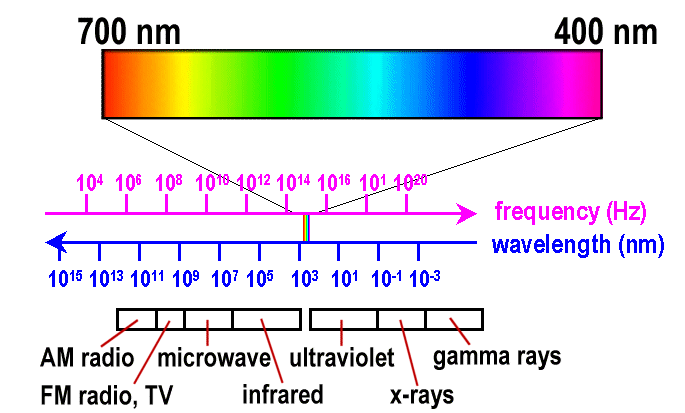
Our seeing is imperfect in that a very small range of the entire electromagnetic spectrum is visible. We cannot see gamma rays, X-rays, radar, TV, FM, or AM waves. Seeing the visual representation of this is impressive: http://groups.csail.mit.edu/graphics/classes/6.837/F01/Lecture02/spectrum.gif


There is a great visual illusion of a small black cross in the middle of a circle which is surrounded by pink disks positioned in a circle, one of which disappears, and then reappears, with the next one clockwise disappearing and then reappearing. If one stares at the black cross, all the pink disks disappear and are replaced with a green disk moving clockwise around the black cross. You can see this at different web sites such as: http://puzzles.about.com/library/weekly/blpinkdots.htm


Can the scientists give us perfect knowledge? Consider this statement by Steven Hawking: “Either we have failed to see 99% of the universe, or we are wrong about how the universe begins.”


Srila Prabhupada says that our sincerity of purpose in desiring to go back to Godhead is the cause of Krishna sending us a bona fide guru. (Srimad-Bhagavatam 1.19.36)


Comment by me: The loud chanting of the holy name increases faith.


Jagannath Puri Prabhu:


We have bodies composed of ignorance, passion, and goodness. But in this age, the goodness is like a little twist of lemon garnishing the top of a preparation.


Most people remember Krishna when they stub their toes, but the rest of the time they think only about themselves.


By studying Srimad-Bhagavatam we realize we are lacking, but it should not stop there. We must decide what we are going to do about it.


It is not necessarily that practice makes perfect, but perfect practice makes perfect.


Whatever the variegated circumstances we are in, as long as we are engaged in devotional service, we are being purified at every moment. We can either accept it or not accept it.


Comment by Brahma-tirtha Prabhu: Srila Prabhupada both encourages the mode of goodness and warns of becoming self-satisfied by it and neglecting to progress spiritually.


Amrita-keli dd (Report on Her India Trip):


My experience was that I couldn’t even begin to appreciate Vrindavan dhama without Prabhupada’s books and the association advanced devotees.


I saw people with long dredlocks and backpacks who did not know about Krishna, who were chanting Hare Krishna when they left. Vrindavan has that effect.


When the river Yamuna flooded during the monsoons of 2010, the Kaliya tree that Krishna jumped off was in the Yamuna making the pastime more realistic.


At the Indian Ratha-yatras you can go up on the carts and see the deities, and the priests give you lots of maha-prasadam, and you can go up again and again.


Jaya Sita dd got to offer flowers on Lord Jagannath from a helicopter at a Ratha-yatra organized by a rich Hindu family.


There was a temporary bridge used to build the permanent bridge over the river Yamuna, but the Vrajavasi’s hated it and dismantled it.


Our tour guide said, “In Vrindavan, there is sweetness and mercy, but sweetness is prominent. In Mayapur, there is sweetness and mercy, but mercy is prominent.”


-----


Inspired by remembering the mercy of Mayapur and Navadvipa-dhama, I share these words of Bhaktivinoda Thakura:


“As Sri Gauracandra [Lord Sri Krishna Caitanya Mahaprabhu] appeared in Navadvipa, it is therefore the crest jewel of all holy places. Offenders are the object of punishment at other holy pilgrimage places, but in Navadvipa-dhama they are purified. The example is the two brothers Jagai and Madhai, who committed great offenses yet still received Nitai and Gaura. What to speak of other places, at Vrindavan the offenders are punished. But a person who has committed hundreds of offenses can easily receive the mercy of Nityananda Prabhu and overcome those offenses in Navadvipa-dhama. For this reason, sages endlessly praise Navadvipa of Gaura-mandala.


“He who lives in Navadvipa-dhama is very fortunate, for he achieves attraction for Krishna. He who happens to go there becomes freed from all offenses. What one attains by traveling to all the holy places is attained just by remembering Navadvipa. In this way the scriptures sing. He who sees Navadvipa-dhama gets ecstatic love of Krsna birth after birth. Even one who goes to Navadvipa desiring to gain material comforts through pious activities will not take another birth. The Sastras say that one who walks around Navadvipa attains the fruit of millions of asvamedha yajnas at every step. And one who lives in Navadvipa and chants mantras obtains the sound of Caitanya as his mantra and easily gets free from maya. What yogis obtain after ten years at other tirthas [holy places] is obtained in three nights at Navadvipa.


“That liberation attained by Brahman realization at other holy places is obtained simply by bathing in the Ganges at Navadvipa. Thus, all types of liberation—salokya, sarupya, sarsti, samipya, and nirvana can be obtained in Navadvipa without speculative practice. Falling at the feet of the pure devotees in Navadvipa, Bhukti and Mukti (personified material enjoyment and liberation) remain there as obedient servants. Not caring for their blessings, the devotees kick them away, but still they do not leave the devotee's feet. The fruits obtained by staying one hundred years at the seven holy cities can be attained by staying one night in Navadvipa-dhama.


“In conclusion, Navadvipa is the topmost tirtha. Taking shelter of it, the living entities can cross over Kali-yuga. At this place, taraka, the name of Rama, which gives liberation, and paraka, the name of Krishna, which gives prema [love of God], always serve the residents of the dhama.” (Sri Navadvipa Mahatmya)

Monday, January 10, 2011

Travel Journal#6-22: North Florida

Diary of a Traveling Sadhaka, Vol. 6, No. 22
By Krishna-kripa das
(November 2010, part two)
North Florida
(Sent from Gainesville, Florida, on January 10, 2011)


Where I Was and What I Did

I flew from Tucson back to Jacksonville and chanted at University of North Florida for a couple days before returning to Gainesville. At UNF I met a math professor who loved the Krishna lunch they served once a week at UCSD when she was a graduate student there, and she took my sweet and expressed eagerness for Krishna food opportunities in Jacksonville. In Gainesville, I was happy to encounter Dravida Prabhu, who is enthusiasm in devotional service personified, and who was visiting from San Diego. I heard his classes and learned an excellent verse about Krishna's sweetness (see the quote at the end). I was happy to learn of the the twenty-four hour kirtana in Alachua, which I enjoyed going to just part of, as it unfortunately overlapped our traditional harinamas in Jacksonville at the Christmas tree lighting festival and Tallahassee at the Gators/Seminoles game.


Upcoming Itinerary (If Krishna is Willing)

Gainesville, FL: January 10-30
Tallahassee, FL: January 30-February 6
Gainesville, FL: February 7-14
Ocala Rainbow Gathering: February 13
Tucson, AZ: February 15-March 16
Gainesville, FL: March 25-March 29
Tallahassee, FL: March 30-April 3
Northeast USA: April 5-April 26
London, UK: April 27
Radhadesh: April 28-29
Amsterdam: April 30
UK: June
Scandinavian Ratha-yatras: beginning of July
Poland Woodstock: last week of July, beginning of August
Croatian Harinama Tour: rest of August
Ukraine Festival: second week of September


Harinama at the Jacksonville Christmas Lighting Tree Ceremony

The most impressive part for me of the harinama at the Jacksonville Christmas lighting ceremony was the high percentage of the general public that took the On Chanting Hare Krishna pamphlet we were distributing, perhaps as many as two out of three. Also we chanted in the same place for over two hours, right in front of Jacksonville Landing, a place where in previous years police officers had kicked us out. This year, however, the officers just let us be. About fifteen devotees came out for the event which we have been doing perhaps as long as a decade there in Jacksonville.


Harinama at the Gators/Seminoles Game in Tallahassee

Each second year we chant at the Gators/Seminoles Game in Tallahassee as events and beaches are the places to find the crowds in Florida. This year we really did not advertise the event well enough in Tallahassee to get local devotee participation, and the temple devotees were gone for Thanksgiving weekend. Furthermore, because of the twenty-four kirtana in Alachua, it was difficult to get people to come from there. Thus four of us from Alachua chanted for a couple hours at the stadium. The best parts were a few people voluntarily coming up to us asking for our promotional literature, and people who remembered from us Gainesville and who were glad to see us. The most visibly enthusiastic of these was a girl who jumped up and down, waving her arms and shouting, “Krishna! Krishna!” as she passed our party.


Twenty-four Hour Kirtana in Alachua

This year I attended twelve-hour kirtanas in Manhattan in April and October, and a twenty-four hour kirtana in Birmingham, England. I am happy to see ISKCON taking the congregational chanting of the holy name more seriously as time goes on. Tamal Krishna Goswami was stressing the congregational chanting by having kirtanas in his room each night during his final Mayapur festival as well as praising its unifying power. More recently, Aindra Prabhu wrote a book strongly advocating we increase our congregational chanting. When I was at the forty year anniversary festival in London in 2009, the devotees described how they daily walked the distance between Bury Place and Marble Arch eight times with their harinama sankirtana parties (a total of almost thirteen miles). They said during that time many people were attracted to join the movement from seeing the blissful devotees. Thus I am happy to see this increasing interest in kirtana within the Hare Krishna movement.


A few days before the Alachua Twenty-Four Hour Kirtana, I turned around after guru-puja, and who should I see but Madhava Prabhu, the world renown kirtaneer. After seeing him at Simhacalam Nrisimha festival, the Birmingham Twenty-four Hour Kirtana, the Polish Woodstock, Janmastami at Bhaktivedanta Manor, and the Ukraine festival, here he was in my former home town of Alachua! I especially like his mood of focusing everyone's attention on the holy names in meditation, and I was really grateful that he and many of the other chanters did programs, some with as many as four hours of kirtana, for the several evenings before the Twenty-four Hour Kirtana started (click http://www.alachuakirtan.com/audio to hear audio). I could see all these events really increased the devotional service of the community. Even some of the Gainesville devotees would drive out to Alachua almost nightly to attend them. I saw one college student, who really just began to develop an interest in Krishna consciousness this year, dance for two hours straight in these kirtanas.

The Twenty-four Hour Kirtana was divided into two days of twelve hours each. After attending the Birmingham kirtana which was twenty-four hours straight, I could see the wisdom in Alachua spliting it up. Otherwise, unless you are maha-bhagavata (the highest level of devotee), the tiredness of the body gets in the way of appreciating the chanting.

I only attended the first few hours of the first day of twelve hours as we had a harinama in Jacksonville in the evening. It was difficult to leave the kirtana program because I am completely happy just chanting and dancing in the kirtana, but I do not like to reduce my participation in the chanting programs that reach out to new people as we have so few of them. Thus I missed half the first day and almost all of the second day, chanting in Jacksonville, and then in Tallahassee. It was inspiring to hear the chanting and see the enthusiasm of all the devotees there in Alachua. I hope the next time they do twenty-four hour kirtana in Alachua, I have no conflicting harinamas, and I can fully participate in them.


Insights from Lectures


Satsvarupa Dasa Goswami, Vihara Bhajan#137, “Praise of Lord Krishna, While Feeling Nausea”:


The poor body 
is a temple of illness.”


Dravida Prabhu:


The chanting of the holy name is the engine of this movement.


The holy name will ultimately conquer because He is Krishna Himself.


We have the Prabhupada murti and guru puja so we can become attached to Srila Prabhupada for such spiritual attachment counteracts material attachment.


How can we be a friend to all? We can start by being a friend to the person next to us, and encourage them in their Krishna consciousness.


Dravida Prabhu shared some of his poems with us, like this rendition of the Srimad-Bhagavatam 3.25.20 praise of association with devotees:

Mundane affection keeps us tied
To birth and death infernal,
But love for sadhus opens wide
The doors to life eternal.”

And this beautiful description of Krishna entering the Vrindavan forest from Srimad-Bhagavatam 10.21.2, 5.

Vrindavan’s rivers, lakes, and hills
Ring out with charming hums and trills
As flocks of birds and maddened bees
Rejoice among the flow’ring trees.

To those idyllic woods and glens
Repairs Govinda with His friends,
Sri Rama and the cowherd boys,
To taste the most exquisite joys.

And as they walk along the way,
Absorbed in herding and in play,
Sri Krishna, beauty absolute,
Begins to blow His mystic flute.

With peacock plume upon His head
And fragrant flower on each ear,
He enters Vraja’s woods with tread
Sublime—a dancer without peer.

His golden-yellow raiment glows,
His garland reaches to His knees,
And from His lips the nectar flows
And fills His flute with melodies.

As Krishna thus begins His day
With friends who sing His glories sweet,
He beautifies the forest way
With fine impressions of His feet.

Samadhi culminates in this:
To always see this scene of bliss
Within your heart and outside too.
May Krishna give this boon to you.”

The first two verses of the “Venu-gita” chapter of Srimad-Bhagavatam are about both Krishna and Balarama because the gopis are afraid of their superiors hearing them talking about Krishna alone.


The whole world has become infected with greed and materialism because of the example of the United States.


Dina Sharana Prabhu:


To be proud of different capabilities of our bodies is a mistake. All attributes are borrowed plumes only.


Considering we are independent of supreme control is gross ignorance.


Just a little faith in God can elevate one so much.


Although Vaishnavas are beyond material desires and material conceptions, they act in such a way that people with material conceptions will not be disturbed.


There is such a drive for equality, but we are already equal on the spiritual platform. Demanding some facility in the name of equality can be evidence of a spiritual lacking.


Q (by me): Can you think of examples of devotees nowadays altering their behavior to set a good example for society?
A (by Dina Sarana Prabhu): For renunciates to carefully avoid associating with the opposite sex. For householders to avoid prematurely renunciation.
A (by Puskara Prabhu): Even now we should avoid forcing our way into the Puri temple although Srila Prabhupada protested against the restrictions.


-----


madhuram madhuram vapur asya vibhor
madhuram madhuram vadanam madhuram
madhu gandhi mrdu smitam etad aho
madhuram madhuram madhuram madhuram


Sweet, sweet is my dear Lord’s form, sweeter still His face, so fair,
But His honey-scented gentle smile is sweet beyond compare.”
—(Krishna-karnamrta, 92) [poetic expression by Dravida Prabhu]

Wednesday, January 05, 2011

Travel Journal#6.21: Tucson

Diary of a Traveling Sadhaka, Vol. 6, No. 21
By Krishna-kripa das
(November 2010, part one)
Tucson, Arizona
(Sent from Tallahassee, Florida, on January 5, 2011)


Where I Was and What I Did

   Except for a day trip to Phoenix to do harinama in yet another town, I stayed in Tucson, Arizona, USA, the first half of November, chanting three hours daily with my book table at the University of Arizona. It was an eventful time with a Diwali Festival, a meeting with the U of A Skeptics Club, Ratha-yatra in the All Souls Procession, and a program at Pima, the local community college. During that time, I took notes on some lectures by Srila Prabhupada, Mother Sandamini's report on her trip to Vrindavana, the Following Prabhupada DVD #9 (including Srutakirti Prabhu), a class on Govardhan Puja by Jaya Nitai Prabhu, and a few other classes. I also gave a lecture on "Scientific Evidence Supporting Krishna Consciousness" at the Sunday feast which you can hear online by clicking the above link.


Upcoming Itinerary (If Krishna is Willing)

Tallahassee, FL: January 4–9
Gainesville, FL: January 10–31
Tallahassee, FL: February 1–6
Gainesville, FL: February 6–14
Ocala Rainbow Gathering: February 13
Tucson, AZ: February 15–March 15 (tentative)
Gainesville, FL: March 25–March 29
Tallahassee, FL: March 30–April 3
Northeast USA: April 5–April 26
London, UK: April 27
Radhadesh: April 28–29
Amsterdam: April 30
UK: June
Scandinavian Ratha-yatras: beginning of July
Poland Woodstock: last week of July, beginning of August
Croatian Harinama Tour: rest of August
Ukraine Festival: second week of September


Diwali Festival in Tucson

   While visiting Tucson to increase our outreach at the university, I attended the Diwali festival at our Hare Krishna temple there. When I was a new devotee, Diwali festivals were not common. Thus I tend to think they are not so much a part of our practice of Krishna bhakti as given by Srila Prabhupada and his predecessors but something tacked on to it to please the Indian congregations, and for that reason, I am not so inclined to them. Still, they are an opportunity for people to engage in devotional service in different ways so I enthusiastically promoted the Diwali festival at the university, as well as our restaurant, Sunday feast, and my Gita seminar.

   The devotees did a good job organizing the festival, transforming the temple parking lot into an outdoor auditorium and making arrangements for prasadam, a book display, a cooking demonstration, and the chance to offer lights to the deity. It was exciting to see all the people coming, many for the first time. And many of the first timers were genuinely happy they had come. One high school history teacher told her students about it, and many came, some delighting in the face painting as well as the prasadam. A community college Asian religions professor also informed her students about our program, and many of them came as well. Students from both classes promised to give my contact information to their teachers, so they could invite me to speak and the students were very excited about that. Some neighbors came to the Diwali festival as well. Our book table did really well, with several people buying more than one book.

   The stage show consisted of Sruti, a local group that has been playing Indian music and Indian instruments for 25 years. Their music was relaxing and put one in a good mood. Then the Urvasi Dance Troupe, with girls of various ages, performed five different Indian dances. Finally Michelle of Elemental Artistry, with some of her friends, performed different dances with illuminated hoops and some very exciting dances with fire. Inside the temple, was a gloriously decorated altar, with the offering of lamps to the deity, and one college student said for her, that was the best part.

   A couple of university students told me they had a wonderful time and were very happy to have come. I took down their contact information in hopes they would be willing to help staff our club on the campus. Another young man later came to my Gita seminar, saying that he heard about it at the Diwali festival.

   Rather than wait in line for prasadam, some friends and I played bhajanas at the book booth as the line dwindled. Fortunately there was enough prasadam for everyone to get something.

   As a result of the festival, I could see how quite a variety of people came to the temple for the first time and had a good experience, so I felt very good about being part of it. I felt indebted to the Tucson devotees, headed by Mother Sandamini, for having put on such an effective festival for the spiritual benefit of the people in general.


Tucson Ratha-Yatra
(Lord Jagannath Blesses the All Souls Parade)

   I never saw so many people dressed as skeletons as in Tucson’s All Souls Procession, an annual event, which in 2010 was on November 7. Even dogs were dressed as skeletons, either wearing a black coat sporting bones on their backs or having the bones drawn on their backs with white chalk. We Hare Krishnas actually had a cart with small deities of Lord Jagannath, Lord Baladev, and Lady Subhadra, so it could be called a Ratha-yatra. Our cart was steered from the back, a challenging design making it difficult to go straight. Before the parade got moving, many people took pictures of the deities, their cart, and the lively chanting and dancing of the devotees. I think the scene was a new one for them, and they were eager to capture it on camera. Devotees distributed packets containing literature, spiritualized lollipops, and invitations to our Govinda’s Restaurant. Bhakta Geno was the most enthusiastic at making sure every kid got a lollipop. Different devotees sang, and some of the time I played along on my portable harmonium. Unfortunately the event was at the same time as our Sunday feast, and not only that, but the same time as our celebration of Govardhan Puja, so it was not largely attended, but we may have had ten devotees altogether. Some old friends of the devotees were glad to come in contact with them again.


Skeptics Invite the Hare Krishnas

   Ananta Dev Prabhu said one of the members of the University of Arizona Skeptics Club told him they would like us to speak sometime as they are familiar with the Judeo-Christian tradition, but not Hare Krishna, so I decided to schedule a meeting with the club. Hanumat Preseka Swami was in town the night of the meeting, and he gave a entertaining and thought provoking lecture. Many students asked more serious questions than one usually hears. Then we chanted and distributed spiritual food. Some students took seconds on the coconut sweets. We found the skeptics were more serious thinkers than your average student group, and both we and them were pleased with the gathering. Bhakta Sean had previously joined the club with the plan of bringing prasadam to the meetings and engaging the skeptics in devotional service unknowingly, an innovative strategy, and I am sure that helped facilitate the positive reception.


Program at Pima Community College

   Holly, a student of Asian religions, showed up at our Diwali festival all decked out in a sari. Learning from her that her teacher encouraged her Asian religions class to come to our temple, I offered to speak in her class, and her teacher invited me on the final day of my stay in Tucson. I made a traditional Indian coconut sweet for the occasion. Ananta Dev Prabhu and two bhaktas who are starting a center in Flagstaff, Tyler and Alex, also came, and Bhakta Geno took pictures. The teacher asked me to speak about our practice and how it differed from Christianity. I mentioned about how all living creatures, including plants and animals, are eternal souls living in temporary material bodies, and that we human beings can realize our identity as souls by the universally accepted process of chanting the holy name of the Lord, especially in congregation with other faithful people. Among other things, I explained that Krishna teaches in Bhagavad-gita that devotion is the only way to attain the Lord and because Christ was preaching devotion to God, we can accept that he was teaching the only way. In the Vedic tradition, however, there have been many empowered preachers like Jesus Christ, who could heal the sick, forgive sins, conquer over death themselves, and instill faith in God in others, so we do not see him as uniquely empowered as many Christians do. The reverence for and worship of the saints, the repetition of prayers on beads, and the use of incense in worship which is found in Catholicism is also there in Hare Krishna practice. Many Psalms glorify the power of the holy name of the Lord to deliver one, and the Hare Krishna also have that understanding of the power of the holy name to deliver one from a materialistic way of life. Different devotees shared how they became attracted to Krishna consciousness, and their stories were interesting for the students. In talking with the teacher, I learned she remembered seeing the devotees chanting in Greenwich Village in her youth. I told her I had chanted the previous month at the Hare Krishna tree in Tompkins Square Park, where Srila Prabhupada had chanted in 1966 when he began his international society, and I sent her a picture of the tree and the plaque describing its significance, for which she was grateful. At the end of the program, we chanted and distributed spiritual food. Almost all the students took the coconut sweets and a couple students stayed at least half an hour to talk more with us. In fact, the teacher later told us, “Everyone in my class really enjoyed your visit. . . . I hope you will be able to speak to my Asian Religions class in February when you come back to Tucson. Maybe you can discuss the Gita. I’m sure the students would love it.”


Insights from Lectures

   
Srila Prabhupada:

   Although in America we have all material facility, because we are not also taking care of the soul, there is no balance, and thus we are not happy.

   The soul is different from the body and has a different need. We need to make the soul comfortable.

   One who is free from hankering can taste the Bhagavatam, holy name, or anything else in relation to the Lord.

   “Bhava” means become. The repetition of birth and death is called “bhava” because we are always “becoming” something else.

   “Atyantika-duhkha-nivrtti” means ultimate relief from suffering.

   “It does not matter how fallen a man is. If he follows our instruction, he can be turned.”

   People say Krishna comes for this purpose or the that purpose, but actually

   He comes for the benefit of the devotees.

   Even scientists turn to God in danger, but when there is no danger, they defy God. Therefore danger has to be there to teach these rascals.

   There are natural divisions in nature, like crows and swans. Crows do not associate with swans, and swans do not associate with crows. Krishna consciousness can transform the crow class man into the swan class man.

   from his article in the January 2011 Back to Godhead I was proofreading:

   “If the government has the right to exact income tax from you, has not Krishna the right to exact income tax? He is supplying you so many things. What is the government supplying?”

   
Mother Sandamini [report on her trip to Vrindavana]:

   Her notes on Bhurijana Prabhu’s Japa book:

   Causes of lack of taste:

  1. lack of spiritual depth leading to false ego

  2. desire for temporary things
  3. desire for fame
  4. committing offenses

Problems resulting from inattentive chanting:

  1. crookedness
  2. faithlessness
  3. slackness
  4. pride in devotional achievements

   Solution to inattentive chanting: Give the mind the simple task of hearing one mantra with attention.

   When the ashes of deceased persons touch the Ganges River, the souls become free from all their karma.

   They have a laser gun with a red beam that you can get to scare the monkeys.

   Rupa Raghunatha Prabhu has two amazing schools and a hospital, which are greatly benefit the poor children in Vrindavana.

   Mother Sandamini’s notes from a class by Vaisesika Prabhu in Vrindavana:

  1. Voltaire said, “If you appreciate someone you imbibe their qualities.”
  2. It is hard to stop people on book distribution because they have no time. They are too busy taking care of their “time-saving” devices.
  3. In an airport, I met a man who bought a book from a devotee in San Francisco 35 years ago. “That could have been me,” I said. He had just taken the book off the shelf and was appreciating it, so he was happy to see me.

   
Notes on Srila Prabhupad DVD #9:

   Vasudeva Prabhu, an Indian businessman, had a butcher shop in his grocery store. The devotees were surprised and asked if they should tell him to close it. Srila Prabhupada said not for now, that would come. Later most of Vasudeva’s family ended up also becoming devotees.

   They say Kaliya lives in a secluded lake in the mountains of Fiji. Persons who go there either never come back or come back insane. One devotee got a guide and tried to go there but a typhoon made it impossible. Because of that story about Kaliya the devotees started Kaliya Krishna temple in Fiji.

   One devotee recalled Srila Prabhupada coming to Los Angeles. When I saw him, I bowed down, and my eyes will filled with tears. The most amazing thing was that the eyes of two businessman who watched the devotees’ reception of Srila Prabhupada were also filled with tears.

   
Srutakirti Prabhu:

   When we came to Fiji, our hosts served a meal at 1:30 a.m. and took rest at 2:30 a.m. but Srila Prabhupada was ready for his morning walk at sunrise. Jet lag did not exist for him. We hoped he would take a nap after breakfast, which he did, but only 15 minutes. We were all completely out, and he called us in and reprimanded us for sleeping.

   We simply follow the predecessor’s instructions. That is all. We do not have to invent.

   Srila Prabhupada said in Los Angeles, “If you will print my books in all the languages of the world and distribute them, this Krishna consciousness movement will automatically spread.”

   Srila Prabhupada was reading the Krishna book and told me, ‘If you read just this one book [the Krishna book] you can become Krishna conscious. You do not even have to read the whole book, just one chapter, and you can become Krishna consciousness. You do not even have to read the whole chapter, just one page, and you can become Krishna consciousness. You do not even have to read a whole page, you can just read one line. You do not even have to read a whole line. If you read just one word you can become Krishna conscious.’ He said that about three books over the course of a year, Nectar of Devotion, Bhagavad-gita, and the Krishna book.”

   One someone gave Srila Prabhupada a gold watch, and he gave his old watch away. Then someone else gave him a gold Rolex watch, and he gave the other gold watch away, that gold Rolex must have been worth $3,500, then someone gave him a $100 Seiko watch, and he gave the gold Rolex away. He did not keep it for himself.

   Badrinarayana Prabhu explained that Srila Prabhupada was teaching the devotees mantras from Isopanisad but few of them took it seriously enough to memorize them. Srila Prabhupada could see this and told us, “I am writing these books for you.”

   
Jai Nitai Prabhu from Tucson on Govardhan Puja:

   It is said Krishna looked within His heart and found the essence of love, and it manifested as a seed which grew into Govardhan Hill.

   In Upadesamrita, Rupa Goswami explains that Govardhan Hill is more sacred than Vrindavana itself.

   Nanda Maharaja surrendered to Krishna and abandoned the Indra sacrifice, not in the sense of surrendering to the Supreme Personality of Godhead, but by agreeing to execute the will of his son who would not have it any other way.

   The residents of Vrindavana were satisfied by performing the sacrifice for Govardhan because they had served Krishna.

   Krishna lifted Govardhan so its top was above the clouds and so the animals on it were given shelter by Krishna in this way.

   We can learn from the Govardhan pastime that Krishna is always ready to forgive His repentant devotee, even if he made a big mistake.

   Q (by me): We may say or think something bad about a devotee, and we understand that is very bad for our spiritual life, but here Indra had a program to wipe out Krishna’s closest associates in Vrndavana. Could you say something about the magnitude of that offense?
A: (1) Demigods [like Indra] do things on a larger scale.
(2) The pastime shows just how merciful Krishna is.

   
Krishna-kripa das:

   Srila Prabhupada created these Hare Krishna centers just to give people the chance to hear about Krishna. He said, “If I sit under a tree, who will come to hear? Therefore I have built this big, big temple in Mayapur.”

   Simply hearing about Krishna is very powerful as these scriptural references indicate:

   Srimad-Bhagavatam 10.14.3: “Those who, even while remaining situated in their established social positions, throw away the process of speculative knowledge and with their body, words and mind offer all respects to descriptions of Your personality and activities, dedicating their lives to these narrations, which are vibrated by You personally and by Your pure devotees, certainly conquer Your Lordship, although You are otherwise unconquerable by anyone within the three worlds.”

   Krishna to Rukmini: “My dear honored wife, although I have thousands of wives, I do not think that any one of them can love Me more than you. The practical proof of your extraordinary position is that you had never seen Me before our marriage; you had simply heard about Me from a third person, and still your faith in Me was so fixed that even in the presence of many qualified, rich and beautiful men of the royal order, you did not select any one of them as your husband, but insisted on having Me.”

   Srimad-Bhagavatam 1.2.17: “Sri Krishna, the Personality of Godhead, who is the Paramatma [Supersoul] in everyone's heart and the benefactor of the truthful devotee, cleanses desire for material enjoyment from the heart of the devotee who has developed the urge to hear His messages, which are in themselves virtuous when properly heard and chanted.”

   
Radhapada Prabhu:

   Ambarisa showed the whole world how to engage completely in devotional service. We have many duties to do in the world, but we must not forget that it is also our duty to remember the Lord.

   Like the director in a play tells each player how do his part, Krishna tells living entities what to do.

   Durvasa Muni is so named because (1) he lived a long time, (2) he was difficult to live with, and (3) he lived a difficult of austerity subsisting on durva grass.

   Whenever any trouble comes, the devotee remembers Krishna. That is devotee.

   Ambarisa was not disturbed by the demon created Durvasa Muni because he knew that if Krishna wanted to protect him, no one could kill him, and if Krishna wanted to kill him, no one could protect him.

   Krishna could have easily killed Durvasa Muni immediately with his Sudarsana cakra, but He wanted to teach Durvasa Muni about the greatness of His devotee.

   The Lord says makes arrangements to break his devotee’s attachment to family and relatives, but that is only necessary when those relationships are impediments to his devotional service.

   In Ramayana, one squirrel got caught up in the enthusiasm to assist Lord Rama in building the bridge to Lanka. He could not carry anything substantial, so he rolled in the sand to collect some on his body, and then shook it off on the developing bridge. Lord Rama was very pleased to accept his small service.

   
Gangeya Prabhu:

   Material life appears very attractive on one level but is ultimately disappointing.

   American people use two-thirds of the illegal drugs in the world because their society of consumerism and unrestricted sense gratification does not satisfy their souls.

   Vijaya Prabhu says he uses the interest of people in peace, personal and collective, to sell Srila Prabhupada’s books.

   
Ananta Dev Prabhu:

   Our situation is like that of a duck who has just lived on a farm and never been exposed to water. Although the water environment is natural for him, he will take time to get used to living in pond again because of his conditioning.

   
Bhakta Geno:

   Envy, evangelist, and equality have the same root, meaning a sense of leveling the ground.

   To deny the Personality of Godhead is to deny your own unique relationship with Him.

   Materialistic people look for others to serve them, but Krishna takes pleasure in serving His devotees, like on the battlefield, when He drove Arjuna’s chariot.

   All time engaged in Krishna consciousness is gain. All time engaged in a material activities is a loss.

   The Lord is more eager to see His son than the son is to see the father. When my foster child was in jail he was ashamed to see me, but I was eager to see him, thus I could see how that is true.

   It is not so much that we clean ourselves, but that we are cleaned by the Lord.

   Even when a small animal is killed by a man, God is disturbed, because that animal is also dear to him.

   Comment by Sandamini dd: Even modern psychology recognizes that negative emotions like envy have a self-destructive effect.


-----

āpannaḥ saḿsṛtiḿ ghorāḿ
yan-nāma vivaśo gṛṇan
tataḥ sadyo vimucyeta
yad bibheti svayaḿ bhayam

“Living beings who are entangled in the complicated meshes of birth and death can be freed immediately by even unconsciously chanting the holy name of Krishna, which is feared by fear personified.” (Srimad-Bhagavatam 1.1.14)